
Cart is Empty
- Home
- Manufacturers
- Warlord
Special offers
Warlord
Products
-

Inago Medium Walker
The deployment of USMC Grizzly medium walkers to the Pacific posed a serious tactical problem for the Japanese. Developing a similar medium walker to counter it entirely from scratch would be too time-consuming. Again, the Imperial leadership turned to their (then) Axis allies who offered to export a limited number of the Pz.Kpfg. VII Heuschrecke stripped of its gravitic jump assist modules. On inspection of the first units to arrive in Japan the Imperial military discovered that the missing weight of the modules actually benefited the walker’s speed and agility, making it ideal for both general combat and reconnaissance duties. Recently, Japanese reverse-engineering of Axis-supplied components has allowed a fully Imperial-built version of the Locust, the ‘Inago’, to be produced in the Home islands.Contains one resin and metal miniature.Models supplied unassembled and unpainted452601201£37.35£41.50save 10% -
Into the Valley of Death (The Crimean War) Black Powder supplement with 'The Trooper' special miniature (while Stocks last)
Half a league, half a league,Half a league onward,All in the valley of Death,Rode the six hundred.Immortalised in Tennyson’s poem, the charge of the Light Brigade is probably the only part of the Crimean War that remains in the popular imagination. Fought between Russia and an alliance of the Ottoman Empire, Britain, France and Sardinia, the allied campaign was fought mainly on the Crimean Peninsula. Hoping to prop up the ailing Ottoman Empire and to save it from an expansionist Russian Tsar, the allies aimed to take the Russian port of Sevastopol to prevent Russia controlling the Black Sea. The campaign saw more than just the blunder of the Light Brigade, with poor leadership and logistics standing in stark contrast to the bravery and endurance of the men who fought there.Written by Pete Brown, this supplement for the award-winning Black Powder, contains full details for each of the armies that fought in the Crimea, including organisational and uniform information as well as special rules for each of the larger-than-life generals who led them. Alongside this is a full account of the campaign with each of the battles and skirmishes included as scenarios for your wargames table, including the famous Light Brigade action at Balaklava. Will you honour the Light Brigade and save the noble six hundred?301013802£22.50£25.00save 10% -
Italian Army 100-17 Modello 14 medium artillery
The 100/17 Modello 14 was a Skoda-designed medium howitzer that made up the bulk of the Italians’ artillery strength. As a whole, Italian artillery was a piecemeal collection from a previous era, although crewmen were well trained and made the most of the equipment they had. The bravery of the Italian artillerymen on the Eastern Front was legendary, often firing over open sights at the approaching enemy in an attempt to stem the Soviet tide.Contains one metal howitzer with four man crew.403015809£21.60£24.00save 10% -
Italian Army Infantry Section
Box contains 10 metal foot figuresSet includes:7 Random RiflemenRandom NCORandom LMG TeamWGB-II-02£20.00 -
Italian X Arditi Section
Formed in May of 1942, the Arditi X Regiment were named after the famed Italian assault units of the Great War and tasked with competing against the British LRDG and SAS units in the Western Desert.Initially formed up of three companies comprising paratroopers, frogmen and the Arditi Camionettisti motorised forces (often in AS.42 scout cars providing long-range reconnaissance patrols), the Arditi X undertook clandestine sea, air and land operations, often behind enemy lines.Box contains 10 metal figures with plastic bases.Models supplied unassembled and unpainted402215806£23.85£26.50save 10% -
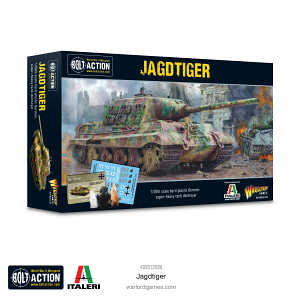
Jagdtiger
The Panzerjäger Tiger Ausf. B, known as the Jagdtiger (hunting tiger) was the heaviest tank ever to see action during World War Two. Developed late in the conflict, only around 80 actually reached combat, the first in September of 1944.Germany, like many nations, made use of existing tank designs to make self-propelled guns and tank destroyers. The Jagdtiger was a colossal example of this practice – the Germans wanted to upgrade the much-feared Tiger II by mounting the 128mm Pak 44 cannon into a purpose-built armoured casement atop the lengthened King Tiger Chassis. 150 units were ordered to tackle the ever-encroaching Soviet armour – the Pak more than capable of tearing through Allied armour.At 71 tons, the behemoth had nearly 10 inches of armour to the front of its casement housing, making it one of the most well protected tanks of the war. However, all this weight and protection came at the cost of reliability. Many roads and bridges simply couldn’t take its weight. This, coupled with the increasing scarcity of spare parts and fuel, kept the Jagdtiger from fulfilling its potential.The 'teeth' of the Jagdtiger, was the 128mm PaK 44 anti-tank gun. Noted for its weapon's performance at long ranges, the Jagdtiger was rightly feared. However, the limited traverse of the gun meant the tank had to turn on the spot to bring the enemy into its sights and the two-part ammunition required extra crew to load. To represent this in Bolt Action, the 128mm Pak 44 does not suffer from -1 penetration penalty when firing at targets at over half range.Only two German schwere Panzerjäger-Abteilung (heavy anti-tank battalions) included Jagdtigers, the 512th Heavy Panzerjäger Battalion and the 653rd Heavy Panzerjäger Battalion. A company of the 512th was commanded by renowned Panzer Ace, Otto Carius, credited with the destruction of more than 150 tanks and a similar number of anti-tank guns – he would earn the Knight’s Cross of the Iron Cross with Oak Leaves. The included waterslide transfer sheet features Carius’ decals.Box contains one plastic tank, unit stat card, vehicle damage markers and waterslide decal sheet.Models supplied unassembled and unpainted402012039£27.00£30.00save 10% -
Japanese Type 92 70mm infantry gun
Pack contains 1 metal gun and 3 metal foot figures
Note: Models supplied unassembled and unpaintedWGB-JI-26£17.10£19.00save 10% -
Judge Dredd - 2000 AD Dice
The setting is late in the 22nd century. Many survivors of the devastating Atomic Wars were mutated by the Strontium 90 fallout. These mutants became an underclass, hated by the ruling ‘norms’. The only job left for them was bounty-hunting. The strongest of these mutants hunt down criminals throughout the galaxy for the Search/Destroy agency, cruelly nicknamed the Strontium Dogs by the ‘norms’. Operating from an orbiting space station known as The Doghouse, SD agents take many shapes and forms. Armed with highly advanced technology including, electrified brass knuckles, short-range teleporters and time bombs to name a few, they bring justice to the far reaches of the galaxy! Contains: 10 x 2000AD combat dice
643410001£7.50£10.00save 25%
-
Judge Dredd - Rulebook
Bring the law to the streets of Mega-City One with the brand new Judge Dredd Miniature Game. Stamp out the gangs or stick it to the Judges! Players of Strontium Dog may find a few familiar ideas within the core rules of Judge Dredd. This game heavily expands on those skirmish rules, however, to reflect the urban environments of Mega-City One. The Judge Dredd rulebook contains everything you need to know about playing the game and includes rules for fighting within buildings and using vehicles. As well as a number of scenarios, there are rules for developing your chosen faction in a series of linked games.
651010001£20.00£25.00save 20% -
K47 - Automated Infantry platoon
The humble British infantryman is being increasingly supplanted by the Automated Infantrymen. These stolid, code-driven mechanical soldiers can be slow to adapt on the battlefield, but are utterly implacable in advance and resolute in defence.As the war drags on, the boffins at Bletchley park are churning out ever more sophisticated designs, capable of executing increasingly complex battlefield orders, and wielding equally more complex and heavier weapons, turning the tide against Axis horrors. Such is the rate of advancement of automated research that dedicated automated platoons are now being deployed to the battlefields, devoid of any human presence, and able to carry out prescribed orders entirely independently.This boxed set contains the following:1x plastic Mk II C Automated Director10x plastic Mk I Automated Infantry2x plastic Mk II Heavy Automated InfantryPlastic BasesAssembly guides452010605£50.00 -
K47 - Mk II Heavy Automated Infantry Squad
A new iteration of automated infantry now supports the more numerous, and vastly cheaper to produce, Mk Is. By necessity larger in order to house more sophisticated computational systems, they are also rendered capable of carrying far heavier armaments, such as specially designed automatic cannons. Capable of acting with more autonomy than the earlier designs, they have a limited operational independence. With their embedded short-range radio device, they are also able to transmit their computational data to other automatons within a limited range. Efforts were quickly made to upgrade the Mk I design with receivers. By staying within close proximity the MK IIs can relay their own calculations to the Mk Is, and thus improve their accuracy and ability to execute more complex commands.Box contains three Warlord Resin Mk II Heavy Automated Infantry (two armed with Light Automatic Cannons and one with a heavy Automatic Cannon), plastic bases, and assembly guide.452410610£27.00£30.00save 10% -
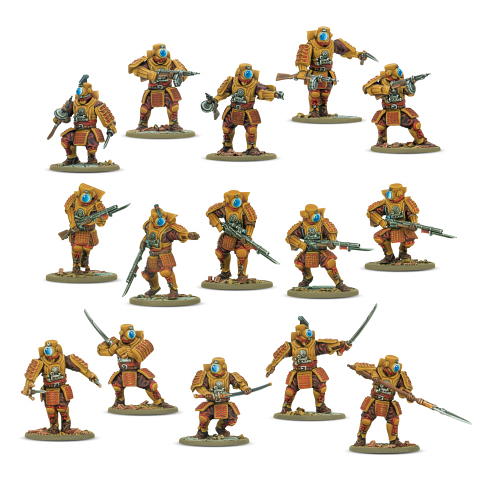
K47 - Empire of Japan Ghost Attack Infantry
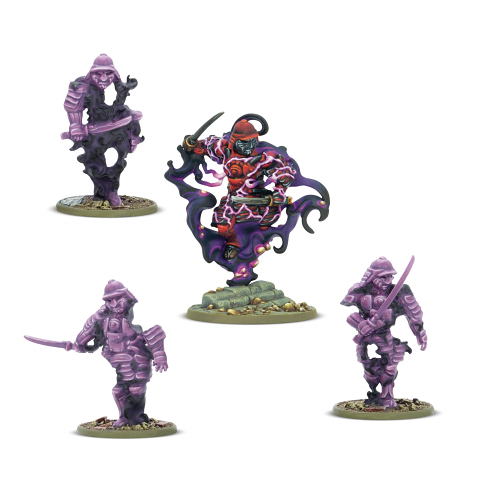
Imperial Japanese scientists have created devices that generate a field capable of temporarily phasing objects or people out of sync with the world around them. These 'Ghosts' have proven adept at surprising enemy forces, literally appearing from nowhere to attack from unlikely directions or through the heaviest terrain.Ghost Attack Squads are typically armed with Shiboru compression rifles; a squad of so-equipped ambushing ghosts can lay down a significant weight of fire before vanishing back into dense terrain, making attempts at pursuit futile. Some squads are close quarters specialists, and carry submachine guns or traditional hand-to-hand weapons that evoke the samurai of old, but in reality practise a brutal new form of ninjutsu.Box contains fifteen plastic miniatures, which can be assembled as either Ghost Attack Squads or Shadow Warrior Squads, supplied with plastic bases.Miniatures sculpted by Marco Sano. Studio miniatures painted by Kirsten Williams.Models supplied unassembled and unpainted452011205£37.00 -
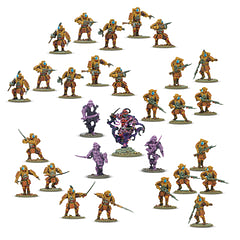
K47 - Ghost Infiltration Platoon
Since their first deployment against United States forces in the Philippines in late 1945, the 'Ghosts' have proven invaluable. Their ability to phase into a state of existence separate yet parallel to our own has stymied enemy commanders. They can strike from anywhere, at anytime and without warning, laying down weight of fire with Shiboru compression rifles or spilling blood with the quick flash of a blade before disappearing into what Japanese researchers have come to call 'Shinobi Space', or 'the Spirit Realm'.In July 1947, Ghost Infiltration platoons would be the instrument of the Empire of Japan's invasion of America. Accompanying them would be Kimura Tadaaki, otherwise known as the Scourge of the Spirit Realm, ready to wreak devastation in service the Empire.This boxed set contains the following:1x plastic Kimura Tadaaki, Scourge of the Spirit Realm3x plastic Shinobi Shadows25x plastic Ghost Attack InfantryPlastic BasesAssembly guidesMiniatures sculpted by Marco Sano. Studio miniatures painted by Kirsten Williams.Models supplied unassembled and unpainted452011208£55.00 -
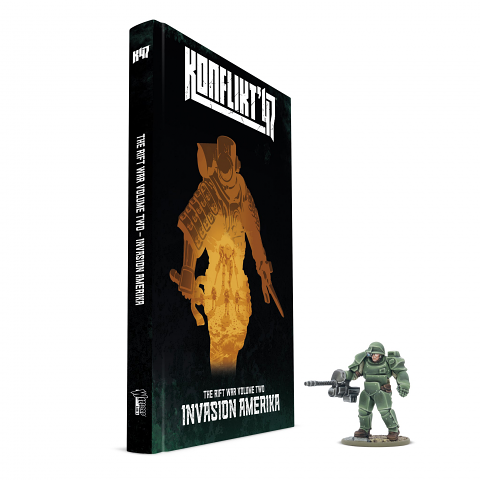
K47 - Invasion Amerika
It is 1947. Breaches in reality known as Rifts have provided the means for the warring nations to unleash unspeakable horrors upon one another in pursuit of victory. On the island fortress of Iwo Jima, away from prying eyes, the Empire of Japan has developed secret new technologies.Whilst fixated on the threat of the Axis in Europe, the Pan-Atlantic Alliance fights a holding war in the Far East and Pacific. However, the Empire is poised to irrevocably alter the trajectory of the Rift War on a global scale.Invasion Amerika is the second in a series of supplements for Konflikt ’47 detailing the background, history, and characters of the Rift War. This volume turns its attention to the Empire of Japan's expansionist ambitions, and their unprecedented attack against the heartland of the United States of America.Within its full-colour pages, rife with glorious photography, artwork, and illustrations, you’ll find timelines, short stories, game scenarios, and more.451010005£30.00 -
K47 - Kimura Tadaaki, Scourge of the Spirit Realm
Until late-1946 Kimura Tadaaki had been a test pilot for the Imperial Japanese Army, specialising in armoured walkers. He would seemingly be killed when a prototype’s ghost engine exploded, engulfing him in Rift energy. Rather than become just another unfortunate victim of phasing experimentation, Kimura miraculously survived, but would become something far beyond human.Kimura had been thrown into Shinobi space, far from human perception, infused with energies that resonated with the place in which he found himself. Though he yearned for death, it would not come, having seemingly developed an imperviousness to physical harm. He also found he had developed the ability to partially manipulate the energies within him, such as to project it with force, or create and control energy constructs.Over the first half of 1947, Kimura would train with Iwo Jima-based philosopher-scientists to gain mastery of his new abilities. They also fashioned a unique armour for him, serving two roles; to help him contain the rampant energies swirling within him, and as a morale-boosting reminder of samurai traditions for the ghosts he serves beside.Box contains four plastic miniatures (Kimura Tadaaki with three Shinobi Shadows) supplied with plastic bases.Miniatures sculpted by Marco Sano. Studio miniatures painted by Kirsten Williams.Models supplied unassembled and unpainted452011206£15.00 -
K47 - M5A2(T) Stuart Light Tank
The M5 Stuart is an improved version of the Stuart Light tank series, famous for its speed, reliability, and adaptability. As with the M3, the design has similarly been up-rated to carry Tesla weaponry in a specially designed turret.Contains one resin and plastic tank armed with a Light Tesla Cannon.452600405£34.20£38.00save 10% -
K47 - Mk I Automated Infantry Squad with MMG
Created from a fusion of Rift-tech advancements and early artificial intelligence principles, these man-shaped fighting machines are designed to bring both firepower and resilience to the battlefield. Multiple internal Programme wheels allow them to support human forces in a variety of battlefield situations, operating effectively in any terrain or climate. While they lack the manoeuvrability of human soldiers their robust construction allows them to withstand considerable damage. Equipped with MMG or HMGs, they can engage enemies with significant firepower, although their limited computational power necessitates their instructions be simple, and operations swift. Most importantly, on the horror-haunted battlefields of this war these automatons are immune to fear and fatigue. While initially treated with distrust by regular soldiers, the ‘Tinheads' have now earned their respect, especially when facing the enemy’s genetically altered monstrosities.Box contains five Warlord Resin Mk I Automated Infantry armed with MMGs, plastic bases, and assembly guide.452200602£27.00£30.00save 10% -
K47 - Nachtalben Squad with StG 44Z
The Nachtalben are one result of human test subjects being exposed to Rift energy, warping them grotesquely whilst leaving them with all their cognitive faculties. Terrifyingly, this means that the test subjects were more than likely voluntary, given their continuing proclivity to military discipline. They are unnaturally fast, with heightened reflexes and unlike other Axis Rift troops carry weapons and fight more like conventional infantry, though they have displayed a limited ability to temporarily shape-shift. As such, Nachtalben specialize in infiltration, ambushes, disrupting enemy lines under the cover of darkness, and moving through tough terrain with unnatural ease.Conatins 5 Warlord Resin miniatures armed with StG 44Z, LMG and Panzerfausts.452410215£22.50£25.00save 10% -
K47 - Percival Medium Assault Walker
Once the United States Armed forces had received the M8 Grizzly medium walker in sufficient numbers, excess production was diverted to the Commonwealth under the lend-lease scheme. By this time, research into equipping Commonwealth vehicles, including walkers, with automated assistance systems was well underway. Rather than being pressed into service, the entire shipment was diverted to Bovington for study. The Commonwealth had become nervous that relying entirely on the US to provide walkers left it too dependent on a foreign supplier, particularly with the growing cracks in the two nations' relationship. It was therefore urgent for the Commonwealth to be able to design and build its own examples. The result was the Percival, a distinct design from the Grizzly, owing to the need to incorporate the latest automated systems and a sufficient power plant for the Commonwealth’s new iteration of the Tesla cannon.Box contains one multipart resin and Warlord Resin Percival Medium Assault Walker, Vehicle Decal Sheet, MDF Base, and assembly guide.452410609£37.35£41.50save 10% -
K47 - Totenkorps
The animated corpses of the Totenkorps divide military opinion, as while they are undeniably effective, many Axis troops consider their very existence an abomination, and view them with fear and disgust. The effect they have on enemy troops is even more pronounced, and their sheer resilience to damage makes them a dangerous foe.Models supplied unassembled and unpainted452200201£26.55£29.50save 10% -
K47 - Type 7 Sasori Light Walker
The success of the Type 6 armed with the Light Shiboru Cannon led to the development of the Type 7. This improved on the previous design by incorporating an elongated chassis, leaving the crew less cramped, and a pair of front-mounted ‘claws’ equally useful for cutting through dense undergrowth as they are swatting away enemy infantry or even other light vehicles. An articulated tail purpose built for the Type 61 Light Shiboru Cannon was also fitted, affording the gunner much more control when gun laying. Given the Type 7’s even more apparent resemblance to an arachnid than its forerunner, and the addition of the tail sting, this inevitably resulted in the walker being named the Sasori (‘Scorpion’).Contains one resin and Warlord Resin Walker.452601202£37.35£41.50save 10% -
K47 - Type 97-Kai Shiboru Chi-Ha Light Tank
Shocked by their first encounters with Allied Matilda, Lee, and Sherman tanks, the Chi-Nu medium tank represented Japan’s attempts to modernise their armoured forces during a period of intense conflict and rapid technological advancement.It was armed with a Type 3 75mm tank gun, capable of engaging Allied tanks more effectively. Additionally, the Chi-Nu had improved armour compared to its predecessors, with a frontal armour thickness of up to 50 mm. Its engine also proved powerful enough to give the Chi-Nu good mobility. Based on the experience with fitting Rift weaponry to the Chi-Ha, a variant of the Chi-Nu mounts the Type 99 Shiboru cannon.Contains one resin and plastic tank.452611202£24.20£38.00save 36% -
K47: Axis Sonderkampfgruppe
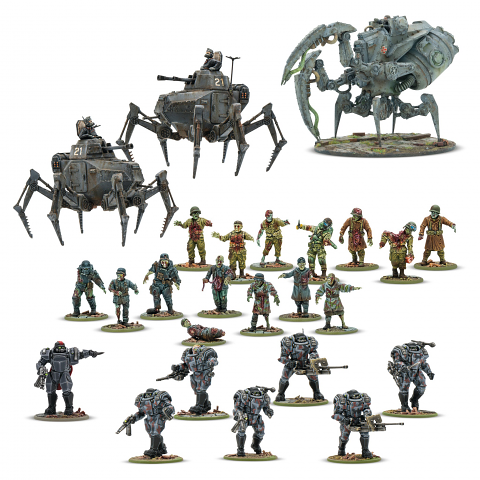
Typical of Axis combined-arms formations fighting across Europe, the Sonderkampfgruppe pairs the mailed fist of the Stahltruppen with the restless dead of the Totenkorps, backed up by scuttling light walkers. Capable of both rapid movement and direct confrontation, it’s a versatile force ready for any challenge.This box gives you everything you need to field a powerful Axis force, containing both an Assault Platoon and Armoured Walker Platoon made up of:1x Stahltruppen Platoon Commander (Warlord Resin miniature)6 x Stahltruppen Specialist Infantry (multi-part plastic miniatures)15 x Totenkorps Specialist Infantry (multi-part plastic miniatures)2 x Vogelspinne Light Walkers (multi-part plastic miniatures)1 x Sd.Kfz. 501/1 Nachtzehrer Light Walker (multi-part plastic miniature)2 x Axis vehicle decal sheets1 x Axis infantry decal sheetAssembly guides8 x Rift Dice7 x Order DicePlastic & MDF basesThe Vogelspinne comes with 4 variant weapons and the Nachtzehrer can also be assembled as an Infernospinne.452600203£99.00£110.00save 10%
-
K47: British Commonwealth Automated Battalion
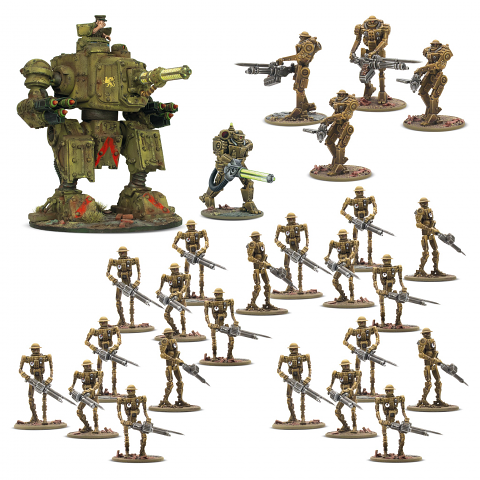
As Commonwealth forces deploy ever-increasing numbers of Automated Infantry to the front lines, it has become commonplace to find them making up the bulk of entire formations. The Automated Battalion is one such force, pairing a stout core of Automata with the human-crewed firepower of the Percival. This force puts out an enormous amount of firepower, and can gun–fight against virtually any foe it might face.This box gives you everything you need to field a powerful British Commonwealth force, containing both an Assault Platoon (or Automated Infantry Platoon!) and Armoured Walker Platoon made up of:1 x Mk IIC Automated Director (multi-part plastic miniature)20 x Mk I Automated Infantry (multi-part plastic miniatures)4 x Mk II Heavy Automated Infantry (multi-part plastic miniatures)1 x Percival Medium Assault Walker (multi-part plastic miniature)1 x British Commonwealth vehicle decal sheetAssembly guides9 x Rift Dice7 x Order DicePlastic & MDF basesThe MkI Automated Infantry include HMG and MMG weapon options, the MkIIs can be built with light autocannon, heavy autocannon or Light Tesla Cannons. The Medium Assault Walker can be built as one of three variants, including Percival and Hornet.452010607£99.00£110.00save 10% -
K47: British MK IIC Automated Director
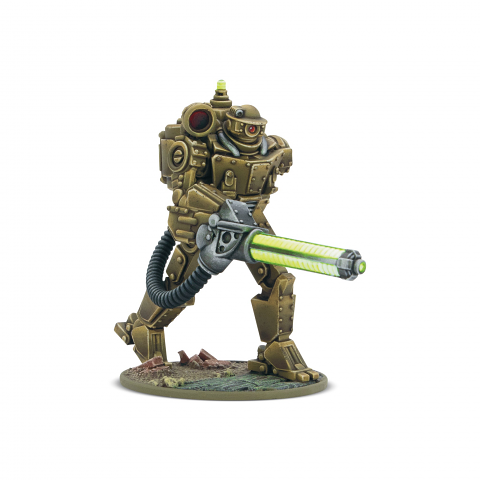
The advanced research into automated systems has yielded results at an entirely unexpected rate, such that production is hardly able to keep pace with new designs coming out of Bletchley Park. In less than a year from the first deployment of Mk I Automated Infantry in Belgium, entirely automated platoons are now increasingly independently organised and commanded by automated platoon commanders. These ‘Automated Directors’ are based on the Mk II Design, with improved computational and radio systems enabling them to distribute orders to other automated units over a wider radius. The advantages of fully automated platoons are numerous; the avoidance of British human casualties and immunity to ever more deleterious psychological effects on the battlefields amongst them. However, Automated Directors lack the imagination of human commanders, and are somewhat limited to enacting the tactics and orders pre-programmed into their systems prior to battle by dedicated British engineers.Box contains one plastic miniature, supplied with plastic base and assembly guide.453210603£17.00 -
K47: Empire of Japan Long Range Penetration Group
Imperial Japanese commanders often deploy the elite Ghost Attack Infantry as spearhead forces, using their Rift-tech to outflank and confound the enemy, softening up defensive positions for an armoured breakthrough. When paired with the very latest in Japanese tank design - the up-gunned Chi-Nu - the Ghost units can reap a fearsome toll on any enemy force.This box gives you everything you need to field a powerful Imperial Japanese force, containing both an Assault Platoon and Armoured Platoon made up of:1x Platoon Commander in Assault-Frame Heavy Armour (Warlord Resin miniature)25 x Ghost Attack Infantry (multi-part plastic miniatures) which can be assembled as:Ghost Attack SquadsShadow Warrior SquadsGhost Platoon Commander2 x Type 3-Kai Shiboru Chi-Nu Medium Tanks (multi-part plastic with resin and Warlord Resin turret)2 x Empire of Japan infantry decal sheets1 x Empire of Japan vehicle decal sheet8 x Rift Dice7 x Order DiceAssembly guidesPlastic & MDF bases452011201£99.00£110.00save 10% -
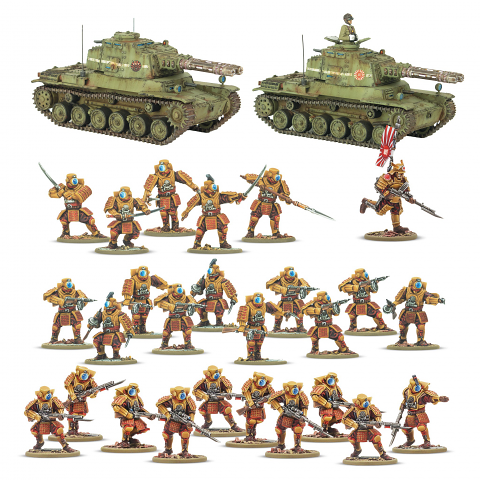
K47: Empire of Japan starter army
Strike from the shadows!
The Empire of Japan uses the power of stealth, the capability to phase through solid objects, and fanatical devotion to their cause to launch co-ordinated close-quarters attacks before fading away just as quickly as they had appeared.
This starter army is the perfect way to start your Empire of Japan collection for Konflikt ’47, arming you with an array of units, complete with Order and Rift Dice.
At the core of the starter army is an Assault Platoon. Led by an LMG-armed Platoon Commander in heavy powered armour (sculpt exclusive to this set), the platoon is anchored by a unit of Assault-Frame armoured infantry and a Ghost Attack Squad, capable of redeploying anywhere on the battlefield by exhausting a Rift Die, and bringing their Shiboru rifles to bear on an unsuspecting target!
A Sasori Light Walker lends its support at the head of an Armoured Platoon, supplemented by a Chi-Ha tank that has been reequipped with a Shiboru Cannon of its own. The combined weight of all the Crush weapons available across both platoons should give any tabletop foe cause for concern.
Konflikt '47 is the game of heroes, horrors, monsters, and mechs, putting you in command of the nightmarish struggle for supremacy as the old world is torn apart and remade in blood and crackling energy. Fast-paced, lethal gameplay provides countless cinematic moments, with fluctuating Rift energies and the ever-present fog of war ensuring that no two games are ever the same, and the outcome is never guaranteed. Heroes and villains on each side lend their unique abilities to turn the tide of battle, as mechs and monsters face off in brutal contests of flesh versus steel.
This is not war. This is the end.
The Empire of Japan Starter Army contains the following miniatures:
1 Empire of Japan Platoon Commander in Assault-Frame Powered Armour (Warlord Resin; exclusive to this set)
5 Assault-Frame Armoured Infantry (Warlord Resin)
5 Ghost Attack Infantry (Warlord Resin)
1 Type 7 Sasori Light Walker (Resin/Warlord Resin)
1 Type 97-Kai Shiboru Chi-Ha Medium Tank (Plastic with Resin/Warlord Resin components)
5 Konflikt ’47 white Order Dice
5 Konflikt ’47 yellow Rift Dice
Waterslide transfer sheetModels supplied unassembled and unpainted
452601203£99.00£110.00save 10% -
K47: Konflikt '47 Introductory Set
This is not war. This is the end.
Konflikt '47 is the tabletop wargame of heroes, horrors, monsters, and mechs – set in an alternate universe in which WWII never ended, and terrifying new weapons of war are unleashed on the battlefield. This Introductory Set is a perfect way to leap into the world of Konflikt ’47 for the very first time, regardless of if you are new to wargaming, or are the veteran of many a tabletop battlefield!
Within this box are finely detailed, multi-part plastic miniatures, twelve jump-pack equipped United States Fireflies squaring off against six imposing Axis Stahltruppen. The Field Manual within walks you step-by-step through building and painting these finely detailed plastic miniatures and through playing your first games. With straightforward, easy-to-follow instructions, you'll quickly learn the basics of Konflikt '47 and be ready to lead your troops to victory over and over again! It also includes dice, cardboard tokens and walkers, plastic terrain, and a battle mat upon which to play!
The Konflikt ’47 Starter Set contains:
Full colour, 68-page book - The Konflikt ’47 Field Manual
12 Plastic United States Fireflies
6 Plastic Axis Stahltruppen
Plastic Ruined Buildings Scenery
Game Token Punchboard
Double-sided Gaming Mat (30” x 22.4” approx.)
Eight Order Dice (4 Green / 4 Grey)
Six Rift Dice (3 Green / 3 Grey)
Ten six-sided dice
Dice Bag
Cardboard Insert that doubles as an in-game Bunker
Models supplied unassembled and unpainted452610008£38.25£42.50save 10% -
K47: Soviet Bloc Elite Operational Group
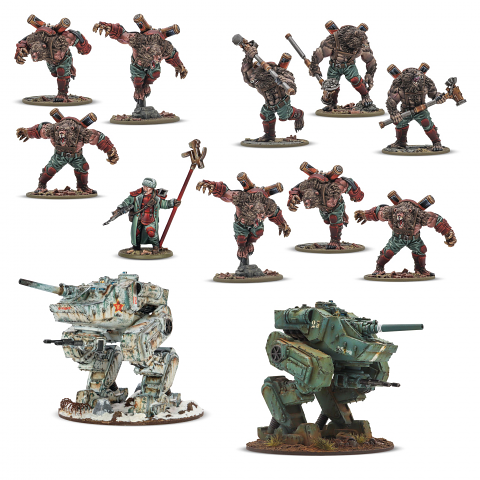
The challenge of supporting the lethal Ursus infantry in combat has led to the formation of specialised Operational Groups by Soviet Bloc commanders. All ‘conventional’ infantry have been discarded, leaving only DM-40 Molot walkers to support the rampaging bears. This force is brutal and unsubtle - it hits hard and fast!This box gives you everything you need to field a powerful Soviet Bloc force, containing both an Assault Platoon and Armoured Walker Platoon made up of:1 x Soviet Bloc Platoon Commander (Warlord Resin miniature)6 x Ursus Infantry (multi-part plastic miniatures)3 x Ursus Infantry with Mauls (multi-part plastic miniatures)2 x DM-40 Molot Medium Walkers (multi part plastic miniatures)1 x Soviet Bloc vehicle decal sheet5 x Rift Dice6 x Order DiceAssembly guidesPlastic & MDF basesThe Molot Walkers can be assembled with a wide variety of weapons.452010807£99.00£110.00save 10% -
K47: United States Rapid Deployment Force
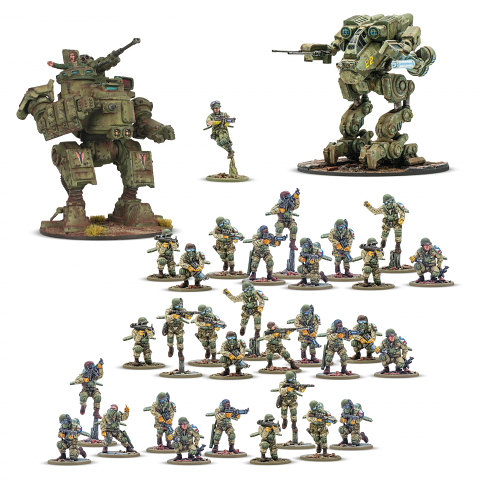
US commanders frequently made use of Firefly jump infantry as ‘fire brigades’ to intervene whenever an enemy breakthrough looked likely. Pairing the ultra-mobile Fireflies with walkers for heavier fire support, a Rapid Deployment Force can strike hard and fast, exactly where it is needed, redeploying before the enemy can counter, and ready to attack again in moments.This box gives you everything you need to field a powerful United States force, containing both an Assault Platoon and Armoured Walker Platoon made up of:1 x Firefly Platoon Commander (Warlord Resin miniature)30 x Firefly Airborne Specialist Infantry (multi-part plastic miniatures)1 x M2A5 Linebacker Medium Walker (multi-part plastic miniature)1 x M10A1 Grizzly Medium Assault Walker (multi-part plastic miniature)3 x United States infantry decal sheets2 x United States vehicle decal sheets6 x Rift Dice7 x Order DiceAssembly guidesPlastic & MDF basesThe Linebacker includes a variety of weapon options, the Grizzly can optionally be built as a Grizzly or Bruin.452010410£99.00£110.00save 10% -
K47: Ursus Infantry Squad with Mauls
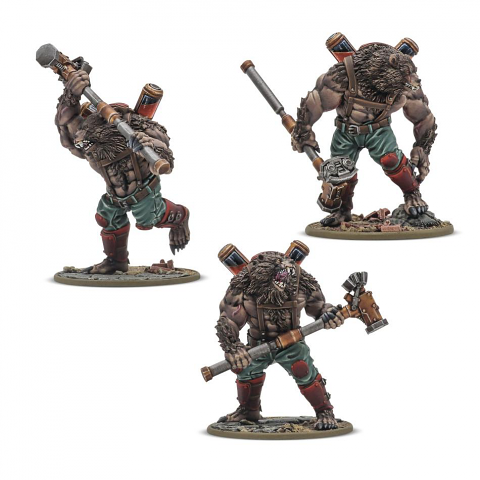
With the appearance of the Rifts, the efficacy of the Proletarian Hemotype serum has been greatly magnified. Taking advantage of this and stolen Axis research Soviet Science has created an astonishing triumph to counter the Axis' dread Shreckwulfen; a new breed of soldier, the Ursus Infantry. Bonding humanity to the formidable Siberian Brown Bear has resulted in an augmented, monstrous soldier. Little is more symbolic of the Soviet Union’s bold embrace of the Rift than the Ursus. Deployed in small squads, they engage in brutal close-quarters combat, ripping their way through enemy lines and leaving carnage in their wake. Even the most advanced Rift-enhanced units are hard pressed to resist their physical and psychological challenge.Some Ursus Squads are equipped with deadly mauls, which supplement their already considerable strength and render even the heaviest of enemy armour susceptible to their brutal attacks.Box contains 3 plastic miniatures, supplied with plastic bases and assembly guide.452010802£27.00 -
Kazak Light Walker
After their initial encounter with the Axis Spinne walker, Soviet forces diligently endeavoured to capture an example. Demonstrating characteristic Soviet determination, scientists and engineers of Science City 4 succeeded in reverse-engineering much of the technology. This, along with plans for bipedal walkers stolen by SMERSH agents from the United States, enabled the Soviet Union to swiftly develop the Kazak walker as the first operational example. This fast and agile reconnaissance vehicle proved to be highly effective and has set the standard for subsequent Soviet walkers.Contains one resin and metal miniature.452600801£31.05£34.50save 10% -
Konflict 47 Rift Dice Blue (12)
Unleash Rift power on the battlefield with these Konflikt '47 Rift Dice!
The Rift mechanic drives Konflikt '47, representing the unstable energy that fuels strange technologies and creatures. These Rift Dice help you track that energy during battle—an essential tool for every Konflikt '47 player using Rift-powered units.
You will need a Rift Die for each Rift Unit, plus each Rift Weapon upgrade in your army. Some Heroes are particularly attuned to the energies of the Rifts, and can bring several Rift Dice to the table singlehandedly!
This box contains 12 Konflikt ’47 Rift Dice.
452610006£16.20£18.00save 10% -
Konflict 47 Rift Dice Green(12)
Unleash Rift power on the battlefield with these Konflikt '47 Rift Dice!
The Rift mechanic drives Konflikt '47, representing the unstable energy that fuels strange technologies and creatures. These Rift Dice help you track that energy during battle—an essential tool for every Konflikt '47 player using Rift-powered units.
You will need a Rift Die for each Rift Unit, plus each Rift Weapon upgrade in your army. Some Heroes are particularly attuned to the energies of the Rifts, and can bring several Rift Dice to the table singlehandedly!
This box contains 12 Konflikt ’47 Rift Dice.
452610003£16.20£18.00save 10% -
Konflict 47 Rift Dice Red (12)
Unleash Rift power on the battlefield with these Konflikt '47 Rift Dice!
The Rift mechanic drives Konflikt '47, representing the unstable energy that fuels strange technologies and creatures. These Rift Dice help you track that energy during battle—an essential tool for every Konflikt '47 player using Rift-powered units.
You will need a Rift Die for each Rift Unit, plus each Rift Weapon upgrade in your army. Some Heroes are particularly attuned to the energies of the Rifts, and can bring several Rift Dice to the table singlehandedly!
This box contains 12 Konflikt ’47 Rift Dice.
452610004£16.20£18.00save 10% -
Konflikt '47 Roberta Wells - Firefly Hero
A graduate in physics, the emergence of the Los Alamos Rift at the Trinity test site led to Roberta dedicating herself to the study of Rift Energy. The deployment of Axis Rift horrors, in particular the dread Totenkorps, in late 1944, led to her volunteering to ship out to the European theatre to conduct studies of the application of Rift-tech in warfare. Despite numerous objections from the US Army, her request was eventually granted.Her no-nonsense approach, resilience to the psychological horrors of the Rift War, and willingness to get stuck in marked her out amongst the raft of scientific advisors seconded to the front. Exhibiting a fierce independence, Roberta would often strike out separately from the squad to which she was attached, lest they constrain her in the pursuit of her studies. Nevertheless, she gradually earned the respect of the US Army soldiers entrusted with her safety in the field, having displayed a remarkable aptitude for combat situations.Roberta is considered the United States’ best hope in assessing the Dresden Rift in the goal of safely controlling or neutralising it, and has returned to the front line in 1947, attached to 109th Airborne Division bound for Dresden. As a high value asset, she has been granted the use of prototype armour designed specifically for use with the Firefly jump pack. Of course she has already begun to make her own modifications…Box contains one Warlord Resin miniature, with plastic base.453210402£9.00£10.00save 10% -
Konflikt '47 Sd.Kfz. 501/1 Nachtzehrer
The development of a new serum solution by the enigmatic Oberstarzt Albrecht von Zögling, also required the development of a machine to effectively distribute it amongst the freshly dead.The ultimate design, dubbed the Nachtzehrer (named after the creatures of folklore; revenants said to drag the living to the realm of death), is reminiscent of a hermit crab; it consists of a small crew compartment within which scientists can operate external instruments without exposure, married to an armoured, temperature-controlled canister which houses the highly volatile serum. Large, bladelike forearms inject the serum directly into subject corpses with abject efficiency, and are themselves equally capable of striking down the living, to immediately convert into the walking dead.This plastic kit also allows you to make the Sd.Kfz.501/4 Infernospinne, which trades the serum housed in its cannister for napalm, and its medical implements for powerful flamethrowers, more potent than its Flammenspinne cousin, though slightly les nimble and somewhat more volatile.Box contains one plastic Sd.Kfz. 501/1 Nachtzehrer, Vehicle decal sheet, MDF base, and assembly guide.452010205£25.20£28.00save 10% -
Konflikt '47 Totenkorps Horde
The Totenkorps were the first examples of Rift-derived forces encountered by the Allies and Soviets. Immune to pain and fear, they swamp their foes through sheer relentlessness and inhuman resilience. As such the Totenkorps are mostly employed as terror troops, soaking up enemy fire before closing and engaging in brutal close quarters combat. Even defeated Totenkorps can rise again, potentially many times, before being finally laid to rest. Their decayed forms invariably spread fear on the battlefield, making them a profound threat to even the most hardened enemy combatants.The initial Totenkorps originated from the dead caught in the vicinity of the opening of the Dresden Rift. In the years since, enigmatic Axis scientist Albrecht von Zögling has perfected a process to replicate the effects on the freshly deceased, and developed the Sd.Kfz. Nachtzehrer, a terrifying machine that can apply his serum to the dead of the enemy on the battlefield itself, so that be immediately employed against their erstwhile allies.The plastic Totenkorps sprue features reanimated soldiers in varying types of uniform taken from the dead of both the Axis and the United States, including a US Firefly and an Axis Schwertruppen!Box contains enough parts to make 30 plastic Totenkorps, plastic bases, and assembly guide.452010204£33.30£37.00save 10% -
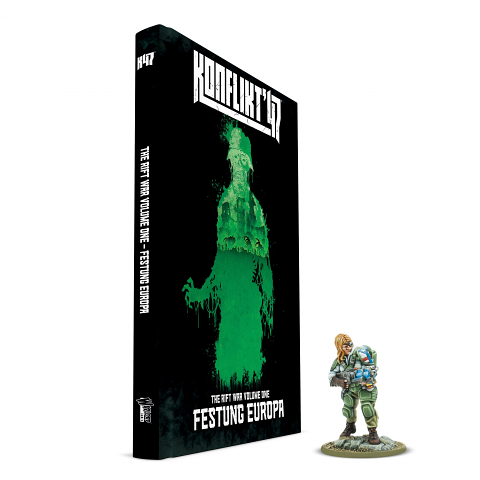
Konflikt '47: Festung Europa
Stalemate. Since the opening of the Dresden Rift, new and unspeakable horrors have poured forth from the heart of the newly emergent Neu Republik. The Allied plan to end hostilities in Europe is in tatters. The world now pays the price of their failure.Technological development, already in overdrive in the fever of war, has escalated further due to the power of the Rifts. Weapons of unprecedented destructive capacity are being deployed with increasing frequency by all the belligerent nations, leaving Europe in utter ruin and no-one able to gain an upper hand.It is now beyond any doubt - control of the Rifts is the path to victory. Dresden is the heart of Axis power, the heart of Festung Europa.Festung Europa is the first in a series of supplements for Konflikt ’47 detailing the background, history, and characters of the Rift War. This volume is centred on the European theatre, and the concerted effort of the British-US alliance, and the Soviet Bloc, to oust control of the Dresden Rift from the Axis.Within its full-colour pages, rife with glorious photography, artwork, and illustrations, you’ll find timelines, short stories, game scenarios, and more. New miniatures will be released alongside each supplement, representing the heroes, horrors, monsters, and mechs, described in its pages.451010004£27.00£30.00save 10% -
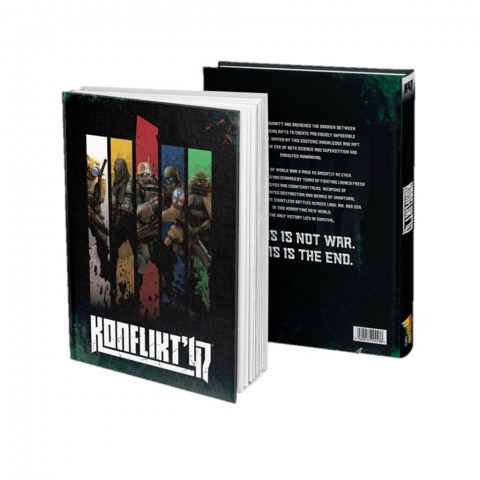
Konflikt 47 Rule Book
It is 1947. Humanity has breached the barrier between realities, using Rifts to create previously impossible technologies. Driven by this esoteric knowledge and Rift energy, a new era of both science and superstition has engulfed humankind. The fires of World War II rage as brightly as ever. Nations bloodied and scarred by years of fighting launch fresh offensives and counterattacks. Weapons of unprecedented destruction and beings of unnatural origin dominate countless battles across land, air, and sea.
In this horrifying new world, the only victory lies in survival.
Konflikt '47 is the game of heroes, horrors, monsters, and mechs, putting you in command of the nightmarish struggle for supremacy as the old world is torn apart and remade in blood and crackling energy. Fast-paced, lethal gameplay provides countless cinematic moments, with fluctuating Rift energies and the ever-present fog of war ensuring that no two games are ever the same, and the outcome is never guaranteed. Heroes and villains on each side lend their unique abilities to turn the tide of battle, as mechs and monsters face off in brutal contests of flesh versus steel.
This is not war. This is the end.
This book is your guide to the brutal warfare and Rift-spawned horrors of Konflikt '47, containing all of the rules needed to play games set in a Second World War elevated to a new intensity by the weird new science and devastating technology now available to humanity. Within its covers you’ll find detailed rules for setting up and playing fast-paced, action-packed games, accompanied by gorgeous artwork and photography to inspire your painting and modelling. That’s not all - there’s an entire section dedicated to introducing the forever-changed world of Konflikt '47, the major factions of the war, and the horrific new creations they unleash upon each other.
4526100021£36.00£40.00save 10% -
LCVP - Landing Craft, Vehicle, Personnel 'Higgins Boat'
The LCVP (Landing Craft Vehicle Personnel) Higgins boat could hold either a 36-man platoon, a jeep and a 12-man squad, or 8,000 lb (3.6 t) of cargo. Its shallow draft (3 feet aft and 2 feet, 2 inches forward) & clever design that pretected the propeller, enabled it to run right up onto the shoreline.
The steel ramp at the front could be lowered quickly allowing troops to swiftly disembark, the boat could then reverse itself off the beach, and head back out to the supply ship for another load within three to four minutes.
Kit Dimensions: L220 x W70 x H45mm approx.
Features working ramp & etched detailing.
Made from MDF & Greyboard
Suitable for Warlord - Made by SarissaN061£10.00 -
Linebacker Jump Walker
Bring death from above and support the US Fireflies with the heavily armed Linebacker Jump Walker!Following the disastrous drop assault on Collegno in 1946, the limitations of the original M2 Mudskipper series became clear. While a perfectly satisfactory design, the Firefly jump infantry were in need of more versatile fire support when they dropped into combat. American designers developed an extensive series of refits for the Mudskipper to increase its tactical flexibility. An M21 Tesla cannon and innovative new universal mounts for secondary weapons enabled the walker to be quickly configured to face a wide variety of threats, more articulated legs and feet were much more resilient to the pressures of high-impact landings, and a new control system enabled it to be piloted by a single crewman without loss of utility. The new variant was dubbed the M2A5, and officially considered a continuation of the Mudskipper line rather than a distinct vehicle, but crews and Firefly troopers alike quickly dubbed it the ‘Linebacker’. The combat debut of the new model came in May 1947 when 200 Linebackers were rushed to the front line to help breach Axis lines during the siege of Stuttgart during Operation Valentine.This highly detailed, multi-part plastic kit allows you to assemble a Linebacker armed with its signature M21 Light Tesla Cannon on one arm, and any from a variety of options on the other, Twin HMGs, Twin Automatic Cannons, or Twin Super Bazookas. It also mounts an MMG in the “nose”, which can be substituted for a flamethrower. The model comes with a clear plastic canopy (which can be assembled hinged), allowing you to see the pilot nestled inside.In games of Konflikt ’47, a Linebacker is a formidable weapon, capable of darting around the battlefield thanks to its jump mechanic, or even deploying anywhere on the table from Reserve to bring its firepower to where you need it most. Coupling this mobility with its Light Tesla Cannon means you can exhaust a Rift Die and unleash a deadly Tesla Arc.Model sculpted by Jon Heeney and Marco Sano. Studio Models painted by Darek Wyrozebski.Models supplied unassembled and unpainted452010403£35.10£39.00save 10% -
M4 Sherman Crocodile
Inspired by the powerful British Churchill Crocodile and their own experiences in the Pacific with other versions of flamethrower tanks the US army ordered some 100 Sherman Crocodile variants from the British, who were recognised as leading the field in Flamethrower technology.Based on the M4A4 (Sherman V) welded hull the Crocodile retained full operation of its turret and 75mm gun and bow-mounted .30 Cal (7.62mm) machine gun. The flame gun was placed above the Bow Machinegunners hatch. All of the flamethrowing equipment was positioned externally, including the iconic wheeled trailer.The trailer weighed 6.5 tons and was protected by 12mm (0.47 in) thick armour. A special joint connector known as “The Link” (made up of 3 articulated joints allowing it to move up, down, left or right and swivel on the horizontal axis) allowed it manoeuvre through rough terrain. This link could also be released from inside the crew compartment in case of an emergency, a great design attribute as the trailer carried 400 gallons (1818 litres) of flamethrower liquid and 5 compressed bottles of Nitrogen (N?) gas!The flamer worked by using Nitrogen gas to propel the fuel along a pipe running from the rear of the tank, up and along the right flank, to a flame projector mounted on the right upper glacis. The co-driver/bow machine gunner would then operated the flamethrower or his machine gun.Of the initial order, only 3 M4A4 Crocodiles were actually made and along with a fourth, the prototype M4A2 (Sherman III), seeing action with the 739th Tank Battalion (Special Mine Exploder Unit). They were sent in February 1945 to take part in Operation: Grenade, the assault on the ancient 13th-century citadel in Julich, Germany. Helping demolish the garrison of the old citadel.402413008£35.10£41.50save 15% -
M5 Stuart Platoon
This new versatile plastic kit can be assembled as either an M5 Stuart, M5A1 Stuart or an E7-7 Mechanised Flamethrower, and to boot is suitable for many a Bolt Action army, including US, British, Soviet and Chinese. This platoon set gives you three of these tanks to assemble as you see fit, whether you're looking to field a three vehicle platoon of a single variant, or want to add one of each variant to your army at a discounted price against purchasing three separately.The Americans favoured light tanks over armoured cars for reconnaissance, and the M5 light tanks were developed for this role. The chief difference between this and the earlier vehicle was its Cadillac engine. This necessitated some redesign of the armour to fit, and the opportunity was taken to improve the armour layout and distribution. In the M5A1 version the lower hull casting was now up to 64mm thick in places. Other improvements include wider access hatches, more interior space for the crew and ammunition stowage for 147 37mm rounds. Production was limited since the introduction of the M24 light tank was imminent.Although it counts as a light tank (Damage Value 8+) in Bolt Action, it benefits from the Reinforced Armour special rule; when taking shots that strike the front of the vehicle it treats its armour value as 9+ instead.Principal service: 1943–45. Numbers manufactured: 6,810.Box includesThree 1/56 scale plastic M5 Stuart Light Tanks with options to make the M5A1 and E7-7 mechanized flamethrower versionsBolt Action Stat CardsFull-colour waterslide decal sheetDamage Markers402011302£55.80£62.00save 10% -
Merrills Marauders Squad
In 1943 the US high command raised a unit to rival the famous British Chindits, men who were to take the war to the Japanese behind their lines. They were officially called 5307 Composite Unit but, under their tough and charismatic leader – Brigadier General Frank Merrill – soon earned their famous name.
These hard-marching, tough volunteers raided Japanese supply lines and airfields, carrying their supplies by mule and by horse. 3,000 strong, the three battalions were equipped with a variety of semi- and fully-automatic weapons, as well as their trademark headgear. They were further toughened by intense training and marksmanship courses.
Their support weapons, man-portable by necessity, consisted of bazookas and 60mm mortars, and even occasionally Boys anti-tank rifles. They fought in numerous raids and earned a reputation for tenacity and jungle-fighting skills, helped on many occasions by native Kachin scouts who knew the terrain of the Burma theatre. Merrill,s Marauders were a tough unit and uniquely each man who served in the three battalions was awarded a Bronze Star medal. Their specialist skills will be of great use to US players in games of Bolt Action.
This Warlord Games box set contains a 10-man Marauders Squad: • 1 NCO and three soldiers with SMGs • 2 soldiers with BARs • 4 riflemen
402213103£23.85£26.50save 10% -
Mythic America Aztec & Nations Starter Set
The new Mythic Americas version of Warlords of Erehwon still keeps at its heart a singular objective in mind – to allow for fast-paced and exciting miniature battles upon a standard-sized table between rival forces known as Warbands. A Warband represents your own band of warriors – courageous humans, blood-thirsty monsters, legendary heroes, and mythological entities from the depths of the darkest myths.Mythic Americas: Warlords of Erehwon provides a new multi-level, scenario-driven approach to your games. This approach offers plenty of opportunities to reward tactical play, but at the same time keeps things manageable in terms of the size of forces and space required. The game still uses ten-sided and Order dice, making for a game with mechanical depth and considerable adaptability. The Order dice test system, at the mechanical core of Mythic Americas, and an extremely balanced rules set offers Warband leaders great tactical freedom, but the game still offers lots of opportunity for fate and chance to have a say in the outcome of your battles. But, every experienced general throughout the ages knows that fate and chance will test even the most ingenious battle plan!This is The Way.The Mythic Americas Starter Set includes:Aztec Starter warband:1 Tlalocan High Priest Hero unit (INCLUDING 4 Bound-Dead Bodyguards. 5 models)2 Tlalocan-Bound Dead WARRIOR units (10 models)Tribal Nations Starter warband:1 Sachem Warlord Unit (INCLUDING 2 Mohawk Warrior Bodyguards - 3 models)1 Mohawk Warrior UNITS (5 models)1 Seneca Warrior UNITS (5 models)DiceSoftback RulebookGame CardsTokensModels supplied unassembled and unpainted721510002£75.00 -
Napoleonic French Line Lancers
In 1809, at the battle of Wagram, some Polish light horse fighting for Napoleon seized lances from Austrian Uhlan prisoners and used them with good effect. Impressed by their use, Bonaparte ordered nine regiments to be formed, six of them clothed in green and three in blue. With their nine-foot ash pole lances, red and white pennants, and topped off with gleaming brass classical helmets they cut quite a dash on the battlefield. Lancers were unusual as they could take their place in the battleline and fight it out with enemy cavalry or infantry, but they were most often used in scouting, raiding, and – especially in Spain and Russia – in skirmishing, even fighting dismounted where the situation arose. Armed with a wicked lance, sabre, and at times a carbine and up to two pistols, the French line lancer was a formidable foe! This Warlord Games boxed set contains: 12 plastic easy-build French Light Cavalry Lancers. 1 additional metal officer and metal horse. 1 additional metal bugler. Optional metal arm for eagle bearer. Although a standard unit size for French Lancers would be 12 in most games, this box allows you to make 13 mounted French Lancers, giving you the choice of fielding them with or without command models.
WGN-FR-13£23.40£27.50save 15% -
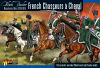
Napoleonic Late French Chasseurs Light Cavalry
Formed originally back in 1743, the Chasseurs a Cheval (mounted hunters) were hard riding, green clad light cavalry whose main role was patrolling and raiding for the French armies. A good Chasseur was at home on his light horse, skirmishing with the enemy cavalry or scouting enemy movements and thus providing valuable intelligence for their commanders.
Armed with carbine, curved sabre and bayonet (an item disliked by the cavalrymen who used it to dig up vegetables or ‘lost’ it on campaign) the Chasseurs were most happy in the saddle, although they were also trained to fight on foot should the need arise.
At the height of the French Army under Bonaparte’s reign there were 31 regiments of Chasseurs a Cheval although only 15 regiments were available for the titanic Hundred Days campaign that culminated at the Battle of Waterloo. Our superbly detailed Chasseurs à Cheval are provided with covered and uncovered shakos as well as the colpacks favoured by the elite companies.
Although requested not to wear the sabretache beyond 1808 many Chasseurs would keep this item well beyond this decree and thus we’ve included it on our models. For those of you wishing to follow regulations over reality simply snip the sabretache off.
This Warlord Games box set contains:
- 12 plastic easy-build French Light Cavalry including 1 metal officer and horse
- Optional metal parts to make a trumpeter and eagle bearer
- Options for shako, oilskin covered shakos and the elite company Colpack fur hat.
WGN-FR-12£23.40£27.50save 15% -
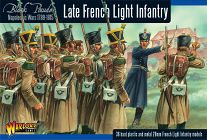
Napoleonic Late French Light Infantry
This Warlord Games boxed set contains:
- 24 plastic French infantry
- Metal command group of:
- 2 Officers
- 1 Drummer
- 1 Standard Bearer
Also full colour background leaflet containing several flags.
302012001£23.40£27.50save 15% -
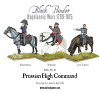
Napoleonic Prussian High Command
The Prussian High Command during the 100 Days campaign leading up to the battle of Waterloo.
- 1 x Field Marshal von Blucher
- 1 x General August von Gneisenau Blucher’s chief of staff
- 1 x Marshal Friedrich Karl von Zeiten
WGN-PR-23£10.10£11.25save 10%














Categories
Recently Viewed
- Beowulf Blue £3.50

News
WarGameStore Facebook page
12-05-2011 We decided it was easier to use Facebook to post regular updates on what's happening at WarGameStore, so for the latest updates check out this link:
Control Panel
Popular Pages
Help
Contact us
Copyright © 2003-2026 WarGameStore.
- Visa
- MasterCard
- PayPal
- Verified-by-VISA
- Sage