
Cart is Empty
- Home
- Manufacturers
- Warlord
Special offers
Warlord
Products
-

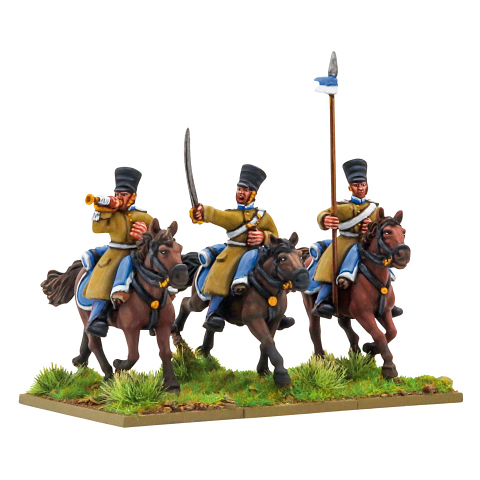
Crimean War Russian Hussars Command
The Russian cavalry force was the largest in Europe, totalling over sixty regiments organised into twenty cavalry divisions. The light cavalry consisted of hussars and lancers or uhlans. Much as with the infantry, the cavalry training consisted of wheels and manoeuvres designed for the parade ground with little tactical application.Russian hussars wore shakos with a black top, peak and with a brass front plate, but the main body of the headgear was coloured differently for each regiment. Similarly, all wore a pelisse that was trimmed with fur, but the colour of each varied between regiments. For the majority of the campaign Russian hussars wore a grey oilskin cover to protect their shako and a grey greatcoat over their bright uniforms.This pack contains three mounted command figures, cast in metal.Sculpted by Mike Percy. Studio miniatures painted by Andrés Amián.Models supplied unassembled and unpainted303013833£9.45£10.50save 10% -
Cruel Seas IJN Fleet
Cruel Seas IJN Fleet
Between the wars Japan reassessed its position with its navy, building the world’s first purpose-built aircraft carrier, the Hosho in 1921 and inventing its deadly fast and powerful type 93 24’’ oxygen fuelled torpedoes. They also decided that as their industrial might could not match that of the west, then they would have to have sharp, training tactics and a crew of superior quality to their foe, and for a while, achieved just this.Their battleships and cruisers were of excellent quality and their growing fleet or aircraft carriers would, after Pearl Harbor, give them the edge in the opening phase of the Pacific War. Excellent training, use of the Long Lance torpedoes and aggressive use of nighttime fast attacks with their destroyers also gave the allies a bloody nose before they learned to counter these attacks.Imperial Japanese Navy FleetCruel Seas focuses on the cat and mouse hunts that happened nightly in the Philippines, Guadalcanal and the Solomon’s. They could be IJN sub chasers stalking a crippled US submarine, or mine layers playing their trade at night. Most commonly it will be Japanese barge convoys defending themselves in shallow water against rapacious PT boats. Turning the tables, a late war game could be played out with American landing ships and the terrifying Shin’yo Kamikaze craft.The IJN, therefore, is an interesting mixture of the very sophisticated and the very amateur, boldness being a connecting factor whether in battleships or tiny craft. It is a do or die force, get in close and things will go well, dither or maintain the range of the allied technology and firepower will overreach you.The Imperial Japanese Navy Fleet Contains:6 x T-14-class MTBs (metal)3 x Maru-Ni kamikaze boats (metal)3 x Shin-Yo kamikaze boats (metal)4 x large Sampan (resin and metal - two of each canopied boat)1 x Escort Type Hei minesweeper (resin & metal)1 x Aichi D3A 'Val' (metal)Ship CardsPlastic Torpedo markers782612003£61.60£77.00save 20%
-
Cruel Seas Marinefahprahm F-lighter
One Resin and Metal Cruel Seas Marinefahprahm F-lighter785112007£17.50£29.00save 40% -
Cruel Seas Rulebook
DescriptionIn Cruel Seas, you take on the role of a naval crew manning their fragile coastal craft as they head out day and night to take on both the sea and the enemy.Command your flotilla of small ships as they head out to attack a convoy, drop off Commandoes for a behind-the-lines mission or task them with one of the other myriads of missions this small and versatile craft would perform.Be it the Coastal waters of England or across the Channel to France, on to the Mediterranean waters or on further to the vast Island chains of the Pacific, Cruel seas will ensure your small ships see plenty of adrenaline-fuelled action!FREE Special Miniature (while stocks last)As with many of our Bolt Action range of books if you order direct from our webstore you will receive a fantastically crafted model and Cruel Seas is no exception! Warlord sculptor Marco has produced this iconic piece, the conning tower of a German U-Boat breaking the surface...Cruel Seas, the rulesWithin the pages of Cruel Seas you'll find the complete rules for small ship action plus full-colour guides, superb art courtesy of Osprey Publishing, history on your fleets, Campaign rules and special weaponry, Aircraft rules and more!781010001£18.00£25.00save 28% -
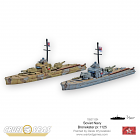
Cruel Seas Soviet Bronekrater pr.1125
A most peculiar type of riverine and estuary craft was also developed by the Russians. This was the 1124 and 1125 class of armoured rivercraft or Bronekater. These shallow draught craft, drawing only 2-foot of water, could penetrate river systems and lakes, even being moved by rail and lorry to new locations. Some featured numerous armoured turrets, even T-34 tank turrets, and again, frequently equipped themselves with rails for the Katyusha launchers. They were tough little boats capable of receiving and dishing out punishment, though they had a small crew and were slow and poor deep watercraft.785011004£11.90£19.50save 39% -
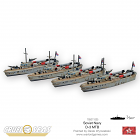
Cruel Seas Soviet D-3 MTBs
The D-3 class was built in wood, and carrying torpedoes openly on deck could attain speeds of 32 knots(59 km/h, 37 mph). Later boats in the series had improved engines increasing operating speeds to 48 knots (89 km/h, 55 mph)!
Although not many D-3s served in the Black Sea they were quite active, sinking German Barges and an Italian midget submarine. A most notable action was the sinking of the Elbing-class large torpedo boat T-31 in the Battle of Nerva Island.785011005£11.90£19.50save 39% -
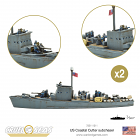
Cruel Seas US Coastal Cutter Subchaser
Submarine chasers were used for destroying German U-boats that were stationed off the coast of the United States (some 67 German U-boats were sunk). In the Pacific Theatre, submarine chasers were used for amphibious landings, courier and escort duty.
SC-497-class submarine chasers were a class of 438 submarine chasers, 98 tons with a length of 110 ft 10 in (34 m) and a speed of 18 knots. 142 were part of the Lend-Lease program with 78 sent to the Soviet Union, 50 to France and 3 to Norway. The three Norwegian examples served with distinction on the Shetland bus service, running agents, refugees and weapons past the German blockade between occupied Norway and Britain.
Contains:
2x resin & metal US Coastal Cutter Subchaser
Ship card
Wake marker785111011£23.45£39.00save 40% -
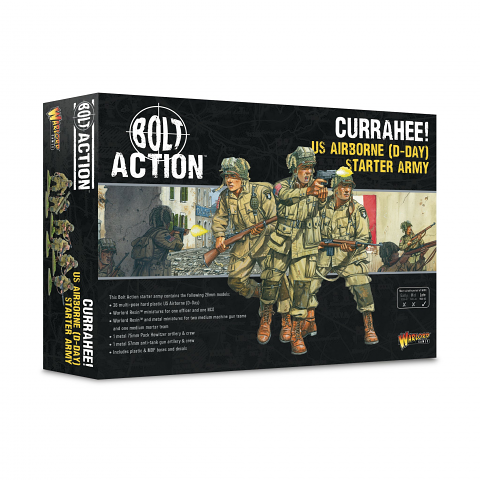
Currahee! US Airborne (D-Day) Starter Army
Drop into the thick of the fight with Currahee!, the US Airborne (D-Day) starter army!Clad in their iconic reinforced M42 jump uniforms, these die-hard American paratroopers are ready to spearhead the assault on the Bolt Action tabletop. Combining plenty of lightweight firepower with a never-say-die attitude and intense training, they're a force of tough, veteran infantry who can take the fight to the foe any time, any place.This Bolt Action starter army gives you a battle-ready force of US Airborne that you can field in games as soon as they're assembled. At its core is a strong Rifle Platoon consisting of a pair of 12-man Airborne squads, supported by a sniper and bazooka team, and guided into battle by a 6-man Pathfinder squad - all of these are made from the included plastic sprues. Leading this element of the force is a Warlord Resin Platoon Commander, ensuring your men know what the mission is!Backing up the Rifle Platoon are a pair of smaller formations deploying powerful support weapons - a Heavy Weapons Platoon of two medium machine gun and one medium mortar teams, plus a Platoon Commander, all in Warlord Resin, and an Artillery Platoon with two metal guns: a 75mm Pack Howitzer for indirect fire support, and a 57mm anti-tank gun for dealing with enemy armour. These are led by a Platoon Commander built from the plastic sprues.This force gives you the perfect starting point for a US Airborne collection themed around the D-Day drops made famous in media such as Band of Brothers and can be endlessly tailored, or built upon, to fit your exact specifications. Get ready to board the aircraft and drop into combat!The Currahee! US Airborne (D-Day) Starter Army contains:36 multi-pose hard plastic US Airborne (D-Day) InfantryOne US Airborne (D-Day) Officer (Warlord Resin)Two US Airborne (D-Day) Medium Machine Gun Teams (Metal Gun with Warlord Resin Crew)One US Airborne (D-Day) Medium Mortar Team (Metal Gun with Warlord Resin Crew)One US Airborne 75mm Pack Howitzer (Metal Gun and three Crew)One US Airborne 57mm Anti-tank Gun (Metal Gun and three Crew)Enough plastic bases for all miniaturesWaterslide DecalsModels supplied unassembled and unpainted402613102£98.80£104.00save 5% -
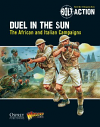
Duel In The Sun - Bolt Action Theatre Book
The heat builds up as we go from one theatre with extreme conditions to another, this time desert warfare in the African and Italian campaigns.
Packed with explosive action from the initial clashes between the British and Italian armies in Libya, and Britain’s first unexpected victories, through the ill-fated British expedition to protect Greece from Hitler’s invading troops, and the subsequent desperate battles of British and Commonwealth forces in Crete against determined German paratroopers.
From there we move onto the epic tank duels in the deserts of North Africa as Hitler reinforced Mussolini’s battered forces with the deadly Afrika Korps, and the ultimate showdown between two legendary desert commanders, Rommel and Montgomery, at El Alamein.
We then have the debut of the Americans into the African theatre, their bloody setback at Kasserine Pass, and eventual success in helping to clear North Africa of Axis influence. Finishing with the Allied invasions of Sicily and mainland Italy, and the stubborn German defence that resisted the invaders almost up to the end of the war in Europe.
WGB-14£15.00£25.00save 40% -
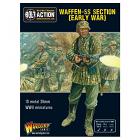
Early War Waffen SS
As Hitler's military machine unleashed their devastating assault on Poland in 1939, the SS were still in the process of transitioning from political to military organisation, becoming the Waffen-SS (armed SS) and the military wing of the Nazi party.This box set contains a 10-man (all metal) section:1 NCO with SMG2-man LMG team7 riflemenWell-supplied and well-led the fanatical Waffen-SS were an increasingly formidable fighting force. These controversial but elite troops were dogged by accusations of atrocities, particularly in Poland and on the Eastern Front during Operation Barbarossa.Dressed in their trademark camouflage smocks and helmet covers, and with squads often built around the firepower of the reliable Czech-made CZ-26 light machine gun, the Waffen-SS were at the forefront of the German Blitzkrieg offensive in the early stages of World War II.402212101£23.85£26.50save 10% -
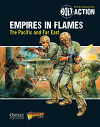
Empires in Flames Pacific and Far East - Bolt Action Theatre Book
Far from the battlefields of Europe and North Africa, Allied forces fought a very different war against another foe, from the jungles of Burma to the islands of the Pacific and the shores of Australia.
This new Theatre Book for Bolt Action allows players to command the spearhead of the lightning Japanese conquests in the East or to fight tooth and nail as Chindits, US Marines and other Allied troops to halt the advance and drive them back. Scenarios, special rules and new units give players everything they need to recreate the ferocious battles and campaigns of the Far East, from Guadalcanal to Okinawa, Singapore, the Philippines, Iwo Jima and beyond.
WGB-13£15.00£25.00save 40% -
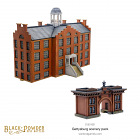
Epic Battles: ACW Gettysburg Scenery Pack
‘Four score and seven years ago our fathers brought forth on this continent, a new nation, conceived in Liberty, and dedicated to the proposition that all men are created equal.Now we are engaged in a great civil war, testing whether that nation, or any nation so conceived and so dedicated, can long endure. We are met on a great battle-field of that war. We have come to dedicate a portion of that field, as a final resting place for those who here gave their lives that that nation might live. It is altogether fitting and proper that we should do this.’Excerpt from the Gettysburg Address – Abraham Lincoln, November 19, 1863Between July 1st and 3rd 1863, the Battle of Gettysburg was one of the largest battles of the American Civil War fought in the state of Pennsylvania. The Confederate Army under Robert E Lee was defeated by the Army of the Potomac, commanded by George G. Meade. Though Lee’s forces escaped across the river, they left in their wake the bodies of the fallen. These bodies were gradually reinterred into what is now the Gettysburg National Cemetery, the site where Lincoln delivered the famous Gettysburg Address of 1863.This scenery pack is designed to allow you to lend your replications of the battle using the Epic Battles system extra authenticity. It includes the Schmucker House, originally constructed as the Theological Seminary building. This site was used by both the Union and Confederate forces as a hospital during the battle.The Cemetery Gatehouse, meanwhile was used as a HQ for XI Corps (Union Army). Major-General Howard had recognized the advantage offered by the high ground of the cemetery and lined his artillery along what came to be known as ‘Cemetery Hill’.This box contains:MDF Seminary BuildingMDF Battlefield GatehouseModels supplied unassembled and unpainted318814001£36.00£40.00save 10% -
Epic Battles: American Civil War Casualty Markers
During the cause of the game a Black Powder General will have a need to track their army's casualties. These casualty markers feature prominent markers enabling just that – track wounds effectively and with a visual flourish. These are generic, and are thus suitable to be painted up as either Union or Confederate troops.Although designed with the Black Powder Epic Battles: ACW scale in mind, the practice lends itself to equally well to miniatures games of any scale set in the American Civil War period.Each pack contains 6 cavalry casualty bases and 12 Infantry casualty bases, in Warlord ResinTM.312414008£17.55£19.50save 10% -
Epic Battles: Waterloo British Light Cavalry Brigade
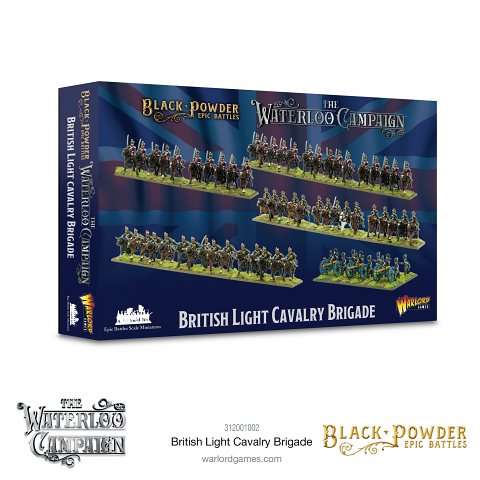
British light cavalry had a reputation of 'galloping at anything' and whilst not entirely fair, they certainly were not shy in taking on enemy light cavalry and indeed even the huge armoured heavy French cavalry, as the men were confident in themselves and their horses being as large as the heavy French steeds. The light cavalry were gloriously attired. This boxed set enables you to build brigades of light cavalry with the two types of hussars and the more sombre light dragoons who thought themselves the equal of the foppish hussars. They are accompanied by the ever-reliable Royal Horse Artillery 9-pounder guns. Tally ho!This plastic set provides enough models to field a complete brigade of three British light cavalry regiments (3 bases of Hussars in shako, 3 bases of Hussars in busby and 5 bases of Light Dragoons) and a 3-gun battery of Royal Horse Artillery 9-pdrs.Models supplied unassembled and unpainted312001002£27.45£30.50save 10% -
Epic Battles: Waterloo French Light Cavalry Brigade
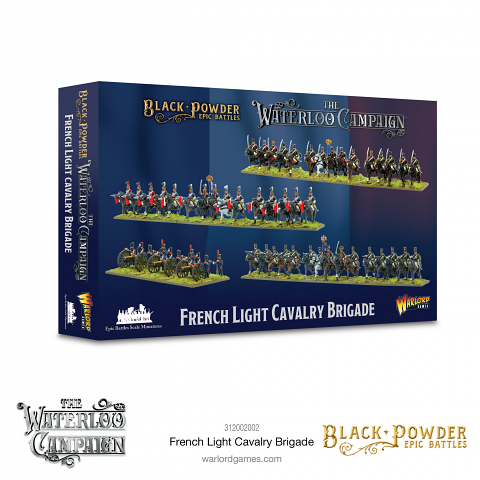
There are few more impressive sights to see than massed French light cavalry in full array. Green-clad Chasseurs and the colourfully dressed Hussars did most of the outpost and scouting duties before battle commenced. Perhaps the most impressive of the light cavalry units are the splendidly dressed and equipped lancers of the line wielding wicked 9 foot long ash lances that used to deadly effect. Accompanying them is a battery of 6-pounder horse artillery served by skilled veteran gunners who can advance with their cavalry brigade.This plastic set provides enough models to field a complete brigade of three French light cavalry regiments (21 Lancers, 18 Hussars and 21 Chasseurs a Cheval) and a 3-gun horse artillery 6-pdr battery.Models supplied unassembled and unpainted312002002£27.45£30.50save 10% -
Epic Battles: Waterloo Hougoumont Scenery Pack
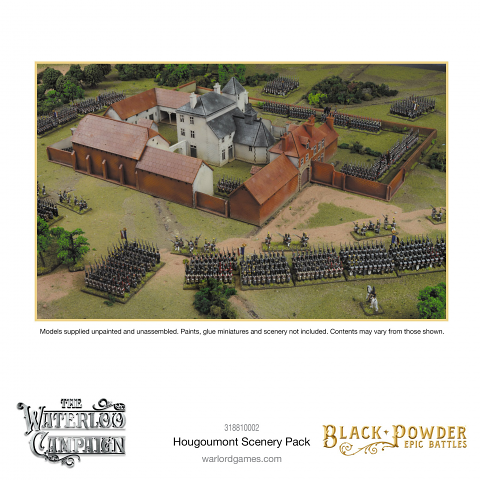
This scenery pack contains the strategically vital farmhouse at Hougoumont. The importance of the walled chateau at Hougoumont was underlined by the elite troops the Duke of Wellington placed in its defence. These troops were garrisoned just before their French enemy also sought to occupy the buildings, such was its significance and the bloody struggle for its control raged for hours.Models supplied unassembled and unpainted318810002£82.80£92.00save 10% -
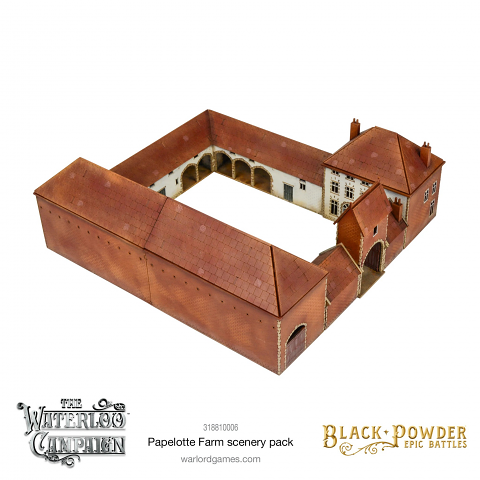
Epic Battles: Waterloo Papelotte Farm Scenery Pack
Can you succeed where Napoleon Bonaparte's French Army failed? Can you capture the farm at Papelotte from the Allied garrison before the Prussians enter the field during the battle of Waterloo, or will your valiant Nassau defenders see off the savage assaults of Les Bleus?Included in this pack is a laser-cut Black Powder Epic Battles scale model of the Papelotte farm complex. Use it to add more authenticity to your games set during the Napoleonic Wars.Models supplied unassembled and unpainted318810006£36.00£40.00save 10% -
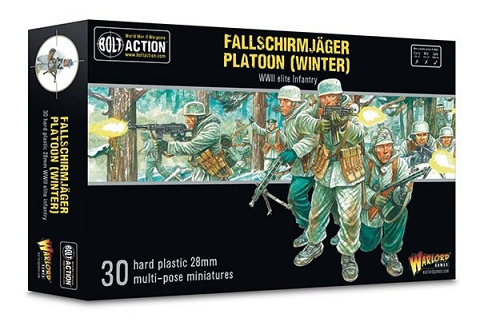
Fallschirmjäger (Winter) Platoon
The elite paratroopers of the German Luftwaffe, the Fallschirmjäger would find themselves fighting exclusively as ground troops as the Second World War progressed, where their intense training and esprit de corps stood them in good stead and earned them a fearsome reputation as determined and deadly combatants. As a part of the German air force rather than the army, their equipment was unique and highly specialised - from their uniforms to the iconic FG 42 assault rifles - making them an instantly recognisable force on the battlefield.This box gives you everything you'll need to build thirty plastic German Fallschirmjäger in their distinctive quilted winter uniforms, perfect for the unforgiving snowy woodland terrain of the Battle of the Bulge. Each sprue contains:Six dynamically posed bodies in the iconic winter uniforms of Germany’s elite paratroopers.Twelve unique head options, including covered and uncovered helmets, peaked caps, and furry winter hats!A wide range of weaponry, including the unique FG 42 paratrooper assault rifle (including one with marksman’s scope), legendary MG 42 machine gun, Kar 98K rifle, MP 40 submachine gun, Panzerfaust anti-tank launchers, and more.Tons of extra details - arms carrying ammunition and equipment, webbing and belt kit, pistols, flare guns, grenades and entrenching tools used as close-combat weapons!With their distinctive camouflaged jump smocks and quilted winter oversuits, Fallschirmjäger armies look unique and absolutely fantastic on the table, and offer a brilliant opportunity to show off your painting skills. Whether in defence of the Fatherland or on the attack in the Ardennes, you’ll have a force of die-hard paratroopers that looks great and can do some serious damage on the tabletop!Models supplied unassembled and unpainted402012102£35.15£37.00save 5% -
Finnish Officer and Sniper Team
The vast Soviet military machine that invaded Finland during the Winter War of 1939-1940 was stunned by the lightly armed but intensely motivated and skilled Finnish troops. The Soviets were outfought despite hugely superior weight of numbers. Although eventually seeking terms the Finns had delivered a harsh lesson to their rapacioius neighbours.When the Soviet Union - having by then joined the Allies - again attacked in 1941, the Finns were left with little option but to side with Germany in a conflict known as the Continuation War, making good use of German weaponry.The Finns were masters of fieldcraft, sniping, and small unit tactics that hit hard then disappeared into the dense forests. Their weapons were light but used with great dexterity, and many made use of captured Russian kit as there was always plenty left behind after the Finns had struck!These miniatures are mostly dressed in standard issue M36 tunic and armed with a variety of Finnish weaponry and so are most suitable for use in Continuation War (1941-1944) against the might of the Soviet Union. Dig in and stop the arrogant Russians marching into brave Finland!WGB-FN-39£6.75 -
Finnish Rifle Squad
The vast Soviet military machine that invaded Finland during the Winter War of 1939-1940 was stunned by the lightly armed but intensely motivated and skilled Finnish troops. The Soviets were outfought despite hugely superior weight of numbers. Although eventually seeking terms the Finns had delivered a harsh lesson to their rapacioius neighbours.When the Soviet Union - having by then joined the Allies - again attacked in 1941, the Finns were left with little option but to side with Germany in a conflict known as the Continuation War, making good use of German weaponry.The Finns were masters of fieldcraft, sniping, and small unit tactics that hit hard then disappeared into the dense forests. Their weapons were light but used with great dexterity, and many made use of captured Russian kit as there was always plenty left behind after the Finns had struck!These miniatures are mostly dressed in standard issue M36 tunic and armed with a variety of Finnish weaponry and so are most suitable for use in Continuation War (1941-1944) against the might of the Soviet Union. Dig in and stop the arrogant Russians marching into brave Finland!Contains a 9-man Rifle Squad:NCO and 1 soldier with SMGs1 soldier with Lahti-Saloranta M/26 light machine gun6 Riflemen (1 with Molotov Cocktail)WGB-FN-02£21.20£26.50save 20% -
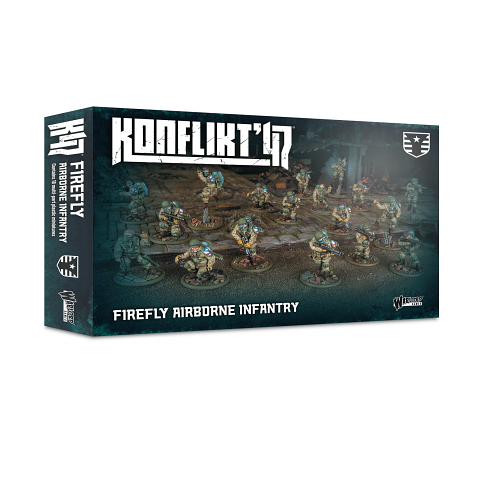
Firefly Airborne Infantry
Drop into hell on Earth - and come out the other side!
American advancements in repulsorlift Rift-tech have allowed a man to soar through the air in great bounds, or drop from an aircraft and control his descent safely. Using this technology, US Airborne paratroopers have been reborn as the Fireflies! These elite troops are used where surgical precision and lightning speed are called for, dropping behind enemy lines or as the vanguard of American assaults. Only the bravest and fittest men pass Firefly training, and their missions are some of the most hazardous imaginable.
This plastic boxed set gives you 18 multi-part US Fireflies, equipped with a range of weapons including M1X Thompson Rift SMGs, lethal flamethrowers, and anti-tank rocket launchers. Packed with extra components, including alternate heads, extra equipment, and a choice of flying or ‘grounded’ legs, this kit offers incredible poseability and almost endless modelling options. The detail on these models is staggering, allowing you to go all-out with your painting and create a unit that looks truly impressive on the tabletop.
On the Konflikt '47 tabletop, Fireflies are some of the best Specialist Infantry available to an American player. With superb tactical mobility, courtesy of their Regroup in Hell! Rift ability, and armed with their signature M1X Thompsons, they can get in, hit hard, and get out again. Just make sure to keep these unarmoured troops away from anti-infantry weapons!
Models supplied unassembled and unpainted.452010404£33.30£37.00save 10% -
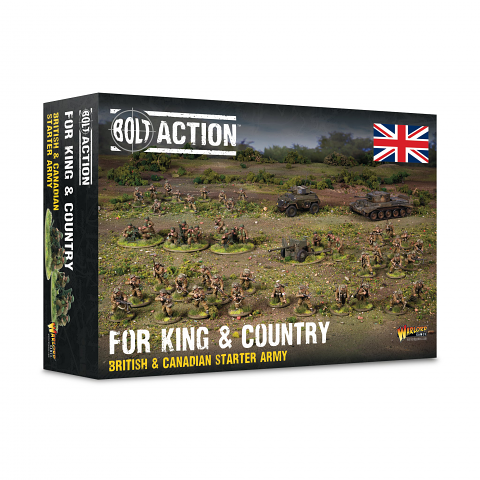
For King & Country - British & Canadian starter army
By the latter half of the Second World War the British Army had brought its combined arms approach to warfare to a perfect pitch. Meticulous planning and overwhelming firepower made it an efficient fighting force, and one that could achieve its objectives while minimising casualties. From the discipline of the Guards, the ferocity of the Black watch to the elan of the Yeomanry, regiments from all corners of the country fought with distinction. The Canadians used British equipment but had their own character and their own famous regiments, including the Royal Winnipeg Rifles, the Calgary Highlanders and the Sherbrooke Fusiliers.This Starter Army allows you to field a fully legal British or Canadian force for Bolt Action: Third Edition - entirely in plastic! With 36 infantry armed with rifles, light machine guns, light mortars and PIATs, forming a Rifle Platoon, backed up by the mortar teams and machine guns of the Heavy Weapons Platoon, you’ve got a flexible core of troops ready for any tactical challenge. Supporting them is an Armoured Platoon composed of a Cromwell medium tank and a Humber armoured car for scouting the battlefield, with a 6-pounder medium anti-tank gun in an Artillery Platoon providing still more firepower. The artillery and heavy weapon crew, 16 in all, are fully interchangeable with the infantry.Able to be built and customised to an incredible degree, or built and played straight out of the box, For King & Country is the perfect way to start a new Bolt Action force.Includes British and Canadian decals.Miniature sculpted by Wojtek Flis. Studio miniatures painted by Darek Wyrozebski and Andres Amian.Models supplied unassembled and unpainted402011030£104.00 -
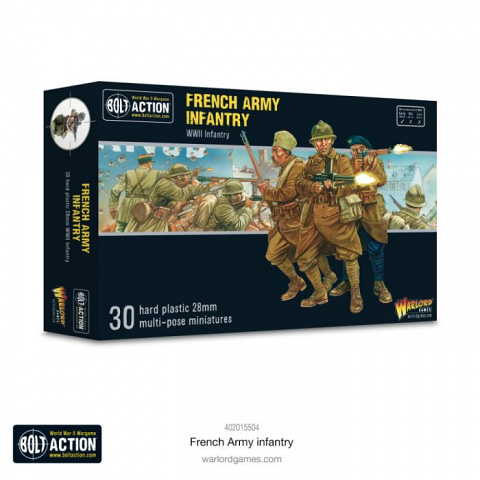
French Army Infantry
The French army started World War II as the most powerful army in the world. Well-equipped, with excellent tanks and artillery, the infantry divisions were numerous and confident of fighting off the hated Boche as they had twenty-two years before. This was not the same war though, and the French infantrymen found themselves all too often fighting off German armoured units which had outmanoeuvred them as the Blitzkrieg rolled across Europe.It was for the honour of France and their regiments that so many Frenchmen dug in and fought it out against a more tactically advanced foe. Resolutely fighting against the sweeping offensives of the German invaders, the French gave their all at battles such as Hannut, Arra, Boulogne and Saumur.Many brave Frenchmen went on to fight against the Allies with Vichy France, ensuring admiration and loathing in equal measure, whilst others would return to France with the Allied invasion in 1944 to reclaim their homeland...This incredibly versatile plastic boxed set allows you to assemble the miniatures as regular French Army infantry, fortress troops, chasseurs à pied, engineers or colonial troops (Algerian, Moroccan or Tunisian).Box contains 30 multi-pose plastic infantry with plastic bases and full colour waterslide decal sheet.Models supplied unassembled and unpainted402015504£33.30£37.00save 10% -
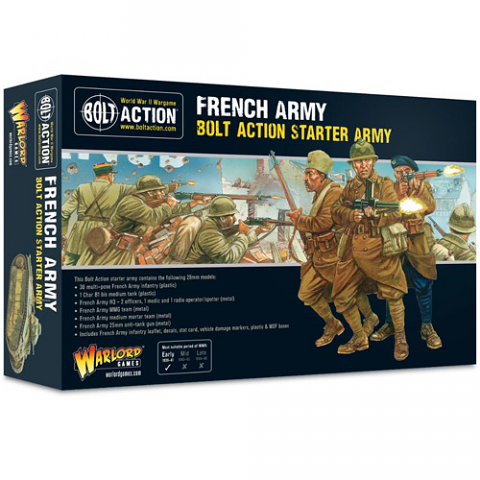
French Army Starter Army
This Bolt Action starter army provides a solid core to your new French Army force. The highly detailed multi-pose plastic infantry can be assembled and painted as regular infantry, fortress troops, chasseurs a pied, engineers or colonial troops (Algerian, Moroccan & Tunisian), giving you a colourful army with plenty of variety and flexibility with which to face the German Blitzkrieg.A medium mortar, medium machine gun and 25mm anti-tank gun provide additional firepower to these brave sons of France, whilst armoured support is found in the Char B1 bis medium tank. The comprehensive Bolt Action range has additional troops and vehicles to add to your army when you are ready to expand your French force.This Bolt Action Starter Army contains:36 multi-pose plastic infantryPlastic Char B1 bis medium tankMetal HQMetal medium mortar teamMetal MMG teamMetal 25mm anti-tank gunPlastic basesBolt Action stat cardVehicle damage markersFull colour waterslide decal sheetModels supplied unassembled and unpainted402015503£88.20£104.00save 15% -
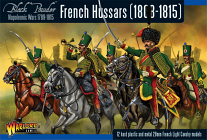
French Hussars 1808-1815
Napoleonic warfare saw bewildering varieties of exotic uniforms worn by the various armies that marched and fought in the early 19th century. There were none so exotic and magnificent as the Hussar regiments of the French army. These dashing light cavalry donned outfits originally inspired by Turkish, and later Hungarian, cavalry. Each of the fourteen regiments formed wore a differing uniform, with the result that a Hussar brigade made a most impressive sight.Mounted on small but tough horses, they were used on campaign in scouting and raiding roles. Their élan and dash made up for their smaller mounts and lack of armour on the field of battle.Principally armed with the curved light cavalry sabre they could also carry a carbine, or more commonly a pistol, into the fray.A regiment was formed into four squadrons, each of two companies, and the first company in a regiment was usually the elite company, distinguished by their bearskin fur colpacks.Vive L’Empereur!Box set Contains:12 plastic easy-build French Hussars.1 additional metal officer and metal horse.1 additional metal bugler.Optional metal arm for eagle bearer.302012002£20.25£27.50save 26% -
French Infantry Section
Declaring war on Germany in 1939, the French armed forces were superior to the Germans in tanks and ships but suffered from outdated tactical and strategic doctrine at the highest level. Fighting alongside their British allies, the French army performed a brave rearguard action culminating in the remarkable withdrawal from Europe at Dunkirk. With the British heading back to England, the French forces battled on stubbornly as the Germans closed on Paris…Although much has been written of the German armoured forces and the defeat of the British at Dunkirk in the dark days of 1940, far too little has been written about the gallant stands made by the French army.The French army started World War II as the most powerful army in the world. Well-equipped, with excellent tanks and artillery, the infantry divisions were numerous and confident of fighting off the hated Boche as they had twenty two years before. This was not the same war though, and the French infantrymen found themselves all too often fighting off German armoured units which had outmanoeuvred them as the Blitzkrieg rolled across Europe.It was for the honour of France and their regiments that so many Frenchmen dug in and fought it out against a more technologically and tactically advanced foe. By the time of the cease fire they had killed 27,000 Germans but had suffered appalling losses of nearly 100,000 dead and 250,000 wounded. Many brave Frenchmen went on to fight against the Allies with Vichy France, ensuring admiration and loathing in equal measure, whilst others would return to France with the Allied invasion in 1944 to reclaim their homeland…Contains a 10-man French Army Infantry Section:1 NCO with rifle1 soldier with VB launcher2-man light machine gun team (loader has pistol)6 riflemen402215501£23.85£26.50save 10% -
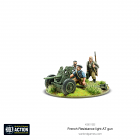
French Resistance light anti-tank gun
Captured anti-tank guns were put to use again their former owners – these would very likely include German 37mm guns.
403011302£15.20£19.00save 20% -
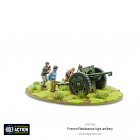
French Resistance Light Artillery
The most useful kinds of light artillery were often mountain guns, as these were more easily moved about and could be disassembled and carried by mules if necessary. All kinds of artillery would be used. The old World War I French 75mm field gun was one of the most common artillery pieces used by many nations at the start of the war, and no doubt a number fell into the hands of partisan forces.403011303£19.20£24.00save 20% -
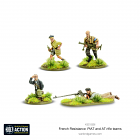
French Resistance PIAT & Anti-tank rifle teams
Partisans had little in the way of anti-tank weaponry. Fortunately, most of the heavier armour of the occupying forces was at the front line, and thus it was mostly outdated and lightly armed vehicles were used for security duty in occupied territory. Some partisan groups were able to get hold of anti-tank rifles such as the British Boys or local ex-army weapons PIAT anti-tank launchers were amongst some of the heavier gear that could be airdropped or smuggled through enemy lines to partisan forces.
402215506£6.75£8.50save 21% -
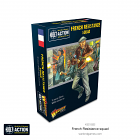
French Resistance Squad
The exceptional men and women of the French Resistance were fiercely patriotic citizens who risked everything to fight back against the occupying German Forces. From sowing disinformation or assassinating German personnel and collaborators, to direct attacks on German infrastructure, they prevented thousands of German troops from fighting the Allies on the frontlines.Armed with captured German weaponry, Allied supplied guns and their own local shotguns and hunting rifles, the Maquis made good use of their intimate knowledge of their homeland to keep the German forces on guard, unsure where or when the next guerilla attack would come.The figures in this set represent the partisans of the French Forces of the Interior (FFI), but are equally suitable for most resistance forces, be they in Poland, the Soviet Union or many of the other countries living under the heel of Germany's jackboot.Contains 10 metal French Resistance models, plastic weapons sprue and plastic bases402215502£21.20£26.50save 20% -
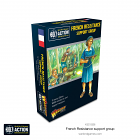
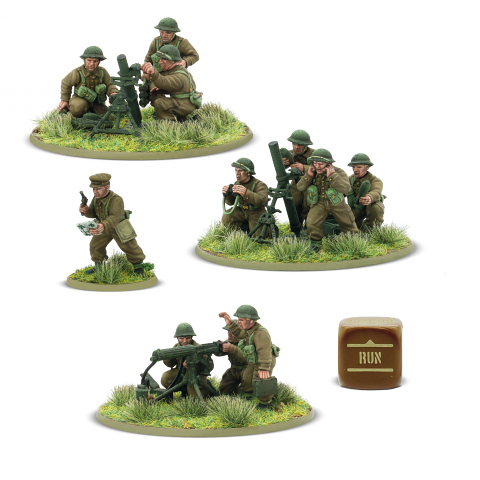
French Resistance Support Group
Germany's occupation of France was resisted by the Maquis - the famous French Resistance. Led by ex-officers or charismatic local leaders, these brave men and women fought desperate guerilla actions which were pivotal in disrupting German forces during the Battle for Normandy. The members of the French Resistance risked everything for a chance to fight back against their Nazi oppressors.Allied airdrops supplied the French Resistance with invaluable heavier weaponry such as the Vickers medium machine gun and 3" mortar included in this set.The miniatures in this set represent the partisans of the French Forces of the Interior (FFI) but are equally suitable for most resistance forces, be they in Poland, the Soviet Union or many of the other countries living under the heel of Germany's jackboot.Contains:HQ Team1 medium mortar team1 MMG teamPlastic German weapons spruePlastic bases402215508£26.55£29.50save 10% -
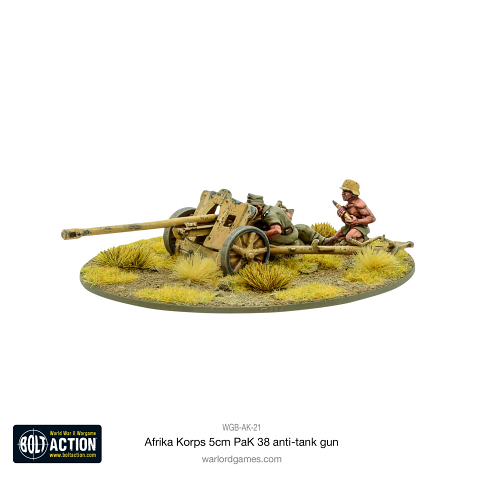
German Afrika Korps 5cm PAK 38 Anti-Tank Gun
This Warlord Games pack contains 1 metal gun and 3 metal crew miniatures
WGB-AK-21£17.10£19.00save 10% -
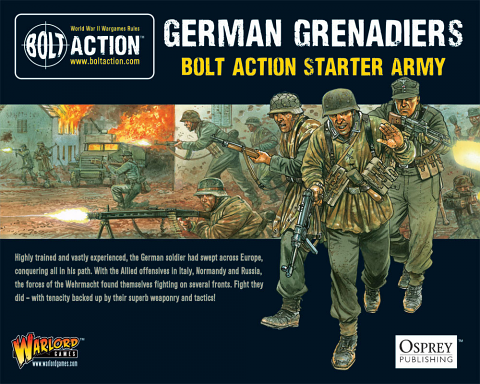
German Grenadiers Starter Army
This boxed set contains;6 plastic German Grenadier SpruesGerman Heer 81mm Mortar TeamGerman Heer MG42 TeamGerman Heer Pak 40 Anti-tank Gun with CrewPlastic Puma kitPlastic Stug III G/StuH42 kitBolt Action stat cardsVehicle damage markersPlease note that the 6 sprues of German Grenadiers contain enough components to make 36 models - so you will have 3 extra men - perhaps to create a FOO, Medic, or other additional units to further bolster your force.Suggested Army List;1 Lieutenant and 2 Riflemen* (70pts).10 man squad of regular German Grenadiers* (2x SMG, 1x LMG, 4x panzerfaust). 146pts.10 man squad of Veteran German Grenadiers* (10x Assault rifles, 4x panzerfaust). 200pts.10 man squad of Veteran German Grenadiers* (2x LMG, 3x SMG, 2x panzerfaust). 189pts.Stug III Ausf G with Schürzen (veteran). 276pts.Plastic Puma armoured car (regular). 160 pts.Pak 40 anti-tank gun (regular). 110pts.81mm Mortar team (regular). 50pts.MG42 MMG team (regular). 50pts.Units marked with an asterix (*) are to be made from the included German Grenadier sprues.402610002£88.20£104.00save 15% -
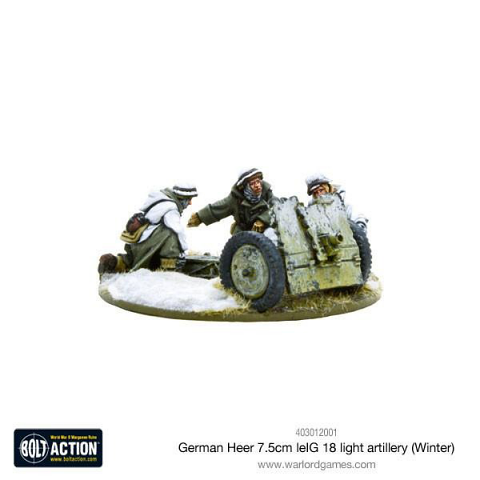
German Heer 7.5cm leIG 18 light artillery (Winter)
The Germans employed a tremendous variety of light infantry guns, field guns and howitzers, which generally had a caliber of 75mm. These guns were used for close support and were light enough to be manhandled by their crews.
403012001£17.10£19.00save 10% -
German Heer Winter Starter Army
Adolf Hitler's aggressive campaign across the world ensured his troops would face the enemy in all environments and climates. None were more unforgiving than the harsh winters on the Eastern Front or in the Italian hills and mountains. The resourceful German Lander often had to make do with little more than their standard-issue woollen greatcoat gloves, scarves and a steely determination to not stave off only the cold, but also be able to fight and win.This boxed set is a great starting point for a Winter German Heer force, whether you intend to campaign in the Battle of the Bulge, the cold Italian winters, or the bitter struggle on the Ostfront. With a strong base of infantry at its core, supported by powerful German armour and weapons teams, you’ll have a visually striking force ready to tackle US, British or Soviet opponents.Box contains:48 plastic Infantry in greatcoats1 metal German HQ1 metal MMG Team1 metal Medium Mortar Team1 plastic Opel Blitz/Maultier1 plastic Panzer IVModels supplied unassembled and unpainted402612003£88.20£104.00save 15% -
German Luftwaffe Field Division Squad
After the the initial spectacular success of the German invasion of Russia in 1941 the invasion slowed to a crawl as the weather and hard fighting ground down their formations. Desperate to shore up the front seven regiments were formed of non-flying personnel taken from the German air force, the Luftwaffe. These regiments were equipped with standard infantry weapons, and sent to quieter areas of the front to gain experience.
As the war continued more and more Luftwaffe personnel were drafted into what became Luftwaffe Field Divisions, 21 divisions being formed with 12,500 men in each at full strength. They wore the trademark Luftwaffe blue/grey uniforms and many also donned the long camouflaged M1942 jacket or zeltbahn tent capes.
Despite their poor levels of training, they fought bravely in Normandy, in Italy and on the Russian front. The average age of the soldier in these units was 30 years old - much older than other front line troops. These difficulties led them to take more casualties than the regular army units but despite these shortcomings Luftwaffe Field Division troops earned 18 of the coveted Knights Cross medals in the three years that they saw service.
This Warlord Games Bolt Action Game box contains a 10-man Luftwaffe Field Division Squad:
- 1 NCO and two soldiers with SMGs
- 1 MG13 LMG team
- 2 Riflemen with Panzerfausts
- 3 riflemen
WGB-WM-08£23.85£26.50save 10% -
Gigant Sea Lion Part 2
Operation Sea Lion has proceeded, both sides have lost a lot and as a result the remainder of the German forces have been pushed to Kent where they prepare their defences against the inevitable British attack. The German high command refuse to let their blitzkrieg falter at this stage and concoct a brave, audacious and completely unexpected plan... Operation Gigant is phase two of the theoretical plan to invade Britain that has been brought forward and into action as phase one falters!
Glider borne troops and vehicles are bought in to create a surprise second front in North East England, splitting the British defences still further and driving a steel wedge down through the heart of the British countryside!
Packed with new units to defend (or destroy) Britain's defences, new scenarios on what could of been historical battles, re-construct your whole army with new theatre selectors and more off-the-wall special rules dedicated to the scientific wonders created to invade, and defend, Britain!
This time however, the Panzerbrigades will leave their treads within the mud of the British countryside and over the rubble of humble villages. With the Germans coming into Britain once again but with their complete force, can the British and the remaining Allies hold the Germans off again? Or will the German war machine repeat their success in France and steamroll over Britain?
401010007£10.00£15.00save 33% -
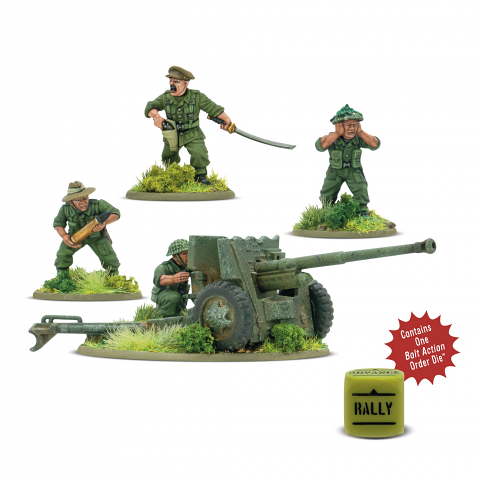
Gurkha 6-pounder anti-tank gun
Knock out that tank!The QF 6-pounder was the standard British and Commonwealth anti-tank gun during the latter half of the War, and against the lighter Japanese tanks found in the Far East it remained a lethal weapon until the very end of the conflict. Indian Army units, including the fearsome Gurkhas, made good use of the 6-pounder to halt Japanese armoured assaults and shore up defensive positions.In games of Bolt Action the 6-pounder can be included in Artillery Platoons and is a Medium Anti-tank gun, that can be towed by most vehicles.This kit pairs the plastic British 6-pounder sprue with four characterful Warlord Resin crew, giving Indian Army forces some extra anti-armour punch.Miniatures sculpted by Jon Heeney and Dimitris Kampourides. Studio miniatures painted by Andres Amian.Models supplied unassembled and unpainted402611006£22.00 -
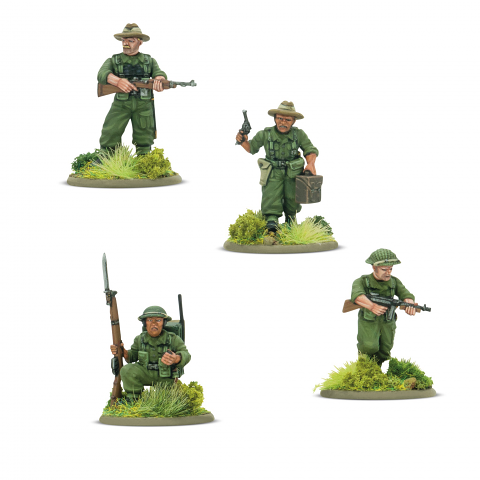
Gurkha Heavy Weapons platoon
Give your Gurkhas the order to attack!While Gurkha units are most famed for their lethal abilities at close quarters, they were also solid professional soldiers, capable of complex operations and accomplishing a wide variety of missions. Naturally, commanders and specialists were needed to plan and enact all of this!This set gives you four Warlord Resin miniatures allowing you to field a pair of officers (perfect for representing Platoon or Company Commanders), as well as a radio operator and medic. These can be used as Forward Observers, Medics, officers, or really anything else you might need extra Gurkhas for!Miniatures sculpted by Dimitris Kampourides. Studio miniatures painted by Andres Amian.Models supplied unassembled and unpainted402611005£25.00 -
Gurkha HQ
Give your Gurkhas the order to attack!While Gurkha units are most famed for their lethal abilities at close quarters, they were also solid professional soldiers, capable of complex operations and accomplishing a wide variety of missions. Naturally, commanders and specialists were needed to plan and enact all of this!This set gives you four Warlord Resin miniatures allowing you to field a pair of officers (perfect for representing Platoon or Company Commanders), as well as a radio operator and medic. These can be used as Forward Observers, Medics, officers, or really anything else you might need extra Gurkhas for!Miniatures sculpted by Dimitris Kampourides. Studio miniatures painted by Andres Amian.Models supplied unassembled and unpainted403201201£12.00 -
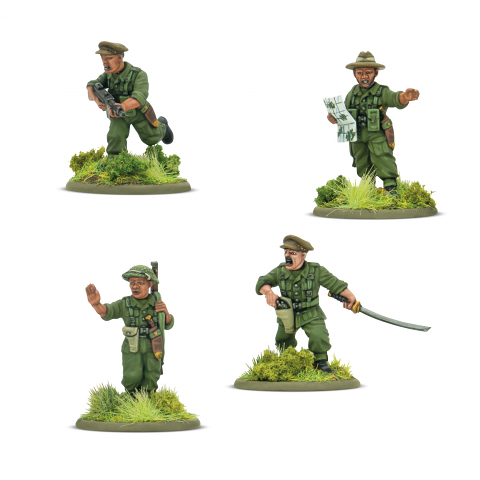
Gurkha platoon commanders
Lead your Gurkhas into the fray!With Gurkha units so renowned for their prowess in close assaults, the men commanding them had to be both brave and fit enough to keep up with their troops!This set gives you four Warlord Resin miniatures, representing Gurkha Platoon Commanders for Rifle, Artillery, Heavy Weapons, and Recce Platoons. Equipped for combat (particularly in the case of the chap who's liberated a Japanese Shin Gunto!), they're ready to command your forces on the tabletop.Miniatures sculpted by Dimitris Kampourides. Studio miniatures painted by Andres Amian.Models supplied unassembled and unpainted403201202£12.00 -
Gurkha weapon teams
Get the support weapons forward!In the claustrophobic jungle conditions encountered in the Far East, lighter support weapons became hugely useful for patrolling and small-scale engagements. Gurkha forces made good use of all available equipment to magnify their firepower, and the relative portability of light support weapons made them omnipresent throughout the war.This box gives you a trio of incredibly useful support weapon teams, perfect for filling out a Gurkha Rifle Platoon. The Boys anti-tank rifle lets your troops engage light armour from a distance, while the 2" light mortar team rains high explosives from on high, and the sniper team stalks through the jungle, hunting high value targets.Miniatures sculpted by Dimitris Kampourides. Studio miniatures painted by Andres Amian.Models supplied unassembled and unpainted403201203£16.00 -
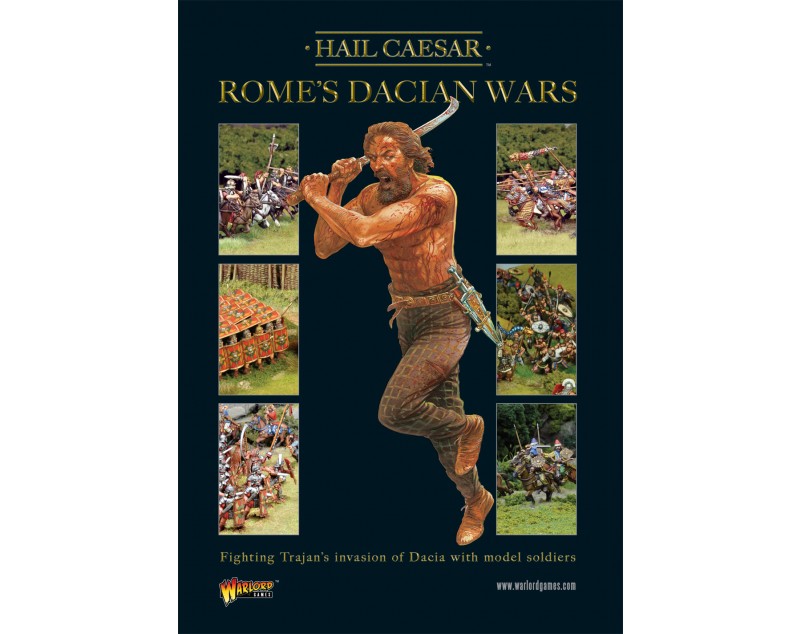
Hail Caesar - Rome's Dacian Wars Rule Book
This supplement for Warlord Games Hail Caesar focuses on Rome’s wars under Trajan against the Dacians and their Sarmatian allies.At the end of the first century AD, the Roman Empire was the greatest military power the world had ever seen. All of Western Europe south of the Rhine and the Danube, southern Britain, North Africa, Egypt, the Balkans and most of the Levant was under its control. The mighty Roman army and its legions had rarely known defeat in living memory – and never for very long.One upstart state and its wily, aggressive leader refused to bend the knee. For almost twenty years, and against all odds, King Decebalus of Dacia defied Rome from his fortress capital deep within the Carpathian Mountains. Composed of thousands of savage tribesmen, heavily armoured Sarmatian lancers and even captured Roman weapons, Dacia’s armies proved to be powerful enough to keep the legions at bay. All this was to change with the ascension of the soldier-emperor Trajan, leading to one of antiquity’s greatest conflicts – the Dacian Wars.Featured battles include the Battle of Adamclisi, the Battle of Tapae and the Siege of Sarmizegetusa Regia. Also included are rules for playing skirmish games, fighting sieges and using warships, as well as campaign and hobby ideas.WGH-004£16.20£18.00save 10% -
Hail Caesar Rulebook
Hail Caesar is written by the hugely talented Rick Priestley who is something of an expert in Ancients gaming. Partly because of his studying in antiquities but some would say that it's also because he was there for the most part.
So aside from firsthand experience of classical civilisations what else do you get?A 192 page, full colour, hardback rulebook By the award winning team that produced Black Powder Covers gaming in periods from biblical times to the Crusades
WGH-001£28.00£35.00save 20% -
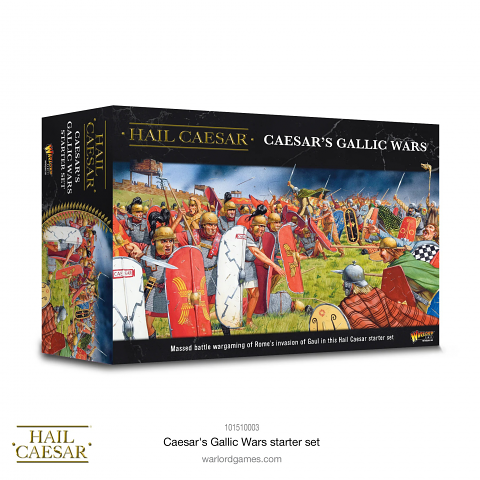
Hail Caesar Starter Set – Caesar´s Gallic Wars
Between 58 BC and 50 BC, the military might of the Roman Republic waged a brutal war on the Gallic Celt tribes living in the lands of Gaul. What the Gaul warriors lacked in the drilled discipline of their Roman foes they more than matched them with in ferocity and individual fighting prowess. The Gallic Wars, a deadly clash of cultures and military doctrine, would shape Western Europe for centuries to come. Gaius Julius Caesar's aggressive campaign would ultimately end with Gaul being subsumed into the Roman Republic, and ensure his name would become legendary.Hail Caesar is a game of tabletop massed battles set in the Ancients era. Pit your wits and tactics against your friends as your armies clash in combat on the tabletop. Can you wield the legions of Rome with the same skill and success as Caesar? Or would you prefer to lead Gallic tribes such as the Nervii, Helvetii and Venetii against the invaders as the renowned chieftain Vercingetorix did?The Caesar's Gallic Wars starter set gives you two starter forces: the barbaric Gauls and the legions of the late Roman Republic – a fantastic start to your campaign to conquer all comers and write your name in the annals of history!Starter set contains:Softback A5 Hail Caesar Gamer's Edition rulebookGallic Wars introductory guide80 hard plastic Gallic Celtic Infantry48 hard plastic Caesarian Roman InfantryCeltic and Roman waterslide shield decals12 6-sided diceReference sheet and casualty counters101510003£74.70£88.00save 15% -
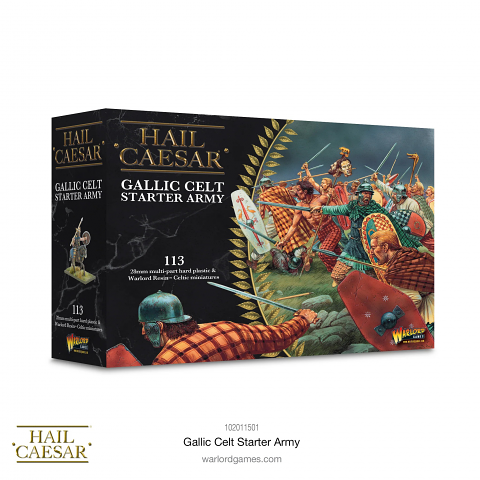
Hail Caesar: Celt Starter Army
A Celt army is one of history's great spectacles – a mass of brightly patterned clothing charging headlong at their enemy, supported by fast cavalry and missile troops armed with javelins. Renowned for their ferocity in battle, what the Celts lacked in discipline they made up for in savagery and fighting spirit – they would hurl themselves at their enemies to sweep them away or die trying!This starter set contains enough units for one complete Hail Caesar Celt army division.Contains:1x Celt Chieftain (Warlord Resin™)100x Celt Warriors with command figures (plastic)12x Celt Cavalry (Warlord Resin™)Full-colour waterslide shield decalsPlastic basesModels supplied unassembled and unpainted102011501£80.10£93.00save 14% -
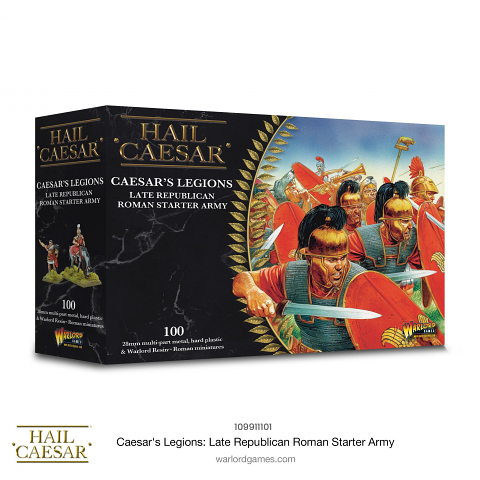
Hail Caesar: Late Republic Caesarian Roman Starter Army
Julius Caesar commanded his late republic Roman legions with skill and aggression, forging them into the best fighting force of the era. Each legionary is protected by chain armour and Scutum shield and armed with Gladius stabbing sword and Pilum javelin. Renowned for their discipline and training, the Roman legionaries are implacable in the face of the enemy – crushing all beneath their unrelenting advance!This starter set contains enough units for one complete Hail Caesar Late Republican Roman army division.Contents:2x Roman officers (metal)96x Roman legionaries with command figures (plastic)1x Scorpion bolt thrower (Warlord Resin™)Full-colour waterslide shield decalsPlastic basesModels supplied unassembled and unpainted109911101£80.10£94.00save 15% -
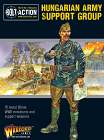
Hungarian Army Support Group
Scale: 28mm - 1/56th4 Infantry2 Artillery Pieces/War Machines6 CrewMetalRequires AssemblyThis product is supplied unassembled and unpainted. Glue and paints not included.DescriptionAvailable in this neat box set, the Hungarian Army Support Group - grab yourself the new Hungarian HQ, Medium Machine Gun and Medium Mortar!Hungarian Army HQSince 1872, the Ludovica Military Academy had been turning out competent and efficient officers and graduated the majority of officers for the Hungarian Army. A core of competent and educated officers struggled to handle the large expansion of the Hungarian Army to meet the needs of the Eastern Front. The Hungarians enjoyed a professional and experienced core of staff officers.Hungarian Army Medium Machine Gun TeamThe Schwarzlose 7/31M machine gun was used extensively in World War I and put to use right away in the new conflict.Hungarian Army Medium Mortar TeamLike virtually all nations, the Hungarians adopted a medium mortar based on the French Brandt 81.4mm. The 36/39M was common throughout the Hungarian Defence Force and employed modern shaped charges to good effect.402217407£26.55£29.50save 10% -
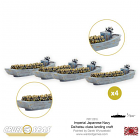
IJN Daihatsu-class Landing Craft
The Daihatsu-class landing craft was a 14-meter long troop transport constructed of metal and powered by a diesel engine. Potentially armed with weapons up to 37mm in size, it was quite seaworthy and could travel at 8 knots for 50 miles carrying 1 type 95 tank or 70 men.785112016£11.90£21.50save 45% -
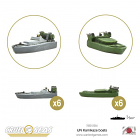
IJN Kamikaze Boats
Just as Nazi Germany had to reach for desperate solutions toward war’s end, Japan followed their air force in developing a Kamikaze or suicide weapon that might just turn the tide of the battle. These were the Shin’yo (Seaquake) speedboats. Over 6,000 were built after 1943. A one-man power boat with a speed of 30 knots and a massive 700-pound explosive charge, they were to be run at enemy vessels and if a hit scored it would be deadly. The army also built tiny speedboats, the 2-man Maruni which carried two depth charges as its main weapon.Mainly used in the Philippines, they were organized into sea raiding regiments, 1, 2, 3, 26, 27, 28 & 29, with 100 boats in each regiment. They fought bravely in numerous actions but were mostly sunk by aircraft, destroyers, and PT boats.As they were manned they could even turn around and do a second run if they missed their target and had the option of abandoning the craft if possible, rather than suffer certain self-immolation. Fortunately for the Allies, the vast majority of the boats were not in the front line but held back in Japan for the proposed final battles. They did cause some severe damage to US destroyers, particularly the large landing craft, several of which were sunk.Contains:6x metal Shin’yo6x metal MaruniShip cardsWake markers785012004£11.90£19.50save 39%

Categories
News
WarGameStore Facebook page
12-05-2011 We decided it was easier to use Facebook to post regular updates on what's happening at WarGameStore, so for the latest updates check out this link:
Control Panel
Popular Pages
Help
Contact us
Copyright © 2003-2026 WarGameStore.
- Visa
- MasterCard
- PayPal
- Verified-by-VISA
- Sage