The cookie settings on this website are adjusted to allow all cookies so that you have the very best experience. If you continue without changing your cookie settings, we'll assume that you are happy to receive all cookies on our website. However, if you would like to, you can change your settings at any time using the Change cookie settings link in the Special menu. 


Printable version

Special offers

Tanks

Tanks Tanks

Products


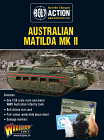
  • Australian Matilda Mk II

    Although obsolete in the European theatre, the A12 Matilda II infantry tank’s heavy armour and proven weaponry were ideal against the lightly equipped Japanese forces in the Far East.
     
    The nature of the terrain precluded the large armoured formations experienced in North Africa. Instead, the Matilda-equipped Australian 4th Armoured Brigade was broken up and deployed as individual troops of three tanks in direct support to the infantry.
     
    The Australians made several field conversions to the standard A12 Matilda II, the two main additions being armoured guards fitted to the front tracks and protection against the turret ring becoming a shot trap.
     
    The Matilda Frog was a terrifying weapon, firing gouts of pressurised flame. Needing a 20-second pause between shots while the pressure built up again, it required close infantry support to prevent the tank being overrun by the enemy.
     
    This set contains all you need to build either a Matilda II with 2-pounder, Close Support with 3” howitzer or Frog flamethrower variants.
    402415001
    £31.95
    £35.50 save 10%
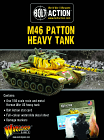
  • Bolt Action: M46 Patton Heavy Tank

    Boxed set resin and metal kit plus decals and game components
     
    This tank was one of the US Army's principal medium tanks of the early Cold War
    Named after General George Patton the M46 proved to be capable against North Korean T-34 medium tanks.
    Patton tanks formed 15% of US tank strength during the Korean conflict.
    405108004
    £31.95
    £35.50 save 10%
  • Jagdpanzer 38(t) Hetzer

    Based on the reliable Czechoslovakian Panzer 38(t) chassis, almost 3,000 of Hetzers (Baiters) were built by the war’s end. Their small size and very low profile gave them distinct advantages in the role of tank hunters.
     
    In addition, the Hetzer wasn’t hampered by the mechanical problems associated with the larger tank destroyers such as the Jagdpanther and Jagdtiger, nor did it have the unprotected fighting compartment of the Nashorn or Marder tank hunters. plus its remote control roof machine gun gave it good close defence capability.
     
    Hetzers equipped many Waffen-SS and Wehrmacht (even the Luftwaffe and Kriegsmarine) formations, seeing action on all fronts on which Germany fought as well as with the Hungarian army. The first Hetzers entered service with 731st and 743rd Heeres Panzerjäger Abteilung in May/June of 1944.
     
    This plastic boxed set allows you to build one of three vehicle types: A mid/late production Hetzer, Flammpanzer 38(t) and 2cm FlaK auf Hetzer reconnaissance/AA vehicle.
     
    Includes: one 1/56th scale hard plastic Jagdpanzer 38(t) Hetzer tank destroyer, vehicle damage markers, full-colour assembly and painting guide, Bolt Action stat cards and waterslide decal sheet (for German and Hungarian vehicles).
    402012020
    £22.50
    £25.00 save 10%
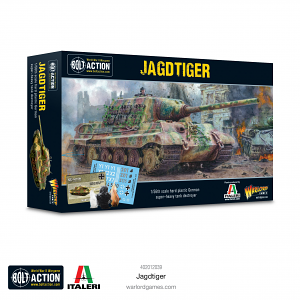
  • Jagdtiger

    The Panzerjäger Tiger Ausf. B, known as the Jagdtiger (hunting tiger) was the heaviest tank ever to see action during World War Two. Developed late in the conflict, only around 80 actually reached combat, the first in September of 1944.
     
    Germany, like many nations, made use of existing tank designs to make self-propelled guns and tank destroyers. The Jagdtiger was a colossal example of this practice – the Germans wanted to upgrade the much-feared Tiger II by mounting the 128mm Pak 44 cannon into a purpose-built armoured casement atop the lengthened King Tiger Chassis. 150 units were ordered to tackle the ever-encroaching Soviet armour – the Pak more than capable of tearing through Allied armour.
     
    At 71 tons, the behemoth had nearly 10 inches of armour to the front of its casement housing, making it one of the most well protected tanks of the war. However, all this weight and protection came at the cost of reliability. Many roads and bridges simply couldn’t take its weight. This, coupled with the increasing scarcity of spare parts and fuel, kept the Jagdtiger from fulfilling its potential.
     
    The 'teeth' of the Jagdtiger, was the 128mm PaK 44 anti-tank gun. Noted for its weapon's performance at long ranges, the Jagdtiger was rightly feared. However, the limited traverse of the gun meant the tank had to turn on the spot to bring the enemy into its sights and the two-part ammunition required extra crew to load. To represent this in Bolt Action, the 128mm Pak 44 does not suffer from -1 penetration penalty when firing at targets at over half range.
     
    Only two German schwere Panzerjäger-Abteilung (heavy anti-tank battalions) included Jagdtigers, the 512th Heavy Panzerjäger Battalion and the 653rd Heavy Panzerjäger Battalion. A company of the 512th was commanded by renowned Panzer Ace, Otto Carius, credited with the destruction of more than 150 tanks and a similar number of anti-tank guns – he would earn the Knight’s Cross of the Iron Cross with Oak Leaves. The included waterslide transfer sheet features Carius’ decals.
     
    Box contains one plastic tank, unit stat card, vehicle damage markers and waterslide decal sheet.
     
    Models supplied unassembled and unpainted
    402012039
    £27.00
    £30.00 save 10%
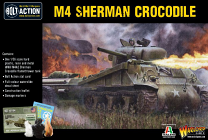
  • M4 Sherman Crocodile

    Inspired by the powerful British Churchill Crocodile and their own experiences in the Pacific with other versions of flamethrower tanks the US army ordered some 100 Sherman Crocodile variants from the British, who were recognised as leading the field in Flamethrower technology.
     
    Based on the M4A4 (Sherman V) welded hull the Crocodile retained full operation of its turret and 75mm gun and bow-mounted .30 Cal (7.62mm) machine gun. The flame gun was placed above the Bow Machinegunners hatch. All of the flamethrowing equipment was positioned externally, including the iconic wheeled trailer.
     
    The trailer weighed 6.5 tons and was protected by 12mm (0.47 in) thick armour. A special joint connector known as “The Link” (made up of 3 articulated joints allowing it to move up, down, left or right and swivel on the horizontal axis) allowed it manoeuvre through rough terrain. This link could also be released from inside the crew compartment in case of an emergency, a great design attribute as the trailer carried 400 gallons (1818 litres) of flamethrower liquid and 5 compressed bottles of Nitrogen (N?) gas!
     
    The flamer worked by using Nitrogen gas to propel the fuel along a pipe running from the rear of the tank, up and along the right flank, to a flame projector mounted on the right upper glacis. The co-driver/bow machine gunner would then operated the flamethrower or his machine gun.
     
    Of the initial order, only 3 M4A4 Crocodiles were actually made and along with a fourth, the prototype M4A2 (Sherman III), seeing action with the 739th Tank Battalion (Special Mine Exploder Unit). They were sent in February 1945 to take part in Operation: Grenade, the assault on the ancient 13th-century citadel in Julich, Germany. Helping demolish the garrison of the old citadel.
    402413008
    £35.10
    £41.50 save 15%