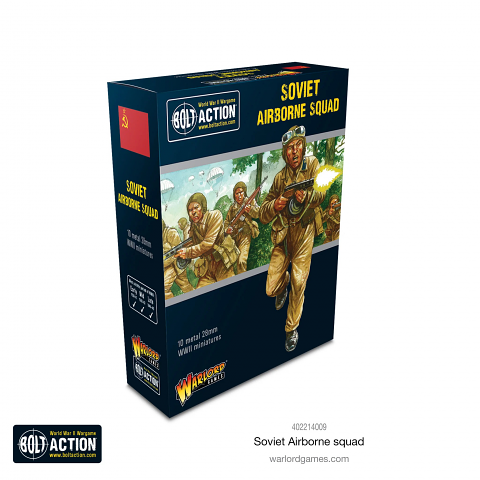
The Soviets were visionaries in the development of airborne troops and tactics, first forming a brigade-sized airborne unit after successful trials in December 1932. More units followed and by June 1941 five Airborne Corps existed in the Soviet order of battle, undoubtedly the strongest airborne force in the world. However in the desperate fighting of the early campaign these formations were pressed into service as regular infantry and virtually consumed.
Airborne troops were finally dropped in battalion strength during the defence of Moscow during December 1941 and January 1942. An entire corps (the 4th) was dropped operationally in February 1942 but while it survived for six months in the German rear, it failed to achieve its objectives. The crisis at Stalingrad then pulled in all available airborne troops to fight as regular infantry again.
Soviet airborne troops always fought with tremendous courage and elan, but lacked heavy anti-tank weapons and were badly supported in every operation they attempted.
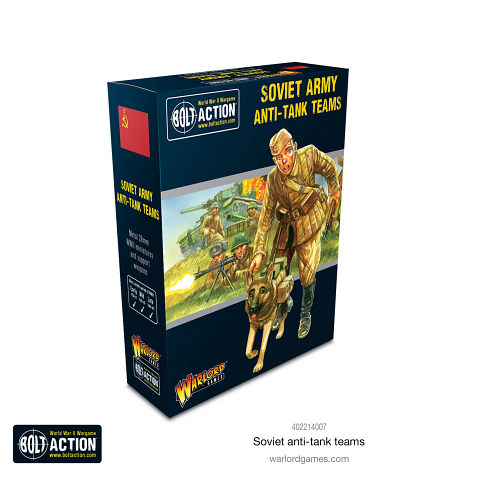
The armies of the Soviet Union had many weapons at their disposal to counteract the threat of German armoured formations - from orthodox anti-tank rifles, oddball 'Molotov Cocktail' throwers and the unconventional use of dogs as living anti-tank mines.
Whilst most nations were finding the anti-tank rifle underpowered against the latest armoured vehicles the Soviet continued to field them in large numbers even though to be truly effective they would need to be fired at a dangerously close range. The Ampulomet was a strange mortar-like device which threw a glass ball containing a mix of phosphorus and sulphur up to 400 yards albeit inaccurately.
Possibly the most unusual and controversial of anti-tank weapons are the 'dog mines'. Fitted with a simple lever which would trigger the carried charge when the dog sought refuge under enemy tanks or vehicles. Many animals simply ran from the noise and smells of battle whilst others bolted for the safety of Soviet machines or trenches. The Germans were sufficiently startled to shoot all dogs on sight - Dog Mine teams are credited with destroying a number of German tanks at the battle of Kursk.
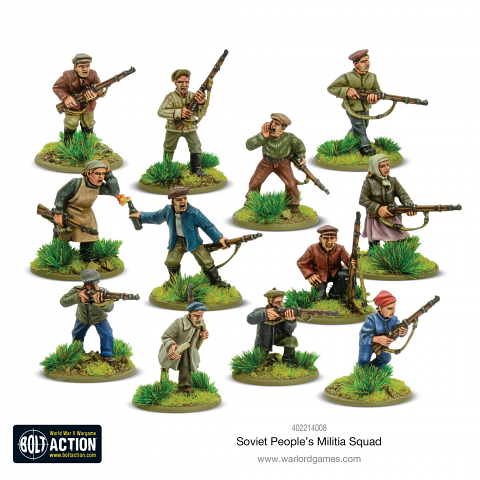
‘Popular regimentation’ or the ‘people’s militia’ (Narodnoe Opolcheniye or Opolchenie) is a Russian tradition dating back to the 16th century and a powerful part of the national heritage. In times of emergency, a militia was selected from volunteers to serve alongside the regular army and defend their homes.
In the dark days of 1941-42, workers and citizens in Leningrad, Moscow, Rostov, Stalingrad and other major Soviet cities organized into militias and quickly found themselves on the front lines as the fascist invaders swept east. People’s militia squads were even more poorly trained and equipped than the average Red Army squad, but they fought on with tragic bravery.
The figures in this set represent one of the many militias that took the war to the Fascist invaders but are also ideal to be used as Soviet Partisans.
Box contains 12 metal Soviet People’s Militia models with plastic bases.