Printable version

Special offers

Kriegsmarine

Products


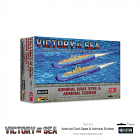
  • Victory at Sea Admiral Graf Spee & Admiral Scheer

    The Deutschland-class of warships were relatively small, by battleship standards, but were well armoured and carried the type of armament traditionally seen only on battleships. This led to them being nicknamed ‘pocket battleships’. Superb commerce raiders, the Admiral Scheer successfully plied the Atlantic and Indian Oceans, disrupting merchant shipping wherever it went, whilst the Admiral Graf Spee was famously cornered during the Battle of the River Plate and scuttled herself soon after.

    742411012
    £22.00
    £27.50 save 20%
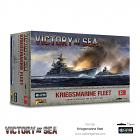
  • Victory at Sea Kriegsmarine fleet box

    The Kriegsmarine had to be virtually rebuilt after the First World War. Forbidden to own capital ships and submarines, Germany nibbled away at first one clause of the Treaty of Versailles, then another, until a powerful navy force existed.
     
    At the outbreak of World War Two, relatively few capital ships were in commission, and no aircraft carriers. There was never any prospect of matching Britain in terms of capital ship numbers, but the qualitative advantage of the proposed super-battleships might have made a considerable difference. In any case, the Kriegsmarine was not a navy designed to tackle a major fleet head-on in fleet engagements. Instead, it was a commerce raiding force.
     
    German capital ships were built according to principles tried out in World War One; internal compartmentalisation and damage control measures made them very difficult to sink, while their efficient power plants ensured a good top speed, essential in a raider. Coupled with excellent fire control – using radar and other means – and big guns to make use of it, these vessels were extremely potent weapons.
     
    It has been said that Hitler never really understood naval warfare; be that as it may, the Kriegsmarine suffered from a lack of funding and materials, and from the internal politics of the Nazi leadership. Among its greatest detractors was Herman Goering, who connived constantly to ensure resources flowed into his Luftwaffe to the detriment of the navy. Major warship projects suffered from constant stops and starts as resources were allocated, then redistributed to other projects.
     
    Eventually, as the tide of war turned against Germany, Hitler gave up on his navy and transferred guns originally intended for ships to the coastal fortifications of the Atlantic Wall. The Kriegsmarine continued to fight on with dwindling resources. U-boats and destroyers remained a menace to allied shipping to the very end of the war.
     
    Contents:
     
    Scharnhorst-class Battleship - Scharnhorst 1939
    Admiral Hipper -class cruiser - Blücher 1940
    Admiral Hipper -class cruiser - Prinz Eugen 1940
    Admiral Hipper-class cruiser - Admiral Hipper 1939
    Königsberg -class cruiser - Köln 1941
    Königsberg -class cruiser - Königsberg 1940
    Type 1936A-class Destroyer x3
    Dive Bomber Aircraft - Junker Ju-87 Stuka flight x4 flights
    Ship Cards and Damage Sliders
    Assembly Instructions
    Ships are in Resin and Warlord Resin
    742411001
    £88.00
    £110.00 save 20%
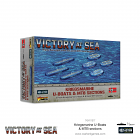
  • Victory at Sea Kriegsmarine U-Boats & MTB sections

    Submarines: A long-ranged submersible, the Type IX was the most successful U-boat of the war, with each vessel averaging over 100,000 tons of shipping sunk. One Type IX, U-107, made the most successful convoy mission of the war, with nearly 100,000 tons of shipping sunk out of Freetown in Africa. The latest variants of this design were capable of ranges of more than 23,000 miles, allowing them to rove far in search of convoys, while their heavy load of torpedoes allowed them to keep pace with a convoy, attacking night after night.
     
    MTBs: The R1-class of R-Boat (from the German Räumboot, meaning minesweeper) was intended to be used as a shallow water minesweeper but, as the war went on, it became a multi-role craft. Its duties expanded to include patrol, antisubmarine, convoy escort, minelaying, and rescue operations. Some classes of R-Boat, such as the R310, were fitted with torpedo tubes, though performance was very modest compared to craft specifically designed for the role.
     
    The ultimate S-Boat to be operational in significant numbers was the S-100-class, which was produced from 1943 and was said to be the best fast patrol boat of its time. The S-100-class was nicknamed the Calotte, as it featured a rounded armoured bridge. It was powered by three Daimler-Benz engines giving it an overall capacity of around 7,500 hp and developing an outstanding top speed of 48 knots.
     
    Box contains:
     
    Type IX U-Boats x 3
    S-100 S-Boat sections x2
    R-Boat sections x2
    Ship Cards
    742411017
    £27.60
    £34.50 save 20%