Printable version

Special offers

US Navy

Products


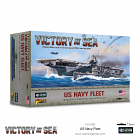
  • Victory at Sea US Navy fleet box

    Although the United States of America contains a vast area of land, almost all of its allies and trading partners are overseas, and those interests require a powerful navy to support them.
     
    The US Navy possessed some of the largest and most modern battleships in the world at the outbreak of World War Two, and despite losses during the Japanese attack on Pearl Harbor, was able to maintain a powerful presence in the Pacific. However, in the vast reaches of that ocean the battleship was no longer the king of battle. It was fortunate for the Americans that the handful of aircraft carriers then in service with the US Navy escaped destruction; given later events it is doubtful that a pure battleship force could have defeated the Imperial Japanese Navy.
     
    The aircraft carrier became the main US naval asset during the war in the Pacific, which was very much a conflict between the air assets of opposing fleets. US carrier forces were hard-pressed early on but as the industrial might of the US was brought to bear, new carriers and air groups for them were deployed in such numbers that the enemy simply could not match their strength.
     
    US naval forces were primarily engaged in the Pacific, but some capital ships and larger numbers of destroyers were deployed to the Atlantic theatre where their primary opponents were German U-boats.
     
    Contents:
     
    New Mexico-class Battleship - USS New Mexico 1941-42
    Essex class Carrier - USS Essex 1944
    Northampton-class Cruiser - USS Houston 1940
    Northampton -class Cruiser - USS Chester 1941
    Portland-class Cruiser - USS Portland 1942
    Clemson-class Destroyer x3
    Fighter Bomber Aircraft - F4-U Corsair x4 flights
    Ship Cards and Damage Sliders
    Assembly Instructions
    Ships are in Resin and Warlord Resin
    742412002
    £88.00
    £110.00 save 20%
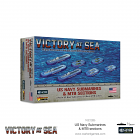
  • Victory at Sea US Navy Submarines & MTB sections

    Submarines: The Gato-class of submarine was the first mass production US submarine class of the Second World War, forming the majority of the United States Navy’s submarine fleet of the war. It was the Gato-class, and the successors of her design that were largely responsible for the disruption of the Japanese merchant fleet. Individual Gato-class vessels were given names of marine creatures, with the lead of her class named for a type of small catshark.
     
    MTBs: The Elco mounted four torpedo tubes which, combined with its speed, made it a serious threat to larger ships. The largest PT boat used by the US Navy, the Elco is also notable for future President Kennedy commanding one. Crews of these boats relied on their smaller size, speed and manoeuvrability – and darkness – to survive.
     
    Box contains:
     
    Gato-Class Submarines x 3
    Elco ‘77 PT Boat sections x 2
    Elco ‘80 PT Boat Sections x 2
    Ship Cards
    743212005
    £27.60
    £34.50 save 20%
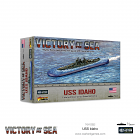
  • Victory at Sea USS Idaho

    USS Idaho, the third of three ships of the New Mexico-class of Battleship, was the fourth vessel to bear the name. She was launched in June 1917 and commissioned in March 1919. She was armed with a battery of twelve 14” guns in four turrets and was protected with heavy armour plate (13.5” thick in the main belt).
     
    During the 20s and 30s, Idaho spent the majority of her time as part of the Pacific Fleet, conducting routine training exercises. She was modernised in the early 30s. During World War II, but before the United States’ entry into hostilities, she was assigned to join the Neutrality Patrols that protected American shipping during the Battle of the Pacific. Following the attack on Pearl Harbour, she was redeployed to the Pacific Theatre, along with her sister ships.
     
    For the remainder of the war she supported amphibious operations in the Pacific, shelling Japanese forces during the Gilbert and Marshall Islands and Philippines campaigns. She also supported the invasions of Peleliu, Iwo Jima and Okinawa. Idaho was present in Tokyo Bay when Japan formally surrendered on 2 September 1945. Idaho was decommissioned the next year and dismantled in 1947.
     
    Contains one ship in Resin and Warlord Resin
    742412052
    £16.40
    £20.50 save 20%