Printable version

Special offers

Royal Navy

Products


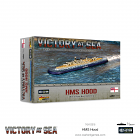
  • Victory at Sea HMS Hood

    At one time, the HMS Hood was the largest and possibly most famous ship in the world, representing the supremacy of British sea power. Though attached to Home Fleet, the Hood took part in the sinking of the French fleet at Oran. She was sunk by the Bismarck in 1941 after accurate shelling from the German ship caused a massive explosion on the Hood which sank within minutes, leaving only three survivors – certainly one of the more spectacular deaths of any capital ship.

    742412018
    £16.40
    £20.50 save 20%
  • Victory at Sea Royal Navy fleet box

    The Royal Navy of Great Britain was the world’s greatest navy at the outbreak of the Second World War. However, Britain went to war with mainly First World War-vintage vessels. Since the Royal Navy already possessed many powerful units, construction of the most modern designs was limited. This meant that at the outbreak of World War Two Britain had far more battleships than most other nations, but they had smaller guns than those built to the most modern ships.
     
    Though the main battle force was kept concentrated in home waters, task forces were assigned to many distant areas, but the Royal Navy could not be strong everywhere. Although badly stretched, the Royal Navy lived up to its traditional ‘can do!’ ethos, fighting hard in all theatres.
     
    In addition to the battleship forces, the Royal Navy maintained a handful of fast battlecruisers – some of them quite old – and aircraft carriers. These were backed up by a strong cruiser force and light forces including destroyers, motor torpedo boats (MTBs) and motor gunboats (MGBs).
     
    As the war went on, aircraft carriers became increasingly important and air defences were steadily improved on all ships. Yet the big guns of the battleships and cruisers played a vital role in many theatres of war. British capital ships saw action in the Arctic and the Atlantic against German commerce raiders, in the Mediterranean against Italian forces, and ventured into the Pacific in an ill-fated attempt to stem the Japanese advance. Though the great fleet actions planned for and desired by the architects of the Royal Navy did not materialise during World War Two, the Royal Navy adapted well to the war it was destined to fight and emerged with great honour.
     
    Contents:
     
    Eagle-class Carrier - HMS Eagle 1940
    King George V-class Battleship - HMS Duke of York 1943
    Leander-class cruiser - HMS Neptune 1941
    Edinburgh-class cruiser - HMS Belfast 1942
    Dido-class cruiser - HMS Dido 1940
    Tribal-class Destroyer x3
    Torpedo-Bomber Aircraft - Fairey Swordfish x4 flights
    Ship Cards and Damage Sliders
    Assembly Instructions
    Ships are in Resin and Warlord Resin
    742412001
    £88.00
    £110.00 save 20%
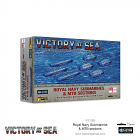
  • Victory at Sea Royal Navy Submarines & MTB sections

    Submarines: Designed for use in North European and Mediterranean waters, the S-class was manoeuvrable with a noted ability to crash dive extremely quickly. Combined with a large salvo of torpedoes, this was a successful design of pre-war years that was soon updated and put back into production.
     
    MTBs: The Fairmile A was designed from the outset to use prefabricated components that could be produced by small businesses such as furniture manufacturers, which would then be assembled at shipyards. Capable of 25 knots, it mounted a 3-pounder gun and a pair of .303 machine guns, as well as Depth Charge.
     
    Designed with the form of a destroyer’s hull, the Fairmile B (like its predecessor, the Fairmile A) was intended primarily as a submarine-chaser, and so was fitted with Depth Charge. Manufactured in large numbers, the Fairmile B was also famously used on the raid on St. Nazaire.
     
    Capable of 26 knots, the Fairmile C was a motor gun boat, mounting two 2-pounders and eight machine guns of various calibres. It was mainly used for close escort duties and some clandestine missions.
     
    Nicknamed ‘Dog Boat,’ the Fairmile D was highly adaptable and could be fitted with a range of armament that meant it could act as both motor gun and torpedo boat. Some were used by the Royal Air Force for long range rescue of downed airmen.
     
    Box contains:
     
    S-Class Submarines x 3
    Fairmile MTB sections (A,B,C & D) x 4
    Ship Cards
    743212006
    £27.60
    £34.50 save 20%