The cookie settings on this website are adjusted to allow all cookies so that you have the very best experience. If you continue without changing your cookie settings, we'll assume that you are happy to receive all cookies on our website. However, if you would like to, you can change your settings at any time using the Change cookie settings link in the Special menu. 


Printable version

Special offers

Black Powder

Black Powder Black Powder

Products


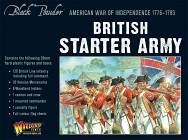
  • American War of Independence British Army Starter Set

    New York - 1776, General Washington has been preparing his defences since April.
     
    After leading British troops to victory in the Battle of Bunker Hill, General William Howe took command of all British forces in America.
     
    General Howe plans an attack with a precision hitherto unknown in British operations in north America. His reinvigorated army sets sail from Halifax, arriving at new York in late June and capturing Staten Island on 2nd July.
     
    These troops are bolstered in August, first by the return of Clinton’s flotilla from Charleston and later by the arrival from England of a 150-ship fleet carrying reinforcements including the Foot Guards and numerous regiments raised from the German Principalities, who will become ever-known as “Hessians”.
     
    With an army now substantially outnumbering the defenders, Howe orders the first units to be landed on Long Island on 22nd August. Within three days there are 20,000 British and allied troops on Long Island, divided into two wings. Half of the force will engage the rebels frontally with feint attacks, while the other half swings far around the rebel left flank. The fighting results in overwhelming defeat for the rebels, but Howe stops short of finishing off the defenders, believing them trapped.....
     
    Prepare your Army and make your plans to fight this battle with the new American War of Independence British Starter Army:
     
    Contains the following 28mm hard plastic figures and bases:
     
    120 British line Infantry including full command
    30 Hessian Mercenaries
    8 Woodland Indians
    1 Cannon and Crew
    1 Mounted Commander
    1 Casualty figure
    Full-colour flag sheets
     
    Models supplied unassembled and unpainted
    WGR-ARMY1
    £90.90
    £101.00 save 10%
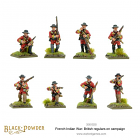
  • Black Powder British Regulars on Campaign

    Description


    Contains: 8 metal British Regulars

    Models supplied unassembled and unpainted

    303013203
    £12.15
    £13.50 save 10%
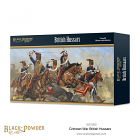
  • Black Powder Crimean War British Hussars

    Includes:

    8 Metal British Hussar cavalry
    302213803
    £21.60
    £24.00 save 10%
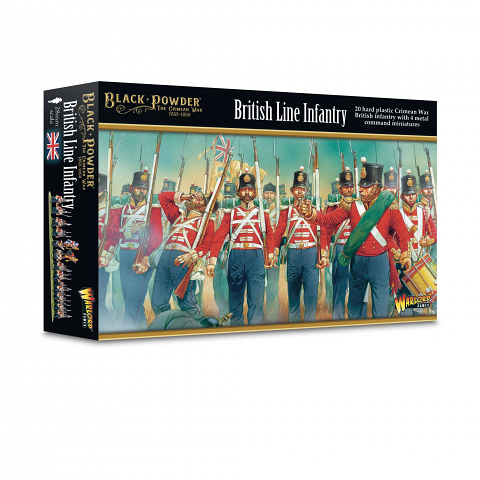
  • Black Powder Crimean War British Line Infantry

    The thin red line! There are few more glorious military spectacles than the measured tread of Her Majesty’s line regiments wheeling by division the marching at their steady pace towards their enemies – unflinching, unafraid, and unstoppable.
     
    If war has any glory in it at all, it can be found in the splendid turnout and resplendence of the British Army and its fabulously dressed soldiery of the Crimean War.
     
    The men of the line regiments, of which over fifty served in the campaign into the Crimea, may not have been saints, and many had enlisted simply to avoid jail or the poorhouse, but they behaved magnificently when put to the test against the Russians.
     
    At the Alma, at Sevastopol, at Inkerman – the redcoats did their bit for Queen and country five-fold, many losing their lives or their limbs. The Crimean War has been described as the first modern war, but has just as accurately been described as the last old-fashioned war – the troops being led to death or glory by officers who had fought at Waterloo all those years earlier! Sadly neglect, incompetent commanders, and disease killed far more British soldiers than the Russians ever did – a poor reward for extraordinary service.
     
    Box Contains:
     
    20 Hard Plastic Crimean War British Line Infantry
    4 Metal British Line Infantry Command
    Full-colour Flag Leaflet
    Plastic Bases
    302000001
    £24.75
    £27.50 save 10%
  • Black Powder Crimean War British Line Infantry Regiment

    Includes:

    24 metal British Line Infantry
    302213807
    £35.55
    £39.50 save 10%
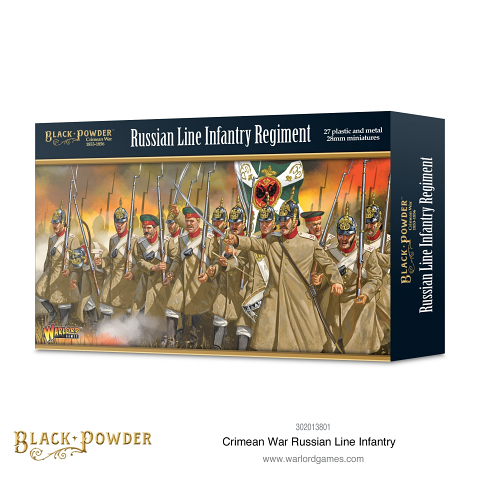
  • Black Powder Crimean War Russian Line Infantry

    The bulk of the Imperial Russian Army that faced the allied nations of Great Britain, France, Sardinia and the Ottomans comprised the stoic infantrymen clad in their green and white uniforms, often covered by a drab greatcoat.
     
    Singing their hymns to Mother Russia, the simple peasant stock that filled Russian regiments had a fervent belief in their Tzar and an equal belief in the bayonet due to their poor musketry skills and old weapons.
     
    The Russians were able to call on a colossal pool of manpower although the individual soldier was on the whole poorly trained, equipped and led. Despite these shortcomings nobody could doubt their bravery – the soldiers were used to privation and sacrifice throughout warfare with the great Ottoman Empire for many years.
    Includes:
    24 plastic Russian Line Infantry in helmets, with 8 optional forage cap heads
    3 metal Russian command group
    302013801
    £24.75
    £27.50 save 10%
  • British Infantry Regiment

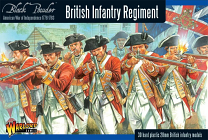
    The British Redcoat of the Revolutionary War was part of a small but well-trained army, stretched all over the emerging Empire. Most of England’s gold went into maintaining a giant and hugely effective Royal Navy to dominate the seas.
     
    The infantry quickly learned many lessons in fighting the French Indian wars, and after initial setbacks proved more than capable of taking on and defeating far larger enemy forces. Devastating firepower and a grim determination to close with the bayonet made the Redcoat in America a dangerous foe indeed.
     
    The British quickly adopted a looser fighting order and the reaped the benefits of using Light and Grenadier companies for specialist assault work. “March on, and God save the King!”
     
    Contains:
     
    30 plastic British Infantry:
    24 musketeers including command group of two officers, drummer, Sergeant and two ensigns
    6 Light Infantry
    4-page background guide including twelve full-colour flags – download here.
    WGR-AWI-01
    £21.60
    £25.00 save 14%
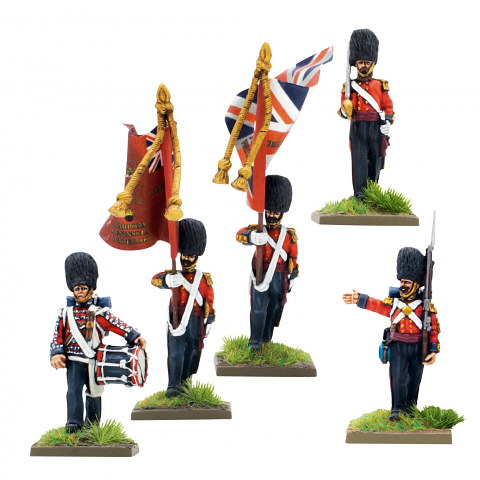
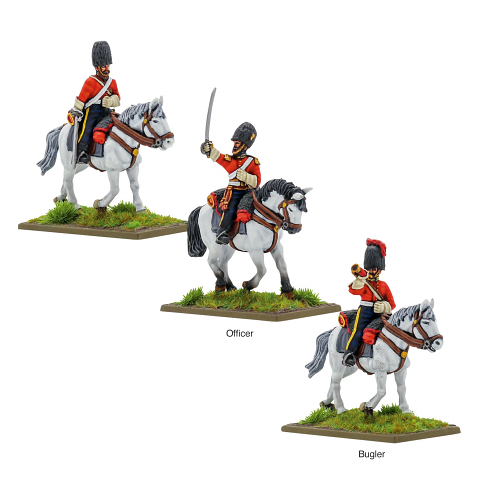
  • Crimean War British Foot Guards Command

    In an exception to the convention of the time of the Crimean War that a British infantry regiment would consist of only a single battalion, the Foot Guards each paraded more than one; the Grenadier Guards had three, the Coldstream Guards two, and the Scots Fusilier Guards two.
     
    Inkerman is an iconic battle for the Foot Guards as they held an isolated position unsupported against overwhelming odds. The Grenadiers were the only regiment to take their colours into the battle and as a result they became a focal point for the battalion, giving it not only a place to rally, but also a place to defend, as the men did not want to lose the colours of Queen Victoria’s premier Foot Guard regiment. During the defence of the colours, Grenadier Captain Percy won the Victoria Cross. To commemorate the battle, one of the Grenadier Guards companies carries the honour ‘Inkerman Company’ as does a company at the Royal Military Academy, Sandhurst.
     
    This pack contains five command figures, cast in metal.
     
    Sculpted by Mike Percy. Studio miniatures painted by Jamie Getliffe.
     
    Models supplied unassembled and unpainted
    303013824
    £10.13
    £11.25 save 10%
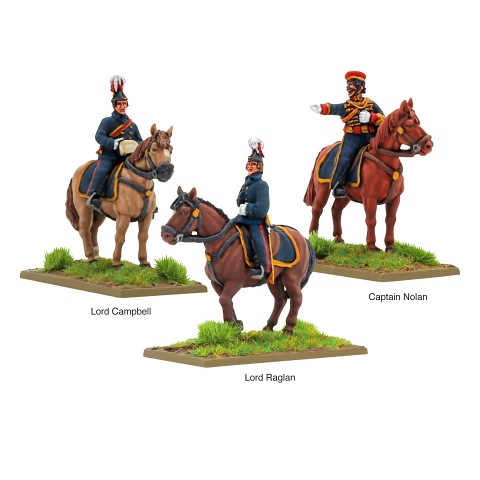
  • Crimean War British Generals & Officers

    The failure of the British army from a wargaming perspective is not in its men, but in its leaders. The generals, with a couple of notable exceptions, were not experienced in warfare and beyond issuing initial orders usually played little part in the battle. Failure to issue orders or to effectively communicate them to the divisional or brigade commanders often left brigades paralysed whilst they awaited instructions. Additionally, a genuine loathing of one another, and some generals’ preference for elevating officers for their social standing, rather than command capability, exacerbated such problems.
     
    This pack contains three of the most famous personalities in command of British forces during the Crimean War, cast in metal:
     
    Lord Raglan
    Lord Campbell
    Captain Nolan
    Rules for their use in Black Powder can be found in the Into the Valley of Death supplement.
     
    Sculpted by Mike Percy. Studio miniatures painted by Jamie Getliffe.
     
    Models supplied unassembled and unpainted
    303013818
    £12.15
    £13.50 save 10%
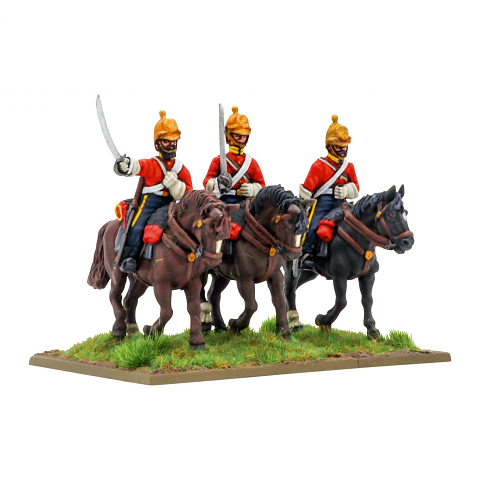
  • Crimean War British Heavy Dragoons

    At the Battle of Balaklava, the British Heavy Brigade was commanded by General Sir James York Scarlett, and composed of two squadrons each of the 1st Dragoons (The Royals), the 2nd Dragoons (Scots Greys), the 4th Dragoon Guards (Royal Irish), the forth Dragoon Guards (Princess Charlotte of Wales's) and the 6th Dragoons (Inniskilling).
     
    The Heavy Brigade's charge against a much larger Russian cavalry force, already in retreat, was enough to put it in disorder and rout it, saving the British supply base from potential disaster.
     
    This pack contains three mounted figures, cast in metal.
     
    Sculpted by Mike Percy. Studio miniatures painted by Jamie Getliffe.
     
    Models supplied unassembled and unpainted
    303013850
    £9.45
    £10.50 save 10%
  • Crimean War British Heavy Dragoons Command

    At the Battle of Balaklava, the British Heavy Brigade was commanded by General Sir James York Scarlett, and composed of two squadrons each of the 1st Dragoons (The Royals), the 2nd Dragoons (Scots Greys), the 4th Dragoon Guards (Royal Irish), the forth Dragoon Guards (Princess Charlotte of Wales's) and the 6th Dragoons (Inniskilling).
     
    The Heavy Brigade's charge against a much larger Russian cavalry force, already in retreat, was enough to put it in disorder and rout it, saving the British supply base from potential disaster.
     
    This pack contains three mounted command figures, cast in metal.
     
    Sculpted by Mike Percy. Studio miniatures painted by Jamie Getliffe.
     
    Models supplied unassembled and unpainted
    303013851
    £9.45
    £10.50 save 10%
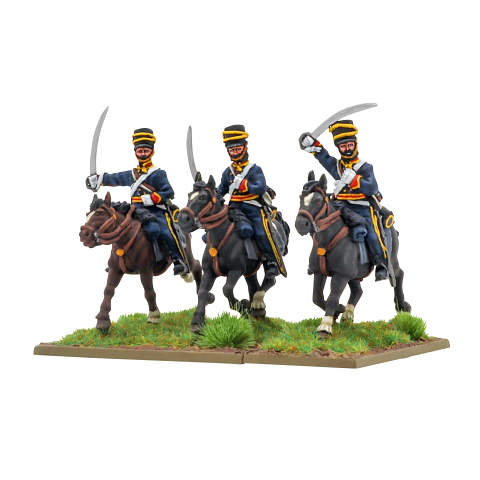
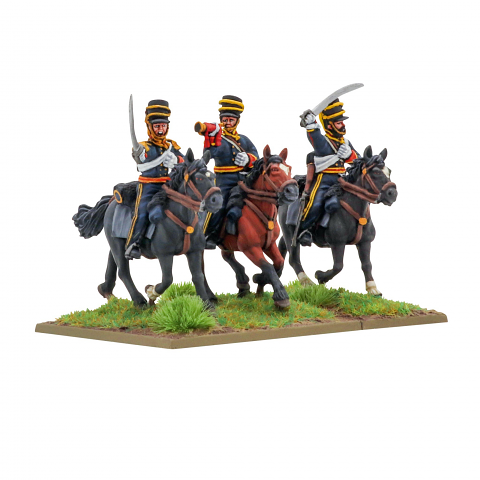
  • Crimean War British Light Dragoons

    At the Battle of Balaklava, the 13th Light Dragoons were at the forefront of the ill-fated Charge of the Light Brigade. Having weathered the storm through the valley, the regiment ploughing through the Russian artillery, and smashed straight into the cavalry beyond, but had insufficient forces to consolidate its position and was forced to withdraw, once again under fire of the Russian guns. In the fiasco, the regiment lost over 40 men, including three officers. The regiment would later go on to play a minor role at the Battle of Inkerman in November of the same year, and the Siege of Sevastopol.
     
    This pack contains three mounted figures, cast in metal.
     
    Sculpted by Mike Percy. Studio miniatures painted by Jamie Getliffe.
     
    Models supplied unassembled and unpainted
    303013828
    £9.45
    £10.50 save 10%
  • Crimean War British Light Dragoons Command

    At the Battle of Balaklava, the 13th Light Dragoons were at the forefront of the ill-fated Charge of the Light Brigade. Having weathered the storm through the valley, the regiment ploughing through the Russian artillery, and smashed straight into the cavalry beyond, but had insufficient forces to consolidate its position and was forced to withdraw, once again under fire of the Russian guns. In the fiasco, the regiment lost over 40 men, including three officers. The regiment would later go on to play a minor role at the Battle of Inkerman in November of the same year, and the Siege of Sevastopol.
     
    This pack contains three mounted command figures, cast in metal.
     
    Sculpted by Mike Percy. Studio miniatures painted by Jamie Getliffe.
     
    Models supplied unassembled and unpainted
    303013827
    £9.45
    £10.50 save 10%
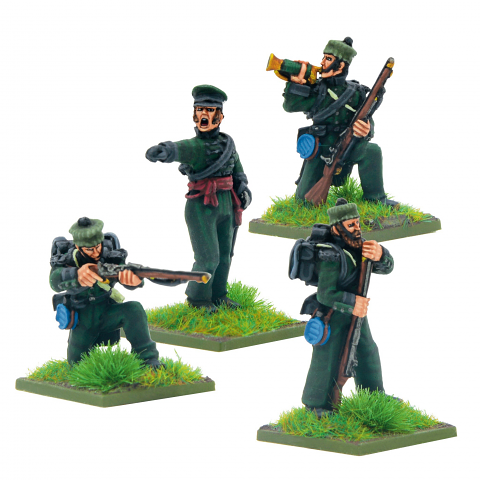
  • Crimean War British Rifle Brigade Fn Forage Caps Command

    When the Crimean War broke out in 1853 the Rifle Brigade sent two battalions. They fought at the Battle of the Alma, where one of their number led the advance across the river. The regiment also saw action at the Battle of Inkerman, and during the Siege of Sevastopol Victoria Crosses were awarded to members of the regiment over the course of the Crimean campaign.
     
    During the campaign, the Rifle Brigade began to wear the softer forage cap in place of the more traditional shako.
     
    This pack contains four command figures, cast in metal.
     
    Sculpted by Mike Percy. Studio miniatures painted by Jamie Getliffe.
     
    Models supplied unassembled and unpainted
    303013852
    £8.10
    £9.00 save 10%
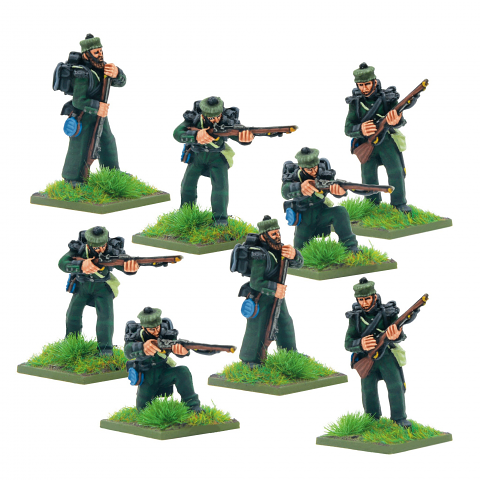
  • Crimean War British Rifle Brigade In Forage Caps

    When the Crimean War broke out in 1853 the Rifle Brigade sent two battalions. They fought at the Battle of the Alma, where one of their number led the advance across the river. The regiment also saw action at the Battle of Inkerman, and during the Siege of Sevastopol Victoria Crosses were awarded to members of the regiment over the course of the Crimean campaign.
     
    During the campaign, the Rifle Brigade began to wear the softer forage cap in place of the more traditional shako.
     
    This pack contains eight figures, cast in metal.
     
    Sculpted by Mike Percy. Studio miniatures painted by Jamie Getliffe.
     
    Models supplied unassembled and unpainted
    303013826
    £16.20
    £18.00 save 10%
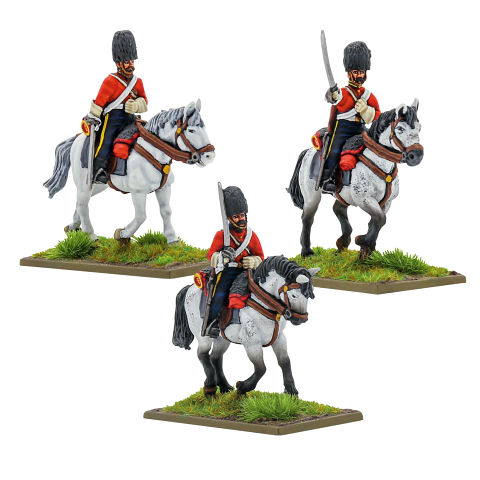
  • Crimean War British Scots Greys Heavy Cavalry

    The Scots Greys, a Dragoon regiment named for their famous grey horses, arrived in the Crimea in 1854, commanded by Lieutenant-Colonel Henry Griffith arrived and assigned to Brigadier-General Sir James Scarlett's Heavy Brigade. On 25 October 1854, as part of the Battle of Balaklava, they repelled a numerically superior Russian Cavalry force of approximately 3,000 sabres (alongside the British dragoons under the same command), inflicting 270 casualties against their 78, routing a direct threat to the Highlanders and the British supply base. However, they could only look on as the Light Brigade were led by Lord Cardigan in that great folly.
     
    This pack contains three mounted figures, cast in metal.
     
    Sculpted by Mike Percy. Studio miniatures painted by Jamie Getliffe.
     
    Models supplied unassembled and unpainted
    303013830
    £9.45
    £10.50 save 10%
  • Crimean War British Scots Greys Heavy Cavalry Command

    The Scots Greys, a Dragoon regiment named for their famous grey horses, arrived in the Crimea in 1854, commanded by Lieutenant-Colonel Henry Griffith arrived and assigned to Brigadier-General Sir James Scarlett's Heavy Brigade. On 25 October 1854, as part of the Battle of Balaklava, they repelled a numerically superior Russian Cavalry force of approximately 3,000 sabres (alongside the British dragoons under the same command), inflicting 270 casualties against their 78, routing a direct threat to the Highlanders and the British supply base. However, they could only look on as the Light Brigade were led by Lord Cardigan in that great folly.
     
    This pack contains three mounted command figures, cast in metal.
     
    Sculpted by Mike Percy. Studio miniatures painted by Jamie Getliffe.
     
    Models supplied unassembled and unpainted
    303013829
    £9.45
    £10.50 save 10%
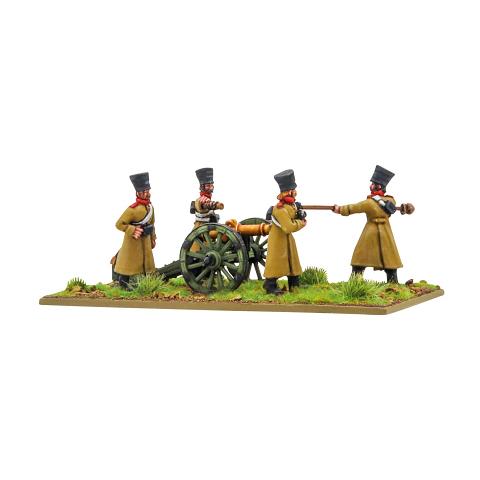
  • Crimean War Cossack Artillery and Crew

    The artillery was the premier arm of the Russian military. The artillery was seen to be, in many ways, the battle winner and large numbers of guns were deployed to every battle in the Crimean theatre. Massed artillery fire had been a central tenet of Russian military doctrine since Napoleonic times with the cannon expected to make up for the lack of infantry firepower. In theory, the cannon should soften up the enemy before the infantry charge them and drive them from the field. However, during the Crimean War, the rifled muskets used by the allies often outranged the Russian cannon.
     
    Russian Artillery has a somewhat conspicuous place in history, with the eight guns of No. 3 Don Cossack Battery being the key objective in the ill-fated Charge of the Light Brigade. This model can be used to represent one such gun, a 6-pdr.
     
    This pack contains one Cossack Artillery piece with four crew, cast in metal.
     
    Sculpted by Mike Percy. Studio miniatures painted by Andrés Amián.
     
    Models supplied unassembled and unpainted
    303013840
    £16.20
    £18.00 save 10%
  • Crimean War French Chasseurs D'Afrique

    The cavalry division that served in the Crimea was quite small, with neither the French nor British able to deploy large numbers of cavalry due to the difficulty with transport and the availability of horses in theatre. The initial cavalry brigade did, however four regiments of the Chasseurs d’Afrique, consisting of eight squadrons each. This cavalry went on to take part in the Battle of Balaklava.
     
    This pack contains three mounted figures, cast in metal.
     
    Sculpted by Mike Percy. Studio miniatures painted by Jamie Getliffe.
     
    Models supplied unassembled and unpainted
    30313847
    £9.45
    £10.50 save 10%
  • Crimean War French Chasseurs D'Afrique Command

    The cavalry division that served in the Crimea was quite small, with neither the French nor British able to deploy large numbers of cavalry due to the difficulty with transport and the availability of horses in theatre. The initial cavalry brigade did, however four regiments of the Chasseurs d’Afrique, consisting of eight squadrons each. This cavalry went on to take part in the Battle of Balaklava.
     
    This pack contains three mounted command figures, cast in metal.
     
    Sculpted by Mike Percy. Studio miniatures painted by Jamie Getliffe.
     
    Models supplied unassembled and unpainted
    303013846
    £9.45
    £10.50 save 10%
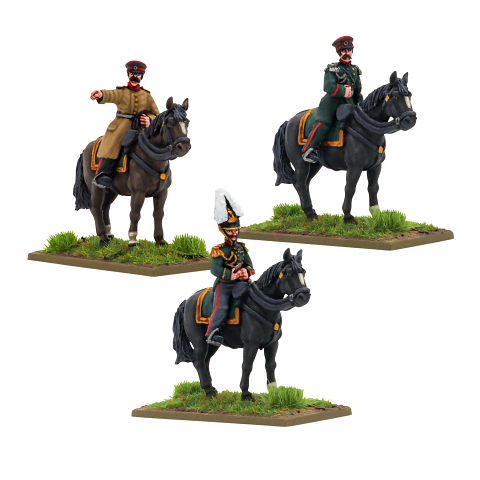
  • Crimean War Russian Generals & Officers

    Russian officers usually came from the nobility and either trained at one of the various military cadet schools or acted as a volunteer officer in a regiment before being confirmed in post. A few officers were promoted from the ranks, having served for a number of years as NCOs, but this was not commonplace. Initiative was not encouraged amongst the officer class, who were given little training beyond the parade ground drill anyway. Officers obeyed orders, but when those orders had been carried out, they usually stopped and waited for further orders rather than seizing the initiative or having the confidence to act on their own.
     
    Pack contains three mounted Russian Generals and Officers, cast in metal.
     
    Sculpted by Mike Percy. Studio miniatures painted by Andrés Amián.
     
    Models supplied unassembled and unpainted
    303013841
    £12.15
    £13.50 save 10%
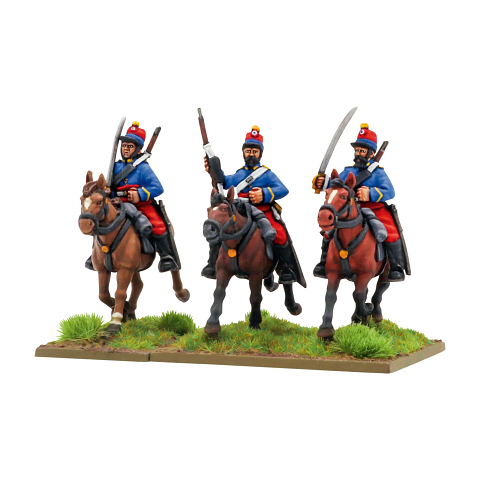
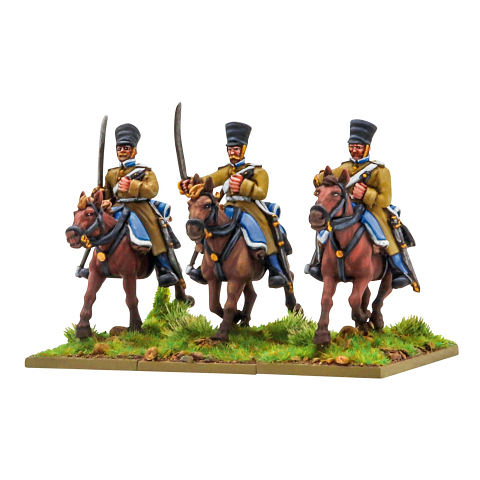
  • Crimean War Russian Hussars

    The Russian cavalry force was the largest in Europe, totalling over sixty regiments organised into twenty cavalry divisions. The light cavalry consisted of hussars and lancers or uhlans. Much as with the infantry, the cavalry training consisted of wheels and manoeuvres designed for the parade ground with little tactical application.
     
    Russian hussars wore shakos with a black top, peak and with a brass front plate, but the main body of the headgear was coloured differently for each regiment. Similarly, all wore a pelisse that was trimmed with fur, but the colour of each varied between regiments. For the majority of the campaign Russian hussars wore a grey oilskin cover to protect their shako and a grey greatcoat over their bright uniforms.
     
    This pack contains three mounted figures, cast in metal.
     
    Sculpted by Mike Percy. Studio miniatures painted by Andrés Amián.
     
    Models supplied unassembled and unpainted
    303013834
    £9.45
    £10.50 save 10%
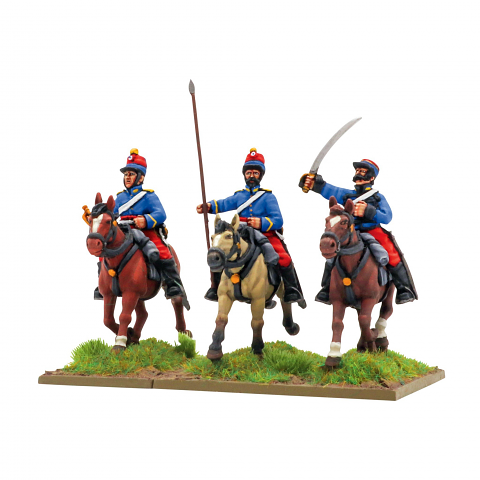
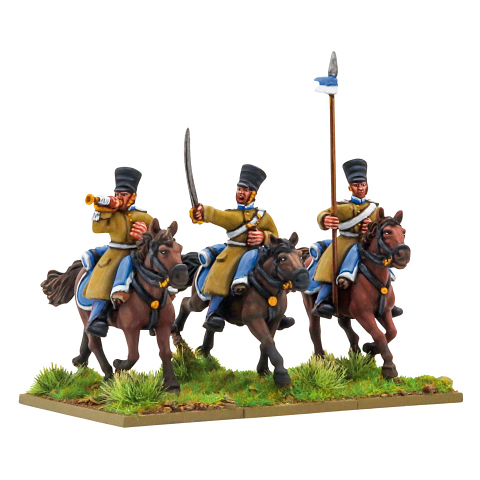
  • Crimean War Russian Hussars Command

    The Russian cavalry force was the largest in Europe, totalling over sixty regiments organised into twenty cavalry divisions. The light cavalry consisted of hussars and lancers or uhlans. Much as with the infantry, the cavalry training consisted of wheels and manoeuvres designed for the parade ground with little tactical application.
     
    Russian hussars wore shakos with a black top, peak and with a brass front plate, but the main body of the headgear was coloured differently for each regiment. Similarly, all wore a pelisse that was trimmed with fur, but the colour of each varied between regiments. For the majority of the campaign Russian hussars wore a grey oilskin cover to protect their shako and a grey greatcoat over their bright uniforms.
     
    This pack contains three mounted command figures, cast in metal.
     
    Sculpted by Mike Percy. Studio miniatures painted by Andrés Amián.
     
    Models supplied unassembled and unpainted
    303013833
    £9.45
    £10.50 save 10%
  • French Hussars 1808-1815

    Napoleonic warfare saw bewildering varieties of exotic uniforms worn by the various armies that marched and fought in the early 19th century. There were none so exotic and magnificent as the Hussar regiments of the French army. These dashing light cavalry donned outfits originally inspired by Turkish, and later Hungarian, cavalry. Each of the fourteen regiments formed wore a differing uniform, with the result that a Hussar brigade made a most impressive sight.
     
    Mounted on small but tough horses, they were used on campaign in scouting and raiding roles. Their élan and dash made up for their smaller mounts and lack of armour on the field of battle.
     
    Principally armed with the curved light cavalry sabre they could also carry a carbine, or more commonly a pistol, into the fray.
     
    A regiment was formed into four squadrons, each of two companies, and the first company in a regiment was usually the elite company, distinguished by their bearskin fur colpacks.
     
    Vive L’Empereur!
     
    Box set Contains:
     
    12 plastic easy-build French Hussars.
    1 additional metal officer and metal horse.
    1 additional metal bugler.
    Optional metal arm for eagle bearer.
    302012002
    £20.25
    £27.50 save 26%
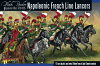
  • Napoleonic French Line Lancers

    In 1809, at the battle of Wagram, some Polish light horse fighting for Napoleon seized lances from Austrian Uhlan prisoners and used them with good effect. Impressed by their use, Bonaparte ordered nine regiments to be formed, six of them clothed in green and three in blue. With their nine-foot ash pole lances, red and white pennants, and topped off with gleaming brass classical helmets they cut quite a dash on the battlefield. Lancers were unusual as they could take their place in the battleline and fight it out with enemy cavalry or infantry, but they were most often used in scouting, raiding, and – especially in Spain and Russia – in skirmishing, even fighting dismounted where the situation arose. Armed with a wicked lance, sabre, and at times a carbine and up to two pistols, the French line lancer was a formidable foe! This Warlord Games boxed set contains: 12 plastic easy-build French Light Cavalry Lancers. 1 additional metal officer and metal horse. 1 additional metal bugler. Optional metal arm for eagle bearer. Although a standard unit size for French Lancers would be 12 in most games, this box allows you to make 13 mounted French Lancers, giving you the choice of fielding them with or without command models.

    WGN-FR-13
    £23.40
    £27.50 save 15%
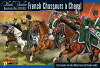
  • Napoleonic Late French Chasseurs Light Cavalry

    Formed originally back in 1743, the Chasseurs a Cheval (mounted hunters) were hard riding, green clad light cavalry whose main role was patrolling and raiding for the French armies. A good Chasseur was at home on his light horse, skirmishing with the enemy cavalry or scouting enemy movements and thus providing valuable intelligence for their commanders.

    Armed with carbine, curved sabre and bayonet (an item disliked by the cavalrymen who used it to dig up vegetables or ‘lost’ it on campaign) the Chasseurs were most happy in the saddle, although they were also trained to fight on foot should the need arise.

    At the height of the French Army under Bonaparte’s reign there were 31 regiments of Chasseurs a Cheval although only 15 regiments were available for the titanic Hundred Days campaign that culminated at the Battle of Waterloo. Our superbly detailed Chasseurs à Cheval are provided with covered and uncovered shakos as well as the colpacks favoured by the elite companies.

    Although requested not to wear the sabretache beyond 1808 many Chasseurs would keep this item well beyond this decree and thus we’ve included it on our models. For those of you wishing to follow regulations over reality simply snip the sabretache off.

    This Warlord Games box set contains:

    • 12 plastic easy-build French Light Cavalry including 1 metal officer and horse
    • Optional metal parts to make a trumpeter and eagle bearer
    • Options for shako, oilskin covered shakos and the elite company Colpack fur hat.
    WGN-FR-12
    £23.40
    £27.50 save 15%
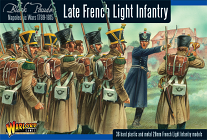
  • Napoleonic Late French Light Infantry

    This Warlord Games boxed set contains:

    • 24 plastic French infantry
    • Metal command group of:
      • 2 Officers
      • 1 Drummer
      • 1 Standard Bearer

    Also full colour background leaflet containing several flags.

    302012001
    £23.40
    £27.50 save 15%
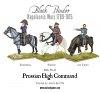
  • Napoleonic Prussian High Command

    The Prussian High Command during the 100 Days campaign leading up to the battle of Waterloo.

    • 1 x Field Marshal von Blucher
    • 1 x General August von Gneisenau Blucher’s chief of staff
    • 1 x Marshal Friedrich Karl von Zeiten
    WGN-PR-23
    £10.10
    £11.25 save 10%
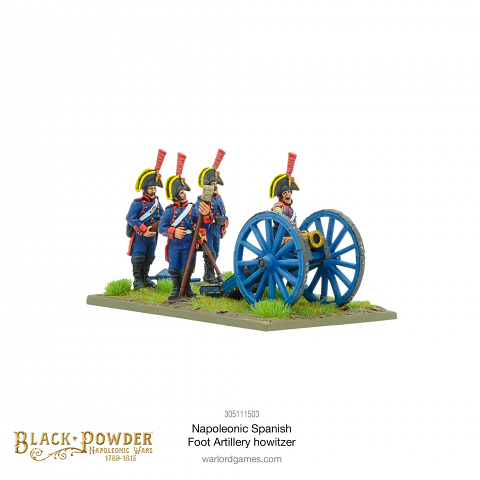
  • Napoleonic Spanish foot artilery Howitzer

    ‘The best of a bad lot’ the artillerymen of the Spanish Army displayed spirit and courage that was rarely matched by their countrymen. Batteries were split between horse and foot, the former having 4 pounders and the latter having 8 pounders. Batteries were supposed to have six guns each, but this was rarely achieved and batteries usually had four guns only. The fact that the batteries were called foot or horse meant little; a severe shortage of horses meant both were drawn in the main by mules and oxen.
     
    Contains one 28mm metal howitzer with four metal Spanish foot artillery crew.
     
    Models supplied unassembled and unpainted
    305111503
    £15.30
    £17.00 save 10%
  • Napoleonic Spanish Infantry (1st Battalion) 1805-1811

    Boxed set containing Warlord Resin miniatures
    Take to the field in the Peninsular War with this great box containing 25 Spanish Infantry miniatures.
    Including both grenadiers and fusiliers and a flag sheet which covers flags for six different regiments.
    A Spanish army looks terrific on the tabletop, and though generally of poor quality, quantity has a quality of its own.
     
    302411501
    £25.20
    £29.50 save 15%
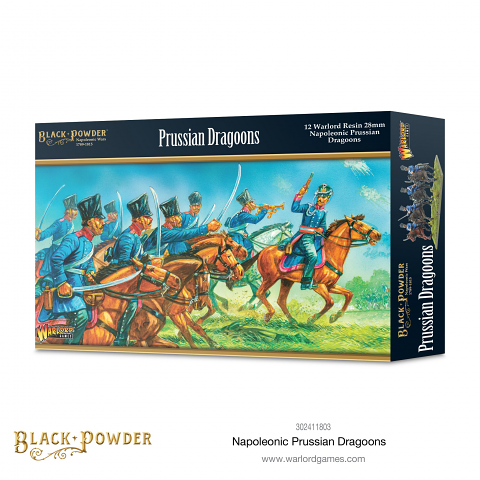
  • Prussian Dragoons

    Prussia was renowned for its excellent infantry under Frederick the Great. Less well known is the efficacy of Prussian cavalry on the European battlefield in the 19th Century. Early in the Napoleonic wars, Bonaparte himself warned his generals of the excellent Prussian cavalry.
     
    The well-trained and disciplined Prussian horse during the Hundred Days campaign formed regiments of cuirassiers, dragoons, hussars and lancers. By Waterloo there were eight dragoon units in the field, comprising 9% of the cavalry under Blücher’s control.
     
    Alongside the cuirassiers, the dragoons were the heavy cavalry of the Prussian army. Their uniform was business-like – a distinctive blue Litewka long coat and grey overalls topped with a basic shako, frequently covered in an oilskin wrap. Armed with a curved sabre in an iron scabbard, dragoons were unusual among Prussian cavalry in the Hundred Days campaign in that they carried cavalry guidons into battles.
     
    Models supplied unassembled and unpainted
    302411803
    £24.30
    £33.50 save 27%
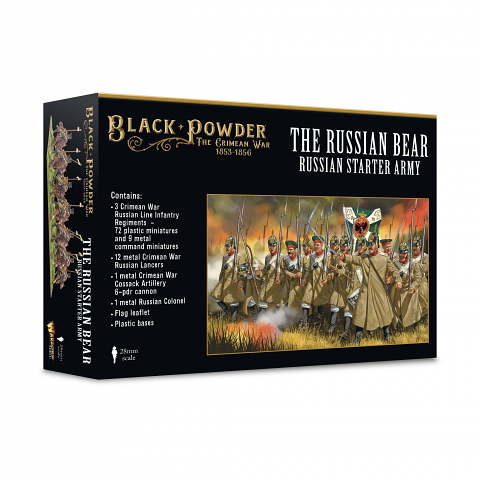
  • The Russian Bear - Crimean War Russian starter army

    At the beginning of the Crimean War the Russian military was the largest in Europe, containing just under one million men, 930,000 of which belonged to the land forces, though size is not everything…
     
    The bulk of the Imperial Russian Army that faced the allied nations of Great Britain, France, Sardinia, and the Ottomans comprised the stoic infantrymen clad in their green and white uniforms, often covered by a drab greatcoat, but conscripted mostly from poor peasants and serfs. The individual soldier was on the whole poorly trained, equipped and led. Despite these shortcomings nobody could doubt their bravery – the soldiers were used to privation and sacrifice throughout warfare with the great Ottoman Empire for many years.
     
    Singing their hymns to Mother Russia, the simple peasant stock that filled Russian regiments had a fervent belief in their Tsar and an equal belief in the bayonet due to their poor musketry skills and old weapons.
     
    Box Contains:
     
    72 Hard Plastic Crimean War Russian Line Infantry
    9 Metal Russian Line Infantry Command Figures
    12 Metal Crimean War Russian Lancers
    1 Metal Crimean War Cossack Artillery 6-Pdr Cannon with Crew
    1 Metal Russian Colonel (Mounted)
    Full-colour Flag Leaflet
    Plastic Bases
    302613802
    £96.30
    £107.00 save 10%
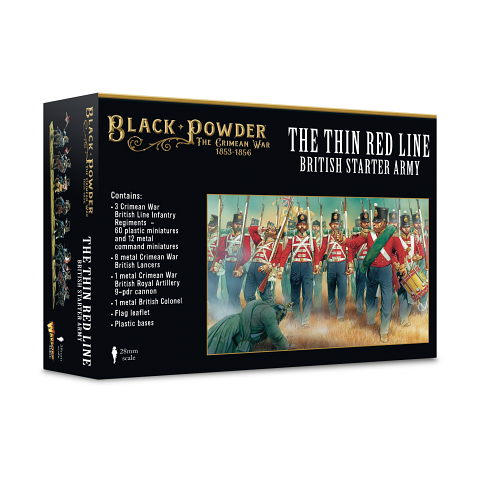
  • The Thin Red Line - Crimean War British starter army

    The thin red line! There are few more glorious military spectacles than the measured tread of Her Majesty’s line regiments wheeling by division the marching at their steady pace towards their enemies – unflinching, unafraid, and unstoppable.
     
    If war has any glory in it at all, it can be found in the splendid turnout and resplendence of the British Army and its fabulously dressed soldiery of the Crimean War.
     
    The men of the line regiments, of which over fifty served in the campaign into the Crimea, may not have been saints, and many had enlisted simply to avoid jail or the poorhouse, but they behaved magnificently when put to the test against the Russians.
     
    At the Alma, at Sevastopol, at Inkerman – the redcoats did their bit for Queen and country five-fold, many losing their lives or their limbs. The Crimean War has been described as the first modern war, but has just as accurately been described as the last old-fashioned war – the troops being led to death or glory by officers who had fought at Waterloo all those years earlier! Sadly neglect, incompetent commanders, and disease killed far more British soldiers than the Russians ever did – a poor reward for extraordinary service.
     
    Box Contains:
     
    60 Hard Plastic Crimean War British Line Infantry
    12 Metal British Line Infantry Command Figures
    8 Metal Crimean War British Lancers
    1 Metal Crimean War British Royal Artillery 9-Pdr Cannon with Crew
    1 Metal British Colonel (Mounted)
    Full-colour Flag Leaflet
    Plastic Bases
    302613801
    £96.30
    £107.00 save 10%
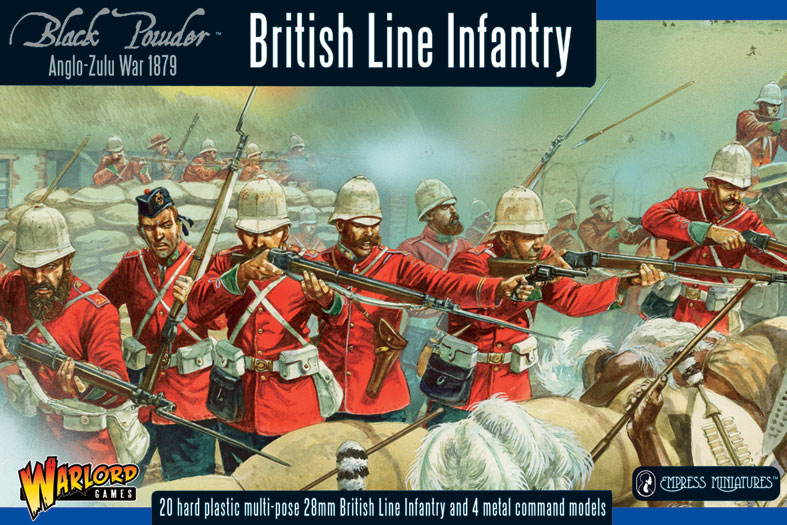
  • Warlord Anglo Zulu War British Infantry

    A casual look at Tommy Atkins of the Victorian period gave little away about his fighting abilities. Standing 5′ 5″ on average, and often shorter, he may or may not be able to read or write. This appearance was deceptive, however. The average British redcoat was the most dangerous animal in Africa, equipped as he was with the Martini-Henry breech-loading rifle which he was capable of firing 15 times a minute out to 1200 yards range in volley fire if needs be. His legendary discipline, his marching ability – enough to traverse all manner of terrain – and his determination to fight his enemies, which were legion, all made the British redcoat an implacable foe. Well led, well-equipped and thoroughly trained in his abilities, he blazed a trail for Empire all over the world. Cheerful and confident the redcoats of the County Regiments served their sovereign well, smashing their enemy with concentrated rifle fire and, if necessary, selling their lives dearly behind the thrust of their wicked long bayonets.
     
    Our Redcoats represent any British unit of the Anglo-Zulu War and contains enough Plastic components to make 20 British Infantry with Martini Henry Rifles 4 metal Empress Command Figures - Bugler, Sergeant and two officers
    302014601
    £22.50
    £25.00 save 10%
  • Warlord Napoleonic French Starter Army (Peninsular Campaign)

    Contains:
     
    96 French Line infantry
    12 French Chasseurs à Cheval cavalry
    Officer on horse
    6-pdr cannon
    Full-colour flag sheets
     
    Note: Models supplied unassembled and unpainted
    309912006
    £90.90
    £107.00 save 15%
  • Warlord Napoleonic French Starter Army (Waterloo Campaign)

    Contains:
     
    84 French Line infantry
    28 French Light infantry
    12 French Line Lancers
    Officer on horse
    6-pdr cannon
    Full-color flag sheets
    Waterslide decal sheets
     
    Note: Models supplied unassembled and unpainted
    309912005
    £90.90
    £107.00 save 15%
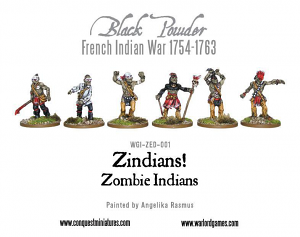
  • Zindians! Zombie Indians

    Pack contains 6 metal foot figures.
     
    Note: Models supplied unassembled and unpainted
    wgi-zed-001
    £10.10
    £11.25 save 10%