The cookie settings on this website are adjusted to allow all cookies so that you have the very best experience. If you continue without changing your cookie settings, we'll assume that you are happy to receive all cookies on our website. However, if you would like to, you can change your settings at any time using the Change cookie settings link in the Special menu.
The StuG G Assault Gun or Sturmgeschutz served on all fronts of World War II, as infantry support tanks and as tank hunters. With their low silhouette, StuG assault guns were easy to camouflage and difficult to spot. The StuG G was the most produced armoured vehicle of the Wehrmacht, with over 7,500 being made.
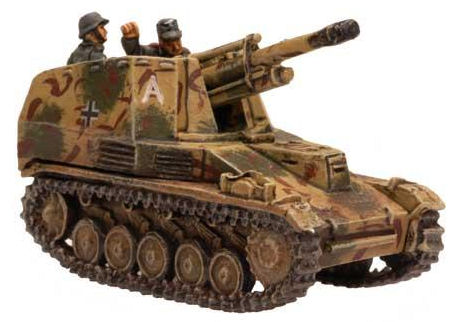
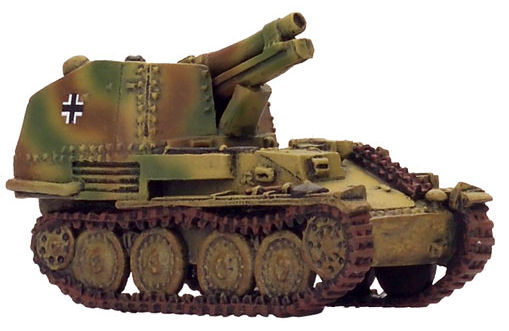
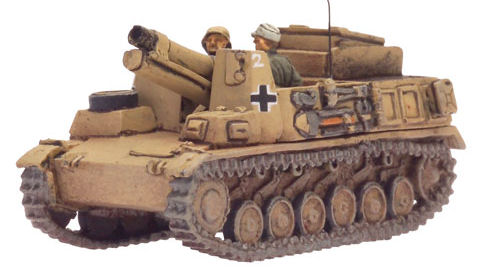
The SdKfz 124 Wespe (German for wasp) was a German self-propelled artillery vehicle based on the Panzer II tank. The Wespe first saw combat in 1943 on the Eastern Front, and proved so successful that Hitler ordered all Panzer II production to be reserved for the Wespe alone, dropping other projects such as the Marder II. They were allocated to the armoured artillery battalions of Panzer divisions along with the heavier Hummel self-propelled guns.
Flames Of War contents: this blister pack contains 1x German Wespe
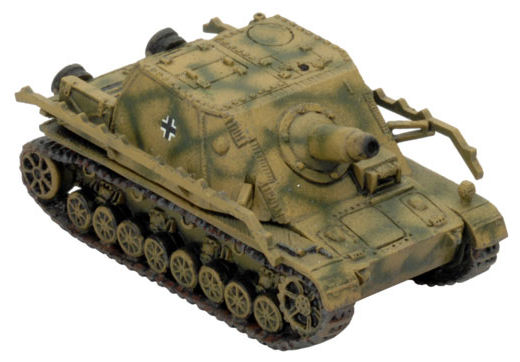
Armed with the powerful 15cm StuH43 gun and thick armour, the Sturmpanzer IV (Sd Kfz 166) assault gun lived up to its nickname Brummbar or 'grizzly bear'. Its presence bolstered Panzergrenadier morale and destroyed that of its enemies with a single shot.
This Flames Of War blister pack contains 1 German Sturmpanzer IV Brummbar
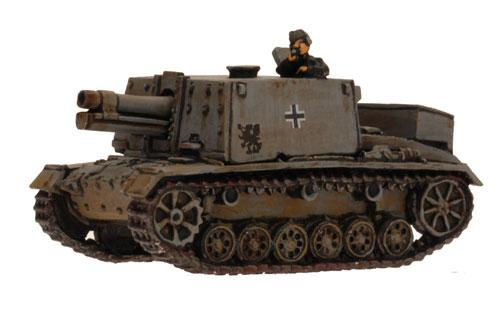
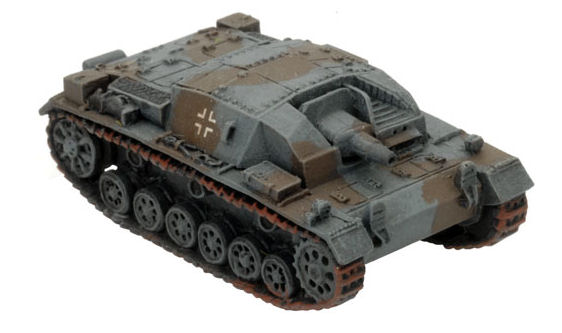
The Sturminfanteriegeschutz (StuIG) 33B was based on the Panzer III chassis and incorporated lessons learned from its assault gun predecessors, featuring a significantly lowered silhouette and a fully enclosed fighting compartment. Armed with a 15cm L/11 howitzer, the StuIG 33B could destroy a house with a single shell and proved their worth in the fighting at Stalingrad.
Flames Of War contents: this blister pack contains 1x German StuIG 33B
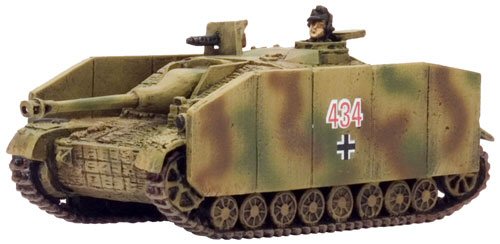
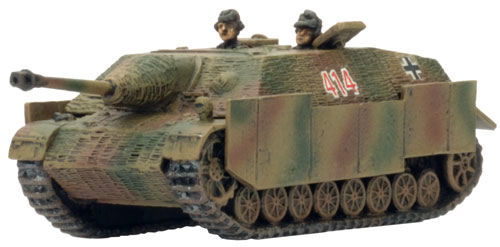
The StuG IV was a combination of StuG III superstructure and the hull of the Panzer IV. The StuG IV was soon being issued to the independent Sturmgeschutz brigades of the Wehrmacht, Panzerjager units, and Panzer units. It was used as both an assault gun in support of the infantry as well as a tank hunter, proving equally deadly in both roles.
Flames Of War contents: this blister pack contains 1x German StuG IV
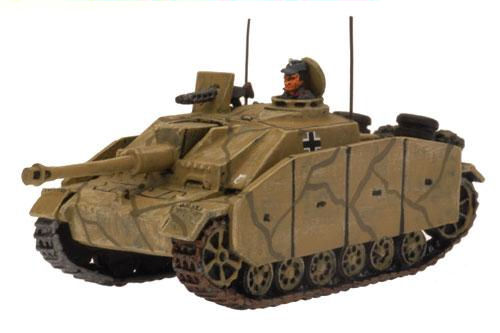
The StuG G Assault Gun or Sturmgeschutz served on all fronts of World War II, as infantry support tanks and as tank hunters. With their low silhouette, StuG assault guns were easy to camouflage and difficult to spot. The StuG G was the most produced armoured vehicle of the Wehrmacht, with over 7,500 being made.
This Flames Of War box set contains includes five plastic StuG III G sprues (with 7.5cm & 10.5cm gun options), one plastic Tank Commander sprue & one StuG III decal sheet.
Produced from 1942 to the end of the war, the Stug III Ausf G StuK40 L/48 was well armoured and armed. It saw action on all fronts, including at Kursk as a tank destroyer.
Flames Of War contents: this blister pack contains 1x German StuG III G
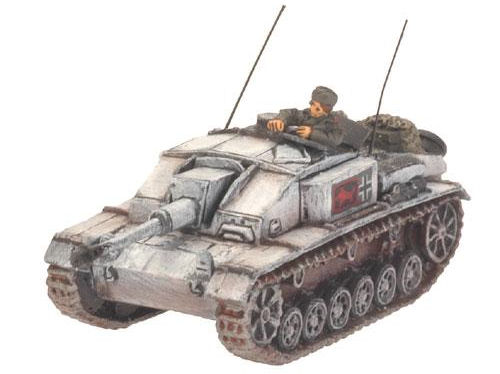
With an improved hull design, the StuG Ausf F/8, 8 serie was made in response to the Panzer armies' demand for more of the excellent range of StuG assault guns.
Flames Of War contents: this blister pack contains 1x German StuG III F/8
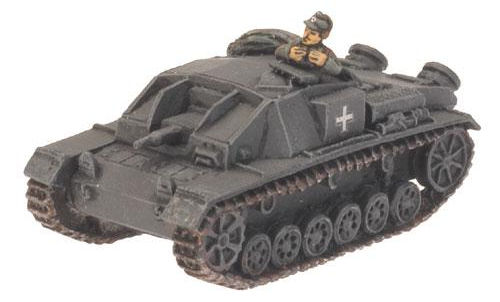
Based on the Panzer III chassis and with its short 7.5cm gun, the StuG III D supported the infantry divisions in Russia and in Africa taking out machine-gun and anti-tank positions with ease.
Flames Of War contents: this blister pack contains 1x German StuG III D
The concept of the SturmgeschÂtz (StuG), or assault gun, began in 1936 after a request for an armoured vehicle for the artillery that could provide support for the infantry through direct fire against machine-gun nests and bunkers. The first five assault gun batteries (each of six StuG) were available for the battles in France: 640. Sturmbatterie with Infanterieregiment Grossdeutschland, 659. Sturmbatterie with XIII Armeekorps, 660. Sturmbatterie with 3. Infanteriedivision, 665. Sturmbatterie operating against the Maginot Line, and an SS-Sturmbatterie with SS-Standarte LSSAH.
The Waffen-SS developed the R-Vielfachwerfer (multiple rocket launcher, pronounced ra-kay-ten feel-fach-vairr-ferr) as a copy of the Soviet BM-8-32 Katyusha rocket launcher. Baustab Becker (Major Becker's engineering workshop) took this weapon and mounted it on the SOMUA half-track giving 21. Panzerdivision its own rocket artillery.
Flames Of War contents: this blister pack contains 1x German SOMUA S307(f) Vielfachwerfer
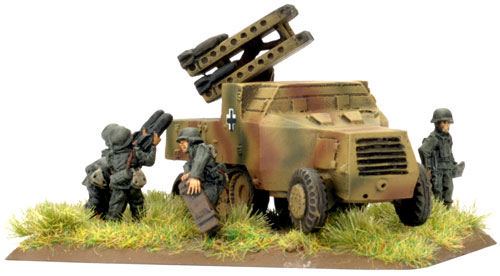
Baustab Becker (Major Becker's engineering workshop) invented a unique infantry support weapon in its Reihenwerfer or rack mortar, pronounced rie-en-vairr-ferr, an array of sixteen mortars mounted on a captured French SOMUA S307(f) half-track. The mortars are all linked together and aimed at the same target. A simple arrangement holds the mortar bombs as they are loaded, then releases them together when they are fired.
Flames Of War contents: this blister pack contains 1x German SOMUA S307(f) Reihenwerfer
Another of Major Becker's conversions was to fit the 7.5cm PaK 40 gun to an up-armoured French half-track so the anti-tank guns of the Panzergrenadier battalions could be used more aggressively rather than as more passive towed weapons. The standard 7.5cm PaK 40 anti-tank gun is mounted in an open-topped armoured body upon the SOMUA MCG5 half-track. Although the resulting vehicle is a little underpowered, it performed well.
Flames Of War contents: this blister pack contains 1x German SOMUA S307(f) (7.5cm PaK 40)
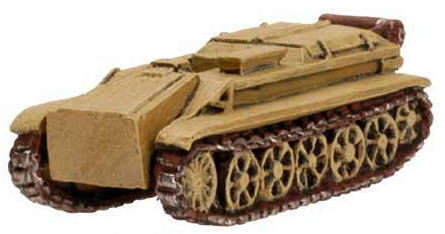
During the invasion of France in 1940 a number of Panzer Is were converted into demolition vehicles for use on mines, pillboxes and fortifications. The success of these improvised vehicles lead to the development of a specialised vehicle, the Borgward B IV (B IV), designed so that it could be driven by an on board crewman within a safe distance of its intended target. It was then radio controlled for the remainder of the distance to the target where the explosive pack on the front could be released before the vehicle was withdrawn and the explosives detonated.
Flames Of War contents: this blister pack contains 4x German Borgward B IV Demolition Carriers
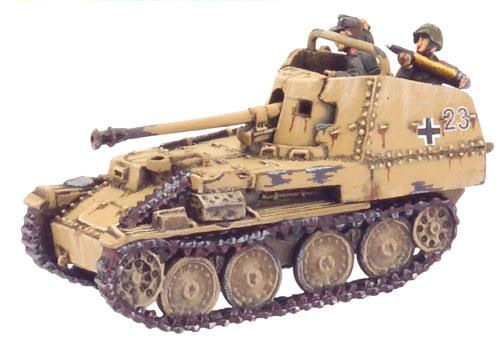
The last Marder III variant was based on the Panzer 38(t) Ausf. M, again armed with the 7.5cm PaK 40 anti-tank gun. In this variant, the gun and fighting compartment were located at the rear but unlike in the previous two Marder IIIs, this compartment was closed at the rear, though still open-topped. The Ausf. M was the variant which was produced in the largest numbers, some 975 vehicles being manufactured in 1943 and early 1944.
Flames Of War contents: this blister pack contains 1x German Marder III M
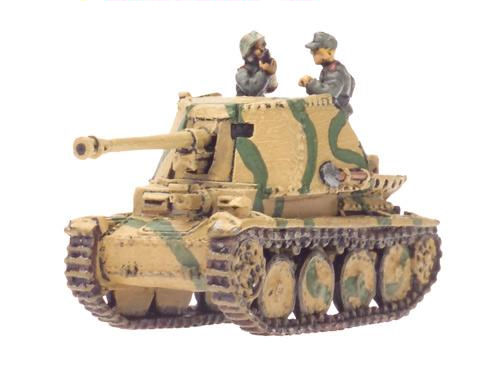
The Germans mounted captured Russian anti-tank guns onto the obsolete Panzer 38(t) chassis, resulting in the Marder III 7.62mm PaK 36(r). Used in Russia and North Africa against Soviet, British and American tanks, it quickly gained a reputation as a fearsome tank hunter.
Flames Of War contents: this blister pack contains 1x German Marder III
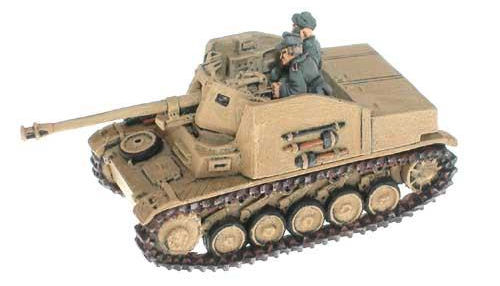
Built on the out-dated Panzer I hull, the Panzerjager Marder II had a high box structure that mounted the 75mm PaK 40 gun. It provided powerful and mobile anti-tank support for both infantry and armour.
Flames Of War contents: this blister pack contains 1x German Marder II
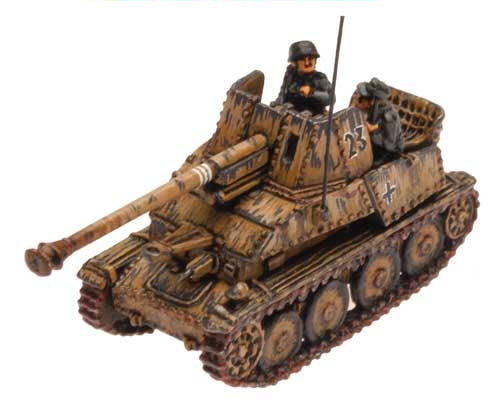
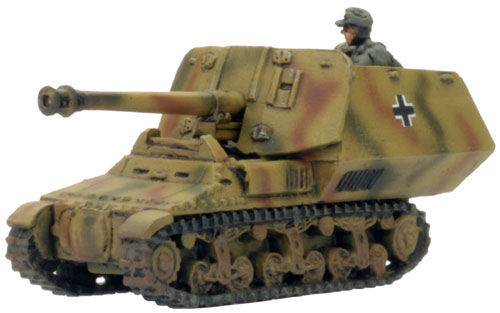
The Marder I was the first Panzerjager of the Marder ('Marten') series of self-propelled anti-tank guns, the need for which arose in the summer of 1941 with the appearance of new Soviet tanks like the T-34 and the heavy KV-1 and KV-2. The Marder I was developed in May 1942 and carried the 7.5cm PaK 40 anti-tank gun on the captured French Tracteur Blinde 37L (Lorraine). This French artillery mover/armoured personnel carrier was captured by the Germans in 1940, with more than 300 seeing their way into German arsenals. The original crew compartment superstructure was removed and the gun placed on top of the chassis. Around this a new open-topped compartment was built to give the gun and crew some protection from small arms fire. Between July and August 1942, 170 Marder I panzerjagers were built on the Lorraine chassis.
Flames Of War contents: this blister pack contains 1x German Marder I
After the fall of France a considerable number of Lorraine 37L light tracked armoured vehicles fell into German hands. First converted into the Marder I and then the 15cm sFH 13 Lorraine Schlepper (f) self-propelled artillery gun, a further thirty were converted into an artillery observation vehicle, the Beobachtungswagen auf Lorraine Schlepper (f).
Flames Of War contents: this blister pack contains 1x German Lorraine Schlepper (f) OP
Conceived in 1942 as a replacement for the StuG assault gun the Jagdpanzer IV was a tank-hunter/assault gun based on the Panzer IV chassis. The main aim of the design was to improve both the armour and hitting power of the Sturmgeschutz vehicles, with requirements for a vehicle with a frontal armour of 100mm and armed with the excellent 7.5 cm L/70 gun as found on the Panther. The pilot production of the first vehicles began at the end of 1943 and immediately ran into several problems. Vormag (the factory manufacturing the vehicle) had substantial problems integrating the L/70 gun into a diagonally angled hull front and the delays forced the development of the temporary solution of arming the first production models with the shorter 7.5 cm StuK40 L/48 gun and having a front armour of only 60mm, although it was well sloped at 45°. This model would be known as Jagdpanzer IV SdKfz 162 with production of the Jagdpanzer IV/70 armed with the 7.5cm PaK42 L/70 gun not starting until August 1944.
Flames Of War contents: this blister pack contains 1x German Jagpdanzer IV
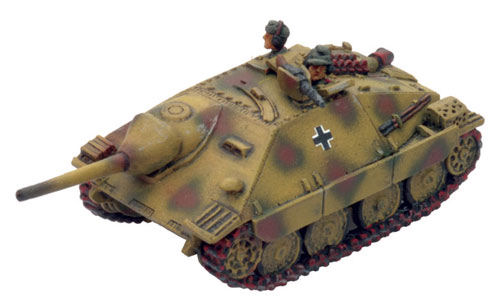
The Jagdpanzer 38(t) 'Hetzer' (German for 'baiter') was intended to provide the German infantry divisions with a tank hunter that had better survivability than the Marder or Nashorn but was not as expensive as the Jagdpanther or Jagdtiger. It was better armoured than the earlier tank hunter designs, carried a reasonably powerful gun, was mechanically reliable and was small and easily concealed. It was also cheap to build, utilising the Skoda factory and much of the production facilities previously used to make the Panzer 38(t) and much of the Marder III series. The 7.5cm PaK39 gun of the Hetzer was the same gun fitted to StuGs and similar to those fitted to Panzer IV tanks. It could destroy nearly all Allied tanks in service at long ranges and its enclosed armour protection made it a safer vehicle to crew than the Marder II or Marder III series. Unusually, the Hetzer mounted a remote-control machine-gun mount that could be fired from within the vehicle. However, to reload the crew needed to open the hatch and expose themselves to enemy fire.
Flames Of War contents: this blister pack contains 1x German Jagdpanzer 38(t) 'Hetzer'
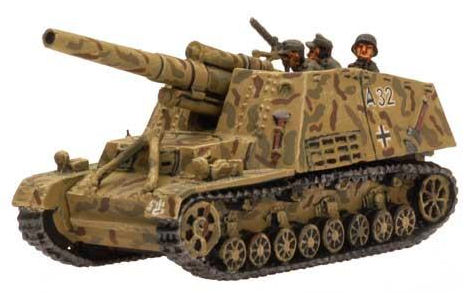
The SdKfz 165 Hummel ('bumble bee') was a self-propelled artillery gun based on the specially designed Geschutzwagen III/IV, which took elements of both the Panzer III (driving and steering system) and Panzer IV chassis (suspension and engine). Armed with the 15cm sFH 18 L/30 howitzer, it had an open-topped lightly-armoured fighting compartment at the back of the vehicle which housed both the howitzer and the crew. The engine was moved to the centre of the vehicle to make room for this compartment. It was used by the German Wehrmacht from late 1942 until the end of the war.
Flames Of War contents: this blister pack contains 1x German Hummel
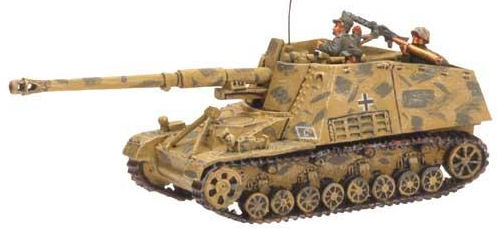
The SdKfz 164, initially known as the Hornisse ('Hornet') until all the vehicles were named Nashorn ('Rhinoceros') by Hitler's orders, was a German tank destroyer based on the specially designed Geschutzwagen III/IV, which took elements of both the Panzer III (driving and steering system) and Panzer IV chassis (suspension and engine). Armed with the outstanding PaK 43 anti-tank gun, and though only lightly armoured and with a high profile, it stayed in service until the end of the war and proved to be a successful tank destroyer.
Flames Of War contents: this blister pack contains 1x German Hornisse/Nashorn
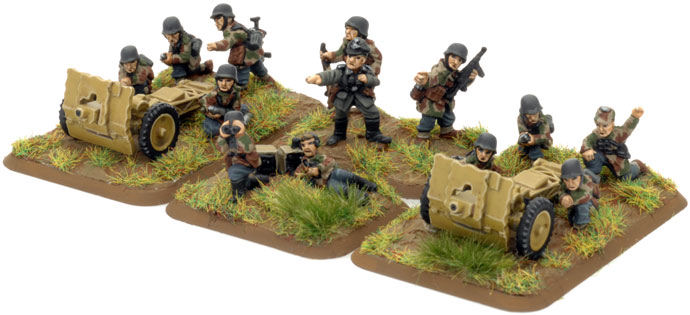
The 15cm sIG 33 gun was a reliable infantry gun for many years, entering service in 1933 and proving valuable in the early months of the war. The 15cm artillery could be used to clear enemy bunkers and trenches and it was particularly efficient at levelling enemy occupied buildings, making it a great asset to urban pacification.
This Flames Of War blister pack contains:
1 Flames Of War German Hermann Goering Command SMG team
1 Flames Of War German Hermann Goering Observer Rifle team
2 Flames Of War German Hermann Goering 15cm sIG 33 Guns
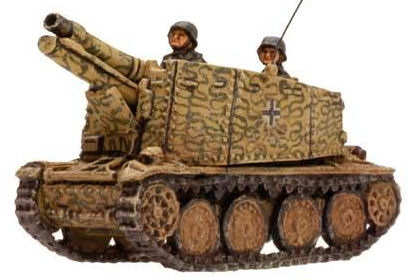
The SdKfz 138/1 Grille ('cricket') series of self propelled artillery vehicles mounted a 15 cm sIG 33 infantry gun. The K variant of the Grille (sometimes known as the M) was based on the Panzer 38(t) Ausf. M, which had its engine in the middle. As with the earlier version, the turret was removed and replaced with a new superstructure and armoured compartment located at the rear of the vehicle and was somewhat smaller and higher.
Flames Of War contents: this blister pack contains 1x German Grille K/M
The SdKfz 138/1 Grille ('cricket') series of self propelled artillery vehicles mounted a 15 cm sIG 33 infantry gun. The first variant of the Grille was based on the Panzer 38(t) Ausf. H, which had its engine in the rear. The turret of the tank was removed and replaced by a low-slung superstructure and fighting compartment. The gun was mounted in the front of this armoured compartment.
Flames Of War contents: this blister pack contains 1x German Grille H
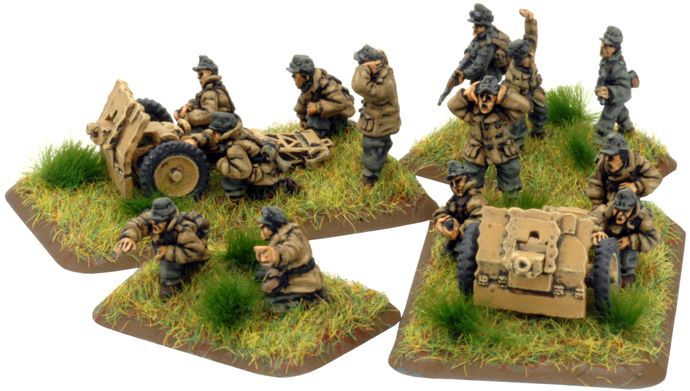
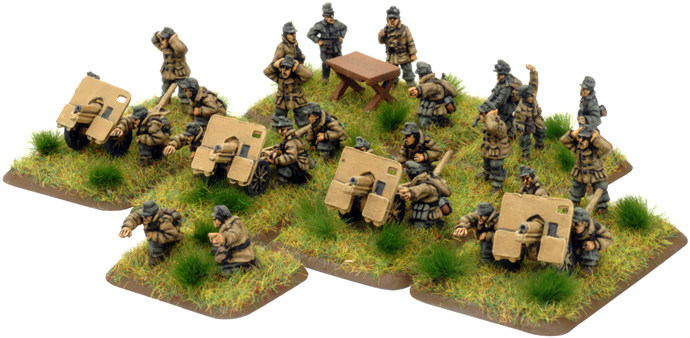
One of the tactical lessons learned during the first war, was that each battalion of infantry would benefit from its own artillery support. This led to the development of light guns that could be used in this role. The development of the 7.5cm infantry gun was conceived by Rheinmetall-Börsig and in 1927 the first model appeared. It entered service in 1932 as the 7.5cm leichte Infantriegeschutz 18.
This Flames of War blister pack contains one German Gebirgsjager 7.5cm leIG 18 Infantry Gun, one German Gebirgsjager Command SMG Team, one German Gebirgsjager Observer Rifle Team, two German Gebirgsjager 7.5cm leIG 18 Infantry Gun Teams.
The old Skoda 7.5cm mountain gun was designed for the First World War, but was still an exceptional piece of equipment. The lightweight guns were ideal for the Gebirgsjager, who can easily move the gun up and over difficult terrain. This meant they could rely on artillery support in areas that are too remote for conventional artillery. The gun could be broken down into six components and carried by pack mules or, in desperate situations, by the Gebirgsjager themselves. A large armoured gun shield was installed to protect the crew.
This Flames of War blister pack contains one German Gebirgsjager 7.5cm GebK 15 Mountain Gun, one German Gebirgsjager Command SMG Team, one German Gebirgsjager Staff Team, one German Gebirgsjager Observer Rifle Team, four German Gebirgsjager 7.5cm GebK 15 Mountain Gun Teams.
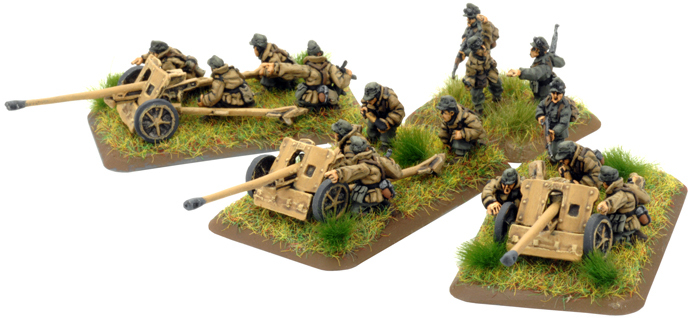
Issued to the German Army in April 1941, the 5cm PaK38 was the successor of the 3.7cm PaK36 anti-tank gun. Developed in the late 1930s by Rheinmetall-Borsig, the 5cm Pak38 soon proved its worth during the early campaigns and into Operation Barbarossa. Mounted on a split trail, the gun was usually towed by half-track but was light enough to be manhandled into position with the aid of a third wheel fitted to the spade piece of the trail. Fitted with a gun shield to provide protection for the crew, the gun was capable of firing both Armour Piercing and High Explosive rounds.
This Flames of War blister pack contains one German Gebirgsjager 5cm PaK 38 Anti-Tank Gun, one
German Gebirgsjager Command SMG Team, three German Gebirgsjager 5cm PaK 38 Anti-Tank Gun Teams.
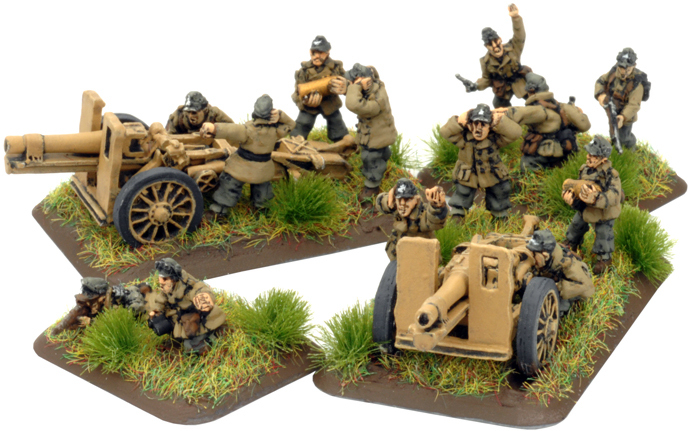
The 15cm schweres InfanterieGeschutz 33 (sIG33) was designed and built to fulfill the requirement for a powerful, close support gun for the infantry. The German Army preferred infantry support guns rather than the mortar that most other countries tended to favor for this kind of role. The design was conventional but rather heavy for its intended purpose. Originally intended to be horse drawn, later versions had rubber-tyred wheels and air brakes to allow them to be towed by vehicles. Attempts were made to lighten the gun but not many of this version were made, as the alloys needed for the job were more essential to aircraft production. It could fire a 38kg (84lb) HE or smoke shell out to 4700m at the rate of 2-3 rpm. A hollow charge round was developed but was mainly used to destroy bunkers and other fortifications. A Steilgranate round was developed as well but was also rarely used.
This Flames of War blister pack contains one German Gebirgsjager 7.5cm leIG 18 Infantry Gun, one German Gebirgsjager Command SMG Team, one German Gebirgsjager Observer Rifle Teams and two German Gebirgsjager 7.5cm leIG 18 Infantry Gun Teams.
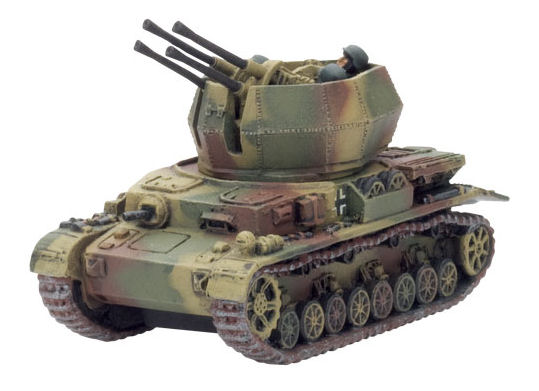
The Flakpanzer IV 'Wirbelwind' ('Whirlwind') was a self-propelled anti-aircraft gun based on the Panzer IV. It was developed in 1944 as a successor to the earlier self-propelled anti-aircraft gun named the 'Mobelwagen'. or 'Furniture Van'. The Panzer IV's turret was removed and replaced with an open-top, nine-sided turret which housed a quadruple 2 cm Flakvierling 38 L/112.5. The combination of armour and rapid fire from the four guns of the Wirbelwind also made it effective against ground targets.
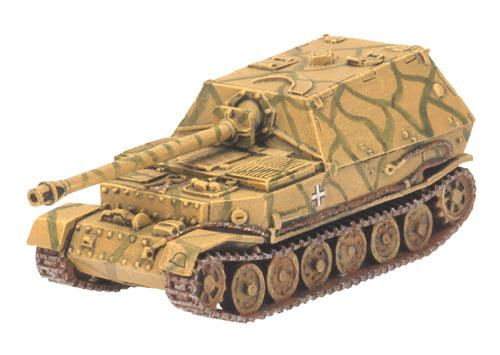
The Sturmgeschutz mit 8.8cm Pak 43/2 or Ferdinand is a combination of excellent armour and gunpower. At Kursk it destroyed Russian armour by the hundreds before being overwhelmed.
Flames Of War contents: this blister pack contains 1x German Ferdinand
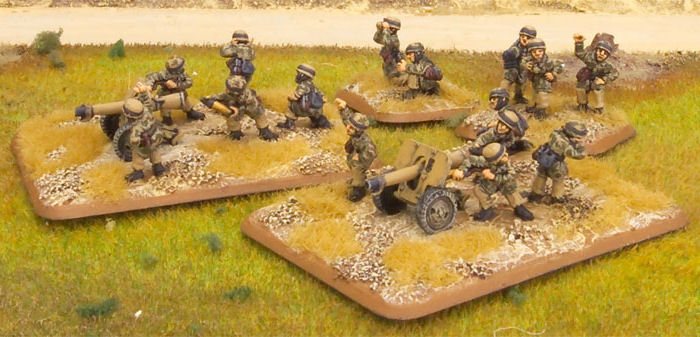
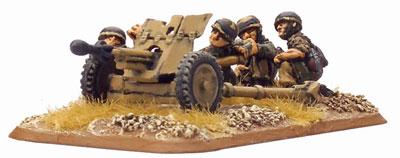
In 1935 Rheinmetall-Borsig AG developed a 7.5cm gun that would go on to become the standard artillery weapon of Germany's mountain infantry, the Gebirgsjager. The weapon entered service in 1938 as the 7.5cm GebG 36 and the whole gun could be broken down into eight separate loads, which became one of the primary reasons the gun was also adopted by the Fallschirmjager. Broken down, the gun could be easily loaded into a Ju-52 aircraft for transport to the combat zone once the Fallschirmjager had secured a landing area. The Fallschirmjager Light Artillery Batteries also used the 7.5cm LG 40, a light recoilless gun designed for use in airborne operations.
Flames Of War contents: this blister pack contains 1x German Fallschirmjager Light Artillery Battery 1x German Fallschirmjager Command SMG Team 1x German Observer Rifle Team 2x German Fallschirmjager 7.5cm GebG 36 Gun Teams with 10.5cm LG 40 Gun options 1x German Fallschirmjager Weapon Canister
Lightly equipped paratroops were always vulnerable to armoured counter-attacks so air-droppable light 3.7cm PaK 36 anti-tank guns protected against this serious threat. In the early campaigns the anti-tank guns could only be airlifted in after an airfield was captured, but by the time of Crete, a new quadruple parachute allowed the guns to be dropped with the assault troops.
Flames Of War contents: this blister pack contains 1x German Fallschirmjager Anti-Tank Gun Platoon 1x Fallschirmjager Command SMG Team 2x Fallschirmjager 3.7cm PaK 36 Anti-Tank Gun Teams with Stielgranate upgrades 1x German Fallschirmjager Weapon Canister
Based on a highly modified Panzer II chassis, which was both widened, lengthened and had an extra roadwheel added, the Bison II was a self-propelled artillery gun produced in limited numbers during 1942 and used in North Africa. It mounted a 15cm sIG 33 (L/12) infantry gun.
Flames Of War contents: this blister pack contains 1x German Bison II
A conversion of the Soviet 76mm divisional gun M1936 (F-22), the 7.62 cm PaK 36(r) (7.62 cm Panzerabwehrkanone 36(russland)) was a German anti-tank gun used by the Wehrmacht that saw combat on the Eastern Front and in North Africa. When the PaK 36(r) reached the battlefield, it was able to destroy any contemporary tank at normal combat ranges. Although the gun was heavier and had somewhat smaller penetration figures than the purpose-built PaK 40, the modernisation of the F-22 provided the Wehrmacht with a very effective anti-tank gun at only a fraction of the cost of producing one from scratch. It was actively used in both anti-tank and field artillery roles until the end of the war.
Flames Of War contents: this blister pack contains 2x German 7.62cm PaK 36(r) Anti-Tank Guns
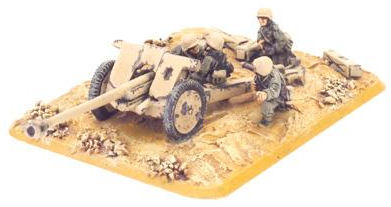
In the Flames of War game, The German 7.5cm PaK40 SS Crew models (GE521) are designed for use in late war battles, deployed as part of an army chosen from the Flames of War book Devils Charge.
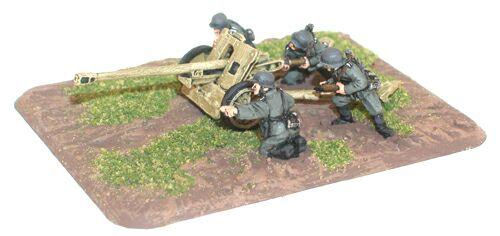
Able to penetrate up to 132mm of armour at a range of 500 metres, the PaK40 remained the standard German heavy anti-tank gun until the end of the war. It was also supplied to Germany’s allies such as Finland and Hungary.
This Flames of War pack includes three 7.5cm PaK40 Anti-tank guns with crew, one Command SMG team, one Small base & three Large bases.
The German PaK 97/38 (7.5 cm Panzerabwehrkanone 97/38) anti-tank gun - also used by the Finns and the Romanians - was a combination of the barrel from the French Canon de 75 mod 1897 and the carriage of the German PaK 38. During the invasions of Poland and France the Wehrmacht captured thousands of Canon de 75 modle 1897, built by the French arms manufacturer Schneider. Initially adopted in the field artillery role, they were soon pressed into service as anti-tank guns to counter the threat of the heavy Soviet tanks in 1942.
Flames Of War contents: this blister pack contains 2 German 7.5cm PaK 97/38 Anti-Tank Guns
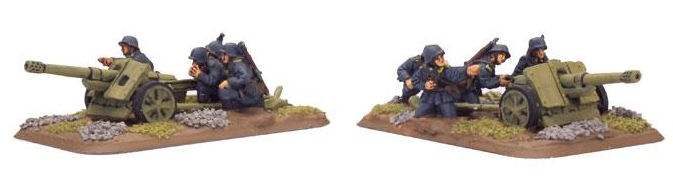
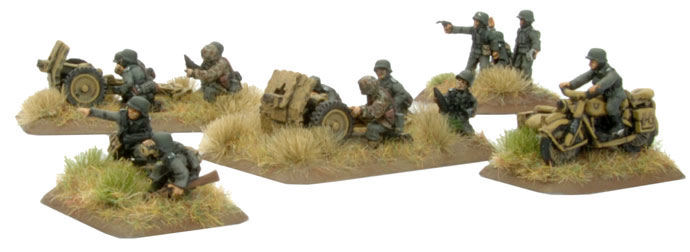
The 7.5 cm leichtes Infanteriegeschutz 18 (7.5 cm leIG 18) was an infantry support gun of the German Wehrmacht. Normally horse drawn, this support artillery was easily light enough to be man-handled into position and it was quick into action and very flexible.
Flames Of War contents: this blister pack contains 1x German Panzergrenadier Infantry Gun Platoon 1x German Command SMG Team (late) 1x German Observer Rifle Team (late) 1x German BMW R75 Motorcycle Combination 2x German 7.5cm leIG 18 Gun Teams (late)
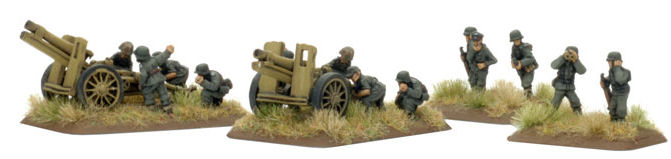
The 7.5 cm leichtes Infanteriegeschutz 18 (7.5 cm leIG 18) was an infantry support gun of the German Wehrmacht. Normally horse drawn, this support artillery was easily light enough to be man-handled into position and it was quick into action and very flexible.
Flames Of War contents: this blister pack contains 2x German 7.5cm leIG 18 Guns
The 5 cm PaK 38 (L/60) (5 cm Panzerabwehrkanone 38 (L/60)) was a German anti-tank gun of 50 mm calibre developed as a successor to the 3.7cm PaK 36, in turn followed by the 7.5cm PaK 40. First used by the German forces in April 1941, the PaK 38 was one of the few early guns capable of effectively penetrating the 45 mm armor of the formidable T-34. Additionally, the gun was also equipped with Panzergranate 40 APCR shots featuring a tungsten core in an attempt to penetrate the armor of the heavier KV-1 tank. Although it was replaced by more powerful weapons, it remained a potent and useful weapon and remained in service with the Wehrmacht until the end of the war.
Flames Of War contents: this blister pack contains 2x German 5cm PaK 38 Anti-Tank Guns
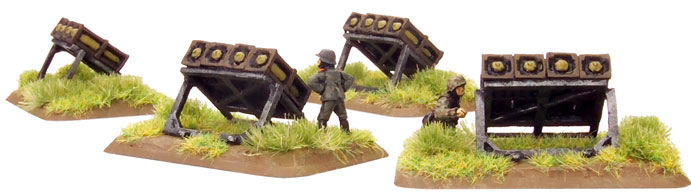
The 28cm High Explosive rocket was the first German rocket to see widespread service and first went into service in late 1940. It had a poor ballistic shape, limited range and was awkward to handle, but it had a very heavy warhead and packed a lot of destructive power ensuring it remained in service until 1945.
Flames Of War contents: this blister pack contains 4x German 28cm sWG 41 Rocket Launchers 2x German Crew
The 21cm NW42 was a larger version of the 15cm NW41. Due to it larger size, the 21cm NW42 had five launching tubes compared to the six on the 15cm NW41. Mounted on a towed carriage derived from the 3.7cm PaK36 anti-tank gun, it featured a stabiliser fitted to the front in order to maintain balance when firing.
The rockets were spin-stabilised and fired electrically, however the back blast created when launching the rockets left a highly visible smoke trail which left the position vulnerable to counter battery fire. Crews often had to act quickly to relocated their positions to avoid such occurrences.
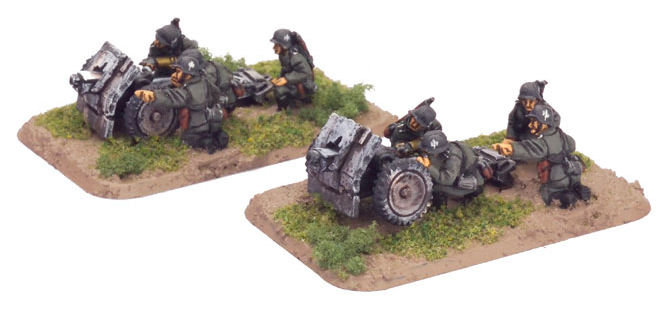
The 15cm sIG 33 gun was a reliable infantry gun for many years, entering service in 1933 and proving valuable in the early months of the war. The 15cm artillery could be used to clear enemy bunkers and trenches and it was particularly efficient at levelling enemy occupied buildings, making it a great asset to urban pacification.
Flames Of War contents: this blister pack contains 2x German 15cm sIG 33 Guns (late)
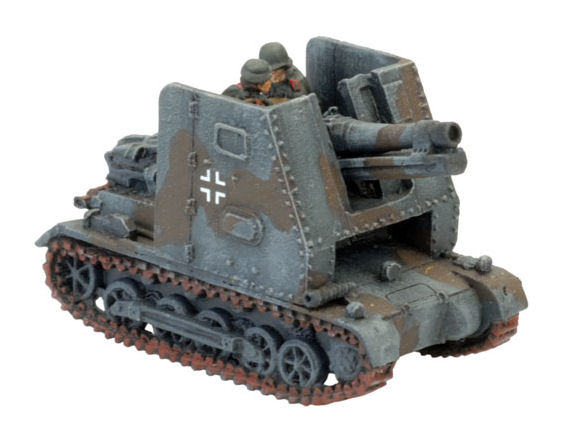
The 15cm sIG 33 (Sf) auf Panzer I Ausf B, sometimes known as the Bison, was an attempt to make the 15cm infantry gun more mobile for attacks on bunkers and fortified buildings, a need highlighted in the Polish Campaign. The result was a devastating weapon for the short-range destruction of guns and fortifications. The gun, complete with carriage and wheel was mounted on a Panzer I Ausf B chassis and protected by armored shields 10mm thick, providing the four-man crew with a basic level of protection while in action but left the crew exposed from above and to the rear of the vehicle. Standing nearly ten feet in height, the 15cm sIG 33 (Sf) auf Panzer I B stood out on the battlefield making it a difficult vehicle to conceal. This was not its only handicap, weighing 8.5 tons the chassis was severely overloaded and mobility suffered accordingly. Allocated to the Panzer Divisions before the campaigns that climaxed in the German victory in France in the summer of 1940, a handful were still in action on the Eastern Front until the middle of 1943.
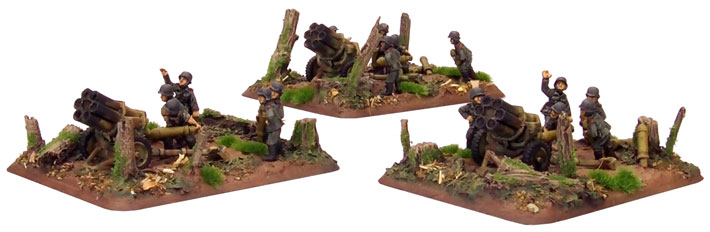
Nebelwerfer literality means smoke launcher, an apt if somewhat misleading name for the German rocket launcher. When firing, the Nebelwerfer leaves an impressive trail of smoke behind the trajectory of the rockets, often making the battery vulnerable to counter-battery fire. It could however fire smoke as well as high-explosive rounds.
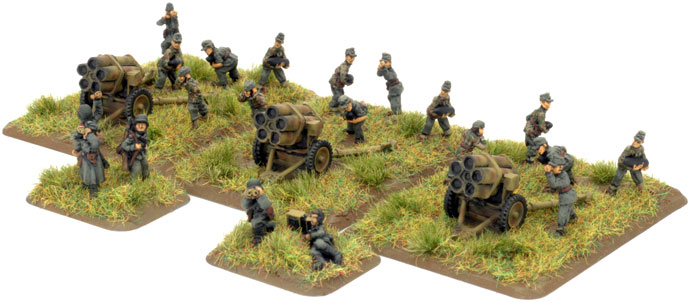
The Nebelwerfer was developed in the early 1930s. The 15cm Nebelwerfer 41 was the most common German rocket-launching artillery piece. It had six barrels; each barrel fired a 34-kilogram 15cm rocket (Wurfgranate 41) out to a range of about 6800 metres. The bundle of launch tubes was mounted on the modified carriage of a light 3.7cm PaK 36 anti-tank gun.
This Flames of War blister pack contains 3 large bases, 3 Nebelwerfers and 15 crew figures and command figures.
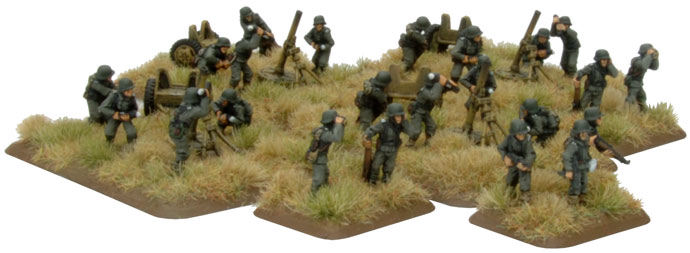
During Operation Barbarossa in 1941 the Germans encountered the large Soviet 120-PM-38 12cm mortars. The qualities of this weapon were immediately recognised and any captured weapons immediately put into service under the designation 12cm Granatwerfer 378(r) (literally, ""grenade thrower""). The Germans were so impressed by this weapon that they immediately set about making their own version. This German duplicate design was called 12cm Granatwerfer 42 (though sometimes it is referred to as the 12cm Granatwerfer 43 for the year it was introduced to service). Initially it was issued to mortar battalions with infantry units receiving the weapon later. A (motorized) heavy mortar battalion was issued thirty-six Granatwerfer 42's, divided between three companies. The 12cm Mortar was effectively a light artillery piece. A Platoon served four tubes.
Flames Of War contents: this blister pack contains 1x German Heavy Mortar Platoon 1x German Command SMG Team with Panzerschreck option 2x German Observer Rifle Teams 4x German 12cm sGW43 Heavy Mortar Teams


 Guns
Guns