The cookie settings on this website are adjusted to allow all cookies so that you have the very best experience. If you continue without changing your cookie settings, we'll assume that you are happy to receive all cookies on our website. However, if you would like to, you can change your settings at any time using the Change cookie settings link in the Special menu.
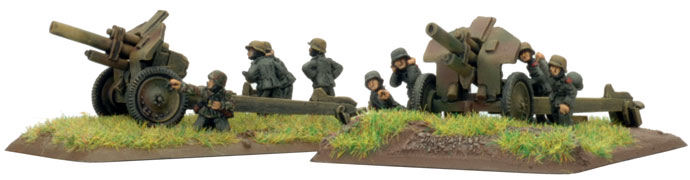
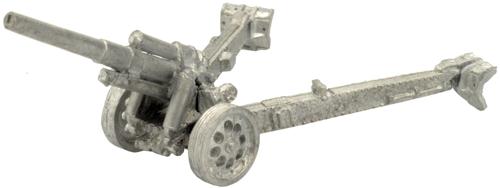
During the war on the Eastern Front the Germans captured large quantities of Soviet equipment, and one of these was the 12.2cm FH396(r) howitzer, a captured Soviet 122mm M1938 (M-30) field howitzer. This was a prized weapon taken in some numbers and extensively employed by the Germans in artillery units and as coastal defence weapons. In 1943 a total of 281 FH396(r) were in German service. When the 21. Panzerdivision was rebuilt in France in 1943 the 12.2cm FH396(r) was utilised to refit the towed artillery component of the division.
Flames Of War contents: this blister pack contains 2x German 12.2cm FH396(r) Howitzers
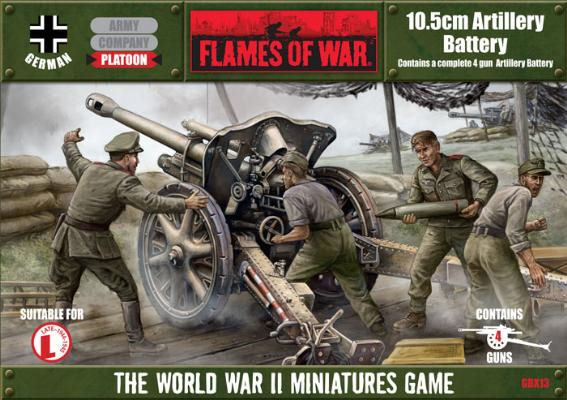
The 10.5cm leFH 18 howitzers of German artillery batteries lay down a formidable amount of firepower, smashing defensive positions ahead of the infantry assault. Should the German lines be overrun, these artillery pieces fire over open sights as anti-tank guns. In this role they are capable of stopping even the heaviest enemy tanks.
8.8cm Heavy AA Platoon includes four plastic 8.8cm Anti-aircraft Guns, two plastic Gun Crew Sprues and one Unit card.
The legacy of the famously versatile 8.8cm FlaK36 anti-aircraft gun on the Eastern Front began with its ability to deal with the heaviest Soviet tanks. The 8.8cm FlaK36 anti-aircraft gun is accurate out to a range of several kilometres giving it the ability to knock out tanks beyond the range at which they can reply.
Check out the 8.8cm Heavy AA Platoon in the online store here...
122mm Artillery Battery (SBX49) includes four plastic 122mm howitzers, two plastic Gun Crew sprues and two Unit Cards.
The 122mm artillery gun throws a bigger shell than the equivalent German howitzer over a longer range, they destroyed guns, tanks, and infantry with equal ease. When rolled up to point-blank range, their brutal shells easily eliminated any target
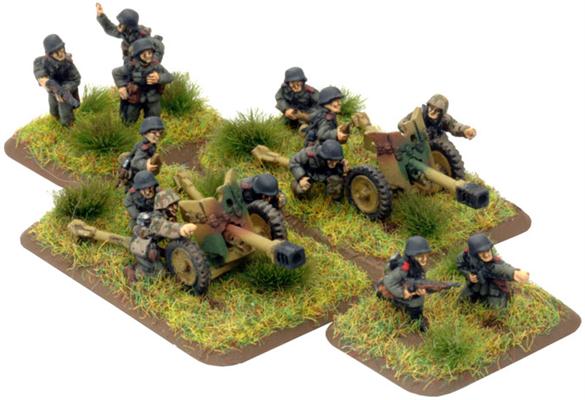
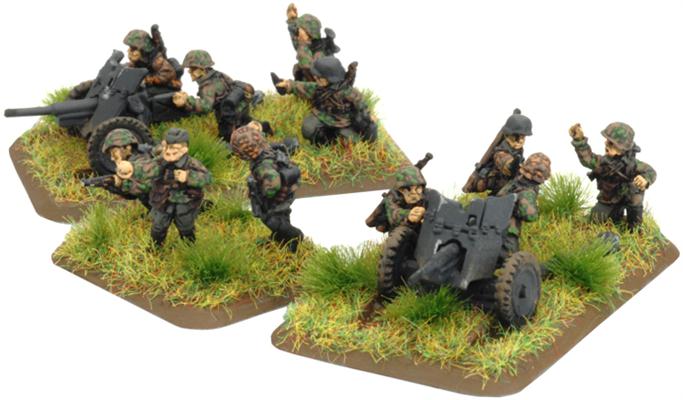
Introduced in 1944, the 7.5cm Infanteriegeschutz (meaning Infantry Gun or IG for short) 37 was based on the gun carriage of 3.7cm PaK36 anti-tank gun which by this late stage of the war was effectually redundant. The gun was originally designated the 7.5cm PaK37, however this caused confusion since the weapon’s primary role was not intended as a anti-tank gun. Therefore, the designation was changed to 7.5cm IG37.
This Flames of War item includes two 7.5cm IG37 guns with crew, one Command SMG team, one Observer Rifle team, one Small three-hole base, one Small two-hole base and two Medium bases.
Introduced in 1944, the 7.5cm Infanteriegeschutz (meaning Infantry Gun or IG for short) 37 was based on the gun carriage of 3.7cm PaK36 anti-tank gun which by this late stage of the war was effectually redundant. The gun was originally designated the 7.5cm PaK37, however this caused confusion since the weapon’s primary role was not intended as a anti-tank gun. Therefore, the designation was changed to 7.5cm IG37.
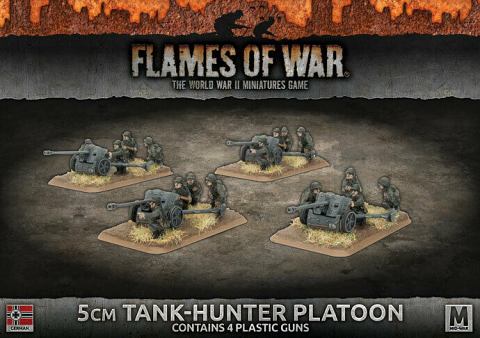
5cm Tank Hunter Platoon (x4 Plastic) includes four plastic 5cm guns, two plastic gun crew sprues and three Unit cards
The 3.7cm PaK36 anti-tank guns served with distinction in the early campaigns of the war and could be armed with the new Stielgranate (stick grenade) ammunition.
5cm Tank Hunter Platoon includes three plastic 5cm Tank-hunter guns, three plastic Gun Crew sprues, three medium five-hole bases, one base plug sprue and one Unit card
5cm PaK38 gun (SS) (GE512) includes three 5cm PaK38 guns with crew, Command SMG team, one Small base & three Medium bases.
Issued to the German Army in April 1941, the 5cm PaK38 was the successor of the 3.7cm PaK36 anti-tank gun. Developed in the late 1930s by Rheinmetall-Borsig, the 5cm Pak38 soon proved its worth during the early campaigns and into Operation Barbarossa.
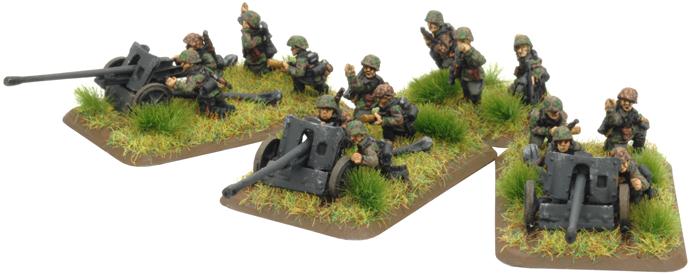
3.7cm Tank-Hunter Platoon includes four plastic 3.7cm guns, two plastic gun crew sprues and three Unit cards
The 3.7cm PaK36 anti-tank guns served with distinction in the early campaigns of the war and could be armed with the new Stielgranate (stick grenade) ammunition.
The 3.7cm PaK36 was Germany standard anti-tank weapon at the outbreak of war in 1939. Contains one Command SMG team, two 3.7cm PaK36 gun with crew, one Small base & two Medium bases.
15cm sIG33 gun (SS) (GE557) includes two 15cm sIG33 guns with crew, one Command SMG team, one Observer Rifle team, two Small bases & two Medium Bases. The 15cm schweres InfanterieGeschutz 33 (sIG33) was designed and built to fulfill the requirement for a powerful, close support gun for the infantry. The German Army preferred infantry support guns rather than the mortar that most other countries tended to favour for this kind of role.
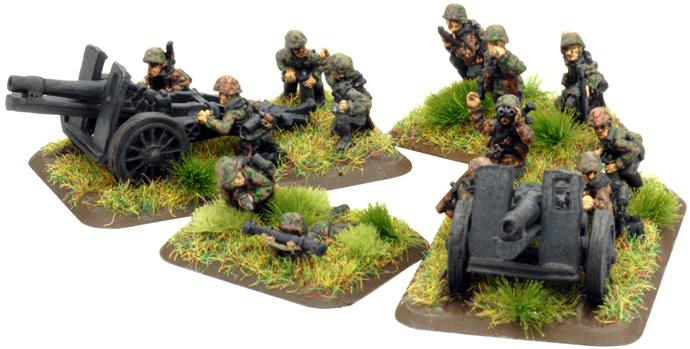
This Flames of War item contains one 15cm sFH18 howitzer with s10 K18 gun option.
The 15cm schwere Feldhaubitze 18 or sFH18 (German: "heavy field howitzer, model 18"), nicknamed Immergrun ("Evergreen"), was produced by Rheinmetall and Krupp companies and adopted by the German army in 1935.
15cm Nebelwerfer Battery (x6 Plastic) includes six Plastic 15cm Nebelwerfer, three Plastic Gun Crew Sprues and one Unit card.
The six-barrelled 15cm Nebelwerfer rocket launcher terrified Allied soldiers, delivering six screaming rockets per launcher and scattering rockets packed with high-explosives across a wide area. When a commander needs a quick, effective suppressive barrage, the Nebelwerfer is the perfect choice.
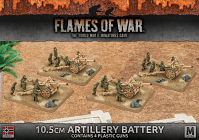
10.5cm Artillery Battery (GBX91) includes four plastic 10.5cm guns, four plastic Gun Crew sprues, four large six-hole bases, one plastic base plug sprue and two Unit cards.
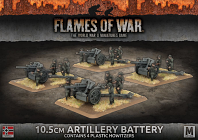
10.5cm Artillery Battery (x4 Plastic) includes includes four Plastic 10.5cm howitzers, two Plastic Gun Crew Sprues and two Unit cards.
The 10.5cm leFH18 light field howitzer's main mission was to support German attacks and to shatter enemy counterattacks before they reached their objective. They also provided a base of fire in a last-ditch line of defence.


 Guns
Guns